Side Handles: Quick Grab - Custom Pet Carrier Handle Systems
Side handles are short grab points set on the left and right panels of a pet carrier so the bag can be lifted, steadied or pulled out of a car footwell in under two seconds. The specification that matters is standoff: a side handle needs 45-60 mm of clearance from the panel and a reinforcement patch roughly four times its width, or it will collapse under a one-handed lift.
Quick-grab side handles are the least glamorous component in a carrier programme and one of the most used. They are touched every time the bag leaves a car, comes off a shelf or is steadied on a station platform, and they are judged entirely on whether the hand finds them without looking. That makes the design problem ergonomic rather than decorative, and it makes the commercial problem one of standardisation: a handle family designed once and repeated across a collection costs a fraction of a handle invented per SKU. Both questions are settled in sampling, before a pattern is graded across sizes and before any carton is specified, which is where the avoidable costs usually hide.
- Sampling: grab handle assemblies with alternative standoffs and wraps in 6-10 working days.
- Minimums: MOQ 500 units per colourway where custom wraps or moulded grips are specified.
- Schedule: handle family development runs alongside shell sampling; bulk completes in 35-50 days.
- Quality: pull, cycle and abrasion checks with finished goods inspected to AQL 2.5.
- Terms: T/T 30/70, FOB Xiamen, handles sleeved so wrap materials arrive unmarked.
Every custom dog carrier we develop is quoted against the same three variables - fabric weight, hardware grade and print method - before the first sample is cut.
The two-second test: what a quick grab actually has to do
A quick-grab handle exists for moments when the wearer is not thinking about the bag. The carrier is in the footwell of a car and needs to come out. It is on a station platform and needs steadying while a ticket is found. It is on a high shelf and needs pulling down one-handed. In none of those moments does anyone look for the handle, so the handle has to be findable by proprioception: the hand reaches to a predictable place and closes on something.
That requirement converts into a small set of measurable design rules. The handle has to sit at a consistent height on the panel across every size in the range, so a customer who has used the medium can find it on the large. It has to stand off from the panel far enough for fingers to pass behind it without scraping the fabric, which in practice means 45-60 mm of usable clearance. And it has to be stiff enough not to collapse when pulled at an angle, which is a materials and reinforcement question rather than an ergonomic one.
The failure modes are instructive because they are all variations on the same theme. A handle that lies flat against the panel is invisible to the hand. A handle with too little standoff forces the fingers to scrape along the fabric and eventually abrades both. A handle with too much standoff snags on door frames and seat backs. A handle placed inconsistently between sizes forces the customer to re-learn the product every time they buy a different one, which is a quiet but real cost to brand loyalty.
There is a second function that is easy to overlook: the side handle is also a stabiliser. When a carrier is carried by a top handle and starts to swing, the natural reaction is to put a hand on the side. A grab point placed where that reaction happens converts an awkward moment into a controlled one, and it protects the shell from being grabbed by a vent panel or a mesh window - which is a common and entirely avoidable damage claim.
From a brand perspective the side handle is also a repeat signature. It appears twice per unit, at eye level in most product photography, and it is one of the few components visible from the side profile. A consistent wrap, stitch rhythm and hardware finish here does more to tie a collection together than a logo printed on the front panel, precisely because it is read as construction rather than as decoration.
Standoff geometry: clearance, stiffness and the collapsing handle
Standoff is the distance the handle holds away from the panel when nothing is pulling on it, and it is the single dimension that determines whether a quick grab works. Too little and the hand cannot get behind it; too much and the handle catches on everything. The geometry is produced by three things together: the length of the webbing loop, the stiffness of the wrap and the way the roots are set into the panel.
Loop length is the starting point. A webbing loop of 140-180 mm sewn at two roots 80-100 mm apart produces a natural arc with roughly 45-60 mm of clearance at the apex, which suits an adult hand in a glove as well as a bare one. Reducing the root spacing with the same loop length produces a taller, more upright handle that is easier to find but more prone to snagging; increasing it flattens the arc and reduces findability. Both should be sampled rather than calculated, because the wrap and the panel stiffness shift the result by more than the arithmetic suggests.
Stiffness keeps the arc open. A soft webbing loop on a soft shell collapses under its own weight and has to be fished for. Adding a stiffener - a bonded insert, a foam core, or a moulded grip - holds the shape at a modest cost. The trade-off is compression in packing: a stiff handle needs carton clearance, and a stiff handle that gets folded in transit arrives permanently creased. This is why the packing specification has to be written in the same document as the handle geometry.
Root setting is the third variable and the one that decides durability. Roots set on a flat panel with a short reinforcement patch will progressively tear outward under repeated angled pulls, which is exactly how a quick grab is used. Setting the roots into a seam, a binding or a structural band - or carrying a reinforcement patch from the root into the panel - moves the load into the structure of the bag. Our production team specifies a patch extending roughly four times the handle width, which is more than a top handle needs because side pulls are almost always angled rather than vertical.
| Parameter | Working range | Why it matters | Symptom if wrong |
|---|---|---|---|
| Loop length | 140-180 mm | Sets the arc and the clearance | Flat handle, hard to find |
| Root spacing | 80-100 mm | Controls arc height | Snagging or invisible |
| Standoff clearance | 45-60 mm | Lets fingers pass behind | Scraped knuckles |
| Handle width | 20-30 mm | Comfort in a one-handed lift | Hot spot in the palm |
| Reinforcement | 4x handle width | Spreads angled pull force | Progressive root tear |
| Height on panel | Consistent across sizes | Muscle memory across the range | Customer re-learns the bag |
Testing is straightforward and should include the angled case, not just the vertical one. A vertical pull test proves the assembly is strong; a pull at 45 degrees proves it works in the situation it was designed for. Both are cheap to run at sample stage and both are more informative than a single number quoted from a component supplier's catalogue.
Designing a handle family, not a handle
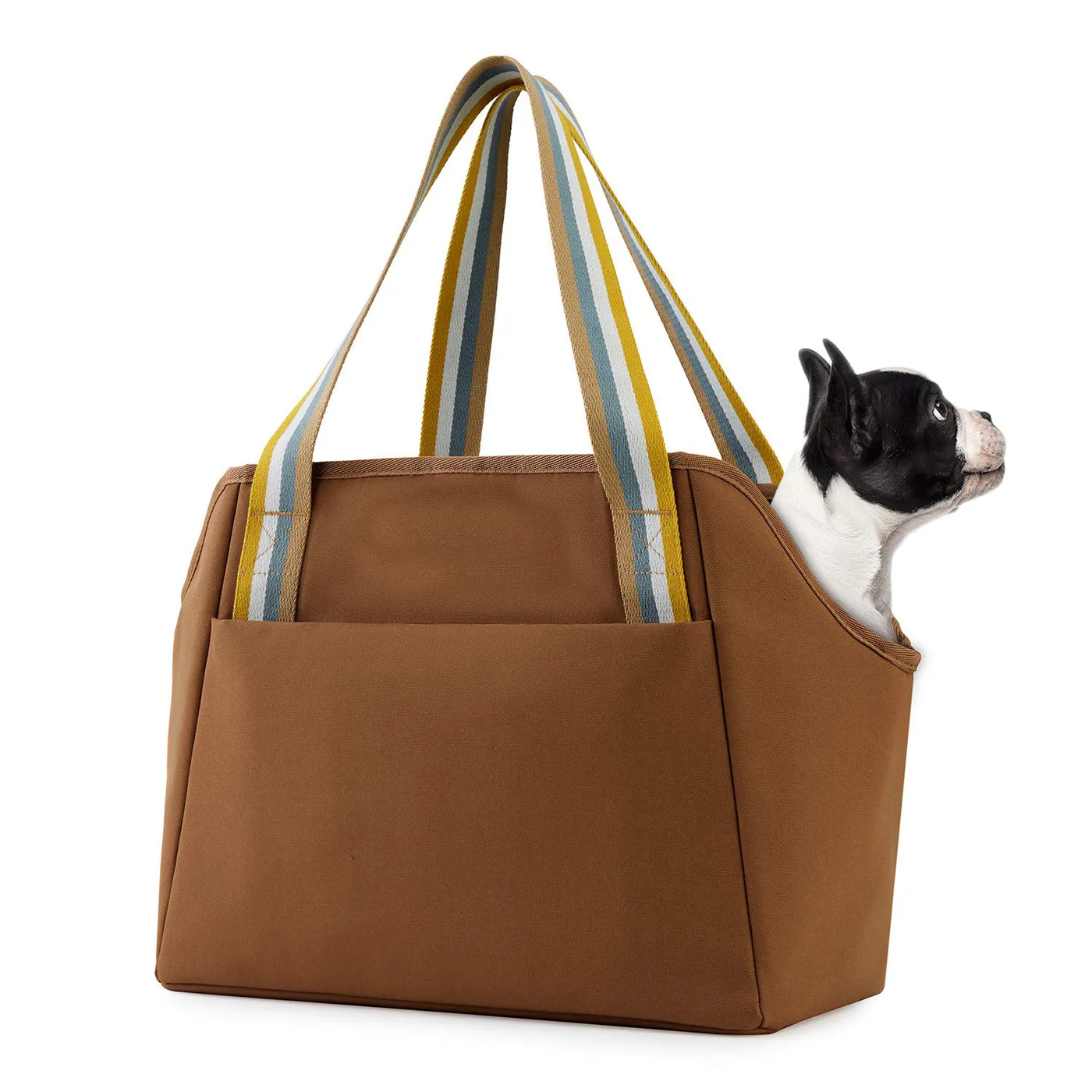
The expensive way to run a carrier programme is to design one handle per SKU. The cheap way is to design a handle family once: a defined width, a defined wrap, a defined hardware finish and a defined reinforcement pattern, applied at consistent positions across every size and every carry mode in the range. The family approach cuts development time, cuts tooling, simplifies inspection and - counter-intuitively - usually looks more designed, because repetition reads as intent.
| Family tier | Construction | Where it appears | Unit cost band |
|---|---|---|---|
| Base | Plain webbing loop, bound roots | Entry SKUs, small sizes | USD 0.25-0.45 |
| Core | Webbing with fabric wrap, bar-tacked | Main collection, all sizes | USD 0.55-0.95 |
| Signature | Wrap plus contrast stitch and plate | Hero SKUs, seasonal colourways | USD 1.10-1.75 |
| Technical | Moulded grip over webbing core | Outdoor and travel capsules | USD 1.90-3.20 |
The family is defined by what stays constant and what is allowed to vary. Width, root spacing, reinforcement pattern and hardware finish stay constant - those are the expensive and the structural decisions. Wrap material, thread colour and the presence of a logo plate vary by tier - those are the visible and the cheap decisions. A brand can then move a SKU up or down a tier by changing a wrap and adding a plate, without re-engineering anything and without a new pull test.
Standardisation also pays at the inspection stage. One reinforcement pattern means one thing for an inspector to check, and one pull-test target means one number to audit. Programmes with four handle constructions across six SKUs end up with four inspection standards, none of which is applied consistently, which is how defects reach customers.
There is an accessory argument as well. Once the family exists, a grab handle can be offered as a spare or as an add-on - a contrast wrap sold as a seasonal pack, or a moulded grip sold as an upgrade - with no development cost at all. Small, light and cheap to hold in inventory, handle accessories are an underused repeat-purchase mechanic in this category, and our notes on modular carrier systems show the same logic applied at a larger scale.
The one caution is over-standardisation. A handle family that is too rigid forces compromises on shapes that genuinely differ - a soft tote and a structured backpack do not want the same side grab - so the family should be defined per silhouette family rather than across the entire catalogue. Two families is usually right; one is sometimes too few and four is always too many.
Wrap materials, edges and the abrasion question
Side handles are abraded more than any other component on the bag. They rub against car door frames, seat edges, conveyor belts and the wearer's own clothing, and they are gripped by hands that may be wet, gloved or holding a leash at the same time. Material selection therefore starts from abrasion resistance and only then considers appearance.
Webbing is the baseline and the most abrasion-resistant option per dollar. Flat polyester webbing in a 20-30 mm width takes years of abuse, dries quickly and is available in recycled grades. Its weakness is comfort: a bare webbing loop under a heavy one-handed lift presses into the palm. That is why most core-tier executions wrap the webbing rather than replacing it.
Fabric wraps match the shell and read as cohesive, but they abrade at the fold where the hand sits and they show soiling on light colourways. Polyurethane wraps are softer and wipe clean, which suits a product that meets car doors, but quality varies widely - the specification should name hydrolysis resistance by test method rather than simply saying PU. Leather wraps look premium and wear in rather than out, at a higher unit cost and with the usual shade variation to manage.
Edges decide whether a handle feels finished. A raw webbing edge is acceptable on a technical product and cheap-looking on a fashion one. Binding the edge in a contrast tape, turning it under, or covering it with a moulded sleeve all raise the perceived tier for a small cost. Because the edge is exactly what the hand feels first, this is a high-return detail.
Thread and stitch close the material specification. A contrast topstitch along the wrap gives a visible signature and reads in a side-profile photograph; stitch density should be stated, and the bar-tack at each root should have its width and length specified rather than left to operator habit. Where a programme has restricted-substance requirements, textile inputs can be supplied as OEKO-TEX certified, which gives a retailer a reference point the brand does not have to explain.
Testing quick-grab handles: pull, cycle, snag and drop
Handle testing is unglamorous and decisive. Four checks cover essentially every realistic failure, and all four can be run on sample-stage assemblies in a couple of days, which is a fraction of the cost of discovering the same problem in a warehouse eight weeks later.
The angled pull is the primary test. A loaded handle is pulled at 45 degrees and at 90 degrees, held, and inspected for root tear-out, stitch failure and hardware deformation. Testing only the vertical case is the most common gap in a supplier's test record, and it is precisely the case that side handles never experience in real use.
Cycle testing addresses fatigue. A handle is loaded and released repeatedly - a few hundred cycles at minimum - because the failure mode in the field is progressive: stitches relax, the wrap migrates, the root patch begins to peel, and then one lift finishes the job. A static pull test will not reveal this and a cycle test will.
Snag testing is the check nobody schedules. A finished carrier is drawn past a simulated door frame and a seat edge to see whether the handle catches, because a handle that catches is a handle that eventually tears. The result is often a small geometry change - a tighter arc, a lower standoff - rather than a material change, which is why it belongs at sample stage.
| Test | Method summary | Acceptance signal | Stage |
|---|---|---|---|
| Angled pull | Loaded pull at 45 and 90 degrees, held | No tear-out, no deformation | Sample and bulk |
| Cycle fatigue | Repeated loaded lift and release | No stitch relaxation or migration | Sample |
| Snag | Drawn past simulated frame and seat edge | No catch, no abrasion on wrap | Sample |
| Abrasion | Wrap rubbed against standard abrasive | No pilling or breakthrough | Material stage |
| Drop | Loaded unit dropped from defined height | Roots intact, hardware secure | Pre-production |
Methods are referenced to recognised standards so that a number means the same thing to both sides: mechanical methods following ASTM procedures and textile surface methods following AATCC procedures. At bulk, finished goods are inspected to AQL 2.5 with handle root and hardware defects classified as critical rather than cosmetic, because a handle failure is a safety event involving an animal and not a finishing blemish.
Interaction with the rest of the shell: vents, panels and structure
A side handle does not exist in isolation. It sits on a panel that also carries ventilation, possibly a pocket, possibly a mesh window and in most designs a structural seam. Deciding where the handle goes is therefore a negotiation between ergonomics and everything else that wants the same piece of fabric.
Ventilation is the first conflict. Mesh panels are usually placed on the sides for cross-flow, and a handle sewn across a mesh panel blocks airflow and puts load into a material that is not structural. The resolution is almost always to place the handle on a solid band - above, below or beside the mesh - and to reinforce that band, which is a pattern decision made once and repeated across the range.
Pockets are the second conflict. A side pocket is convenient and a side handle is convenient, and they frequently want the same space. The usual resolution is vertical separation: pocket low, handle high, so the hand finds the handle without brushing the pocket contents. This also keeps the load path above the pocket, which prevents the pocket pulling open under a heavy lift.
Structure is the third and most important. On a soft shell the handle has to create its own structure through reinforcement; on a framed or semi-framed shell it can tie into the frame. Designs that tie the handle into a frame, a base board or a perimeter band are dramatically more durable, and the difference costs almost nothing because the structure is already there. Identifying those structural elements during concept - before the panel layout is finalised - is what makes this possible.
Photography is the last interaction and the least technical. A side handle is visible in three-quarter and profile shots, which are the shots stylists use to show shape and depth. If the handle is going to be in the frame, it has to be finished to close-up standard - clean bar-tacks, no stray thread, consistent wrap - because it will be seen at full resolution on a product page.

Cost, packing and the line-planning view
Side handles are cheap in absolute terms and expensive in aggregate, because there are two of them per unit. A pair of wrapped, bar-tacked grab handles typically adds USD 1.10-1.90 to a bill of materials, and a pair with moulded grips and hardware roughly USD 3.80-6.40. On a carrier retailing under USD 40 that is a meaningful share of cost; above USD 70 it is not, which is why the handle tier should track the retail tier rather than being uniform across the range.
Packing is where side handles quietly cost money. A stiff, standing handle needs carton clearance, which increases carton volume, which increases freight cost per unit on a product that is already bulky and light. The alternatives are a collapsible handle construction - softer, cheaper to ship, slightly harder to find - or a shaped void in the packing. The right answer depends on shipping mode and distance, and it is worth modelling before the carton is specified rather than discovering at freight quote stage that a 12 mm difference in carton height moved the whole programme's landed cost.
Protection in transit matters as much as dimension. Wrapped handles arriving marked by carton board is a common and entirely preventable defect class. A tissue wrap, a card sleeve or a simple shaped insert costs cents and removes the issue, and the packing specification should name it rather than relying on a general instruction to pack carefully.
Line planning closes the loop. Because handles repeat across sizes and carry modes, they are the natural platform element: one development, one tooling set where hardware is involved, one inspection standard, applied across the collection. Colour and wrap vary by tier and by season, which gives the brand visible novelty without recurring engineering cost. Programmes that treat handles as a platform consistently launch faster and defect less than programmes that treat them as trim.
Sampling for a handle family runs in 6-10 working days for alternative wraps and standoffs, custom hardware tooling runs in parallel, and bulk completes in 35-50 days on T/T 30/70 FOB Xiamen terms. Where independent verification is required, third-party testing through SGS is arranged, and the SGS-verified production base we work with maintains the ISO 9001 quality system that keeps those records consistent from season to season.
Order and quality terms
- MOQ 500 pieces per colourway; samples in 6-10 working days
- Bulk production 35-50 days after approval; AQL 2.5 inspection standard
- T/T 30/70 terms, FOB Xiamen, full document set per shipment
People Also Ask
What is a side handle on a pet carrier for?
Quick lifting and steadying without looking: pulling the bag out of a car footwell, stabilising it on a platform or taking it off a high shelf one-handed. It also stops users grabbing a vent panel or mesh window instead.
How much clearance should a grab handle have?
45-60 mm of usable standoff at the apex, produced by a 140-180 mm loop sewn at roots 80-100 mm apart. Less than that and fingers scrape the panel; more than that and the handle snags on door frames.
Why do side handles tear out?
Because side pulls are angled rather than vertical, and a short reinforcement patch does not spread an angled load. A patch extending roughly four times the handle width, bar-tacked and tied into a seam or structural band, prevents it.
Should every carrier size use the same side handle?
Yes, at a consistent height on the panel. Muscle memory is the whole point of a quick grab, so a customer who has used the medium should find the handle on the large without looking.
Can side handles be moulded instead of webbing?
Yes. A moulded TPE grip over a webbing core holds its shape, feels softer and lasts longer, at the cost of tooling and a higher unit price. It suits outdoor and travel capsules rather than entry tiers.
Do side handles interfere with ventilation?
They can. A handle sewn across a mesh panel blocks airflow and puts load into a non-structural material, so it should be placed on a solid band beside, above or below the vent and reinforced there.
Frequently Asked Questions
What is the MOQ for custom side handles?
MOQ 500 units per colourway applies where custom wraps, contrast stitching or moulded grips are specified, since those carry setup and, for moulded parts, tooling. Stock webbing loops with stock reinforcement can often be placed lower.
How long does a handle sample take?
Grab handle assemblies with alternative standoffs and wraps are produced in 6-10 working days. Because side handles come in pairs, sampling both a base and a signature construction at the same time is standard practice.
Can the handle match our brand colour exactly?
Yes, with an approved physical reference - a lab dip for webbing or a material swatch for wraps - evaluated under a defined light source. The approved sample becomes the bulk reference for shade disputes.
Are side handles tested at an angle?
Yes, and this is the test that matters. A vertical pull proves strength; a 45-degree pull proves the handle works in the situation it was designed for. Both are run at sample stage under recognised mechanical test methods.
Will a stiff handle survive shipping?
Only if the packing specification accounts for it. A stiff, standing handle needs carton clearance or a shaped void, and a wrapped handle needs sleeving so it is not marked by carton board. Both are written into the packing spec.
Can we use the same handle across backpack and tote shapes?
Usually yes, if the silhouettes share a panel structure. The family should be defined per silhouette family rather than across the whole catalogue: two handle families is typically right, four is too many.
What inspection level applies to handles at bulk?
AQL 2.5, with root reinforcement, bar-tack coverage and hardware attachment treated as critical defects. Cosmetic wrap issues are classified separately so functional failures are never averaged into a cosmetic allowance.
Do side handles add much to freight cost?
They can, because a standing handle increases carton volume on an already bulky product. A collapsible construction or a shaped void in the packing usually resolves it, and the trade-off should be modelled before the carton is specified.
Can handles be sold as accessories or spares?
Yes, and standardising the family makes it cheap to do. Contrast wraps or upgraded moulded grips become accessory SKUs with no shell development cost, and spare handle assemblies can be ordered with bulk as service parts.
Are recycled materials available for handle webbing?
Recycled polyester webbing with traceable feedstock is available and performs equivalently to virgin material in tensile and abrasion terms, so it can be substituted without changing the reinforcement pattern.
How do you stop a handle snagging on car doors?
By tuning the arc: tighter root spacing and a lower standoff reduce snagging, and a snag test at sample stage - drawing the unit past a simulated frame and seat edge - confirms the geometry before bulk.
Do you provide restricted-substance documentation?
Yes. Material declarations and test reports can be supplied, OEKO-TEX certified textile inputs are available, and independent verification through SGS is arranged where a retailer requires it.
Talk to QUANZHOU JUNYUAN BAGS about a pet carrier program: MOQ 500 pieces per colourway, samples in 6-10 working days, bulk production in 35-50 days under AQL 2.5 inspection.
Get a free quote Request a sample