Duffle Shape Pet Carrier: Travel Bag Programmes
A duffle shape pet carrier is a barrel-bodied carrier with a U-shaped top opening, end compartments and both grab handles and a detachable shoulder strap, typically 45-55 cm long and rated for 8-12 kg. It needs a framed base, a three-sided zip route and structured end panels, and at MOQ 500 it costs roughly USD 11.60-17.80 per unit.
The duffle is the most functionally generous carry form in this series and the one with the clearest travel logic: a long body that takes a larger animal, end compartments that solve the storage problem every open shape has, and a U-zip that opens the whole top rather than a corner. It is also the shape most likely to be over-designed, because there is room for everything - and room for everything usually means pockets nobody uses, weight nobody wanted and a unit cost that no longer matches the retail price. The discipline that makes a duffle programme work is subtracting: decide what the trip actually requires, put that in, and resist the rest.
- Sampling: pattern with a loaded U-zip and strap test in 6-10 working days.
- Minimums: MOQ 500 pieces per colourway; end panels, zips and strap hardware share one specification.
- Schedule: bulk runs 35-50 days from approved sample, with the three-sided zip the critical path item.
- Quality: zip function, strap anchorage, base board fit and end panel symmetry inspected to AQL 2.5.
- Terms: T/T 30/70, FOB Xiamen, units packed with the body supported so the barrel does not crease.
For a custom pet tote or backpack carrier, strap geometry is the first thing to fix - width, padding and load-lifter position decide how the bag carries.
The duffle grammar: four signals customers read
A duffle is one of the most widely recognised bag shapes in the world, which is both an advantage and a trap. The advantage is instant comprehension; the trap is that customers also know what a duffle should look like, and deviations read as errors rather than as design.
The first signal is proportion. A duffle is long and round: length typically 1.8 to 2.4 times its diameter. Shorter than that it reads as a holdall or a cube; longer and it reads as a kit bag. For a pet carrier the practical length band is 45-55 cm, which is long enough to take a medium dog lying down and short enough to remain carryable.
The second is the rounded body. A duffle cross-section is a circle or a flattened circle, not a rectangle. The flattening matters: a full circle looks like a sports bag, a flattened ellipse looks like travel luggage, and most pet programmes want the latter. A height to width ratio around 0.7-0.8 achieves it.
The third is the end panels. A duffle has defined circular or oval ends, and those ends are what make the shape readable from any angle. They are also, conveniently, the best place for compartments and - as covered later - the best place for branding.
The fourth is the U-shaped top opening. Not a straight zip across the top, not a side opening: a zip that runs up one side, across the top and down the other, letting the upper body open like a lid. It is the feature that makes a duffle usable, and it is the feature most often compromised for cost.
Those four signals are the shape. Everything else - pockets, straps, sleeves, colours - is variation within them, and a programme that keeps the four intact can vary the rest freely without losing the reference.
One caution specific to pet use: a duffle reads as luggage, which means customers expect it to behave like luggage. That includes travel-specific features, and it is why the trolley sleeve and the luggage relationship deserve their own section below.
Volume, and why the end compartments matter most
A duffle's most useful property is that it has two ends. On a carrier, where the pet occupies the central volume, those ends are the only storage space that does not compete with the animal - and that makes them disproportionately valuable.
The standard arrangement is one compartment per end, separated from the pet space by a full-height panel. One end takes the functional items: lead, waste bags, a fold-flat bowl, treats. The other takes the owner's items, or a removable pad and a change of lining. Separation matters, because pet items and personal items should not share a space that gets washed.
Compartment depth should be 8-14 cm. Deeper and it eats the pet's volume; shallower and it cannot hold a bowl. The compartment should be accessed from outside, not from inside the pet space, so that the animal does not need to be disturbed - which is the entire point of having compartments at all.
Central volume is then whatever is left, and it should be specified as a usable floor rectangle rather than as a nominal litre figure. A 50 cm duffle with two 12 cm end compartments offers roughly 34-38 cm of usable floor length, which suits a medium dog up to about 12 kg depending on build.
Headroom in a barrel is generous at the centre and falls away at the sides, so the rated animal should be checked against the usable rectangle rather than against the peak height. This is the same discipline described across the shaped families in this series and it prevents the most common sizing complaint.
Finally, consider making one compartment ventilated. A compartment with a mesh panel can carry a damp bowl or a wet lead without becoming a mould problem, which is a small specification detail that owners notice within a month.
The U-zip: the opening that defines the shape
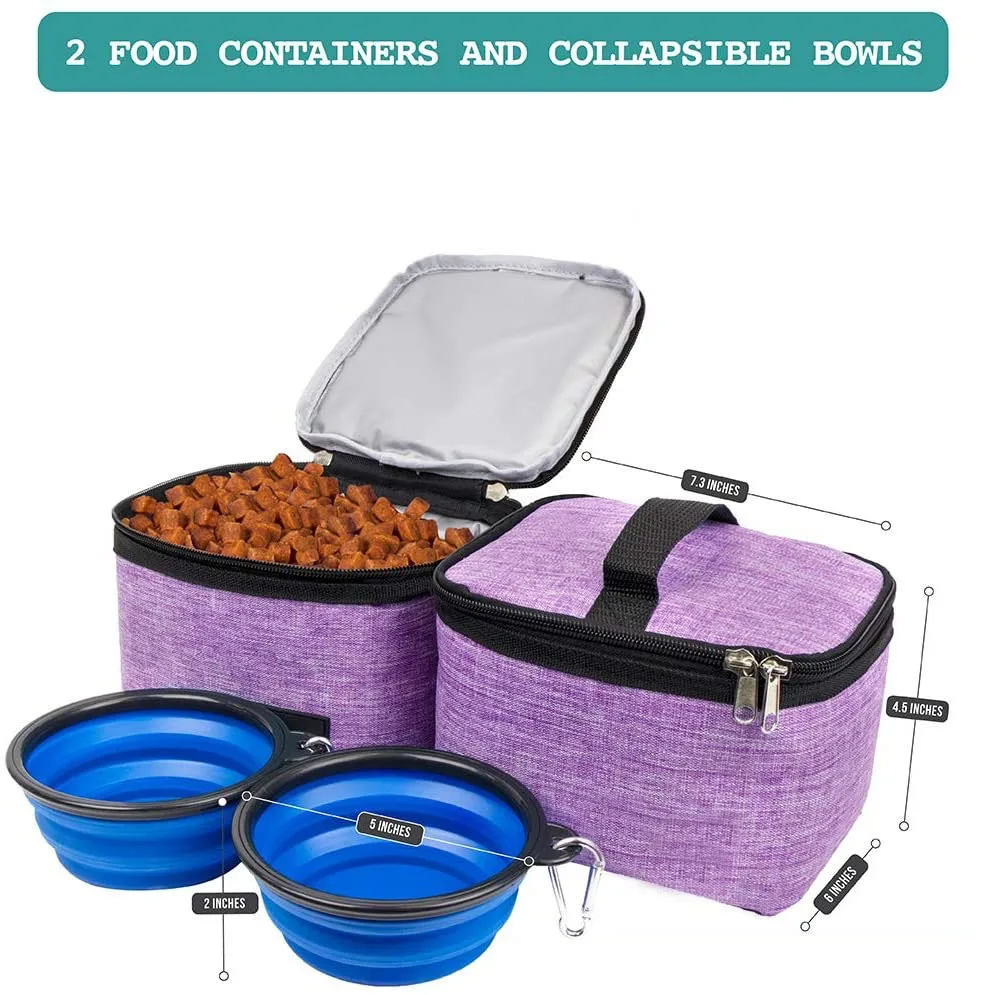
A three-sided zip running up one side, over the top and down the other is the single most important functional component on a duffle, and the one most likely to be under-specified.
Gauge and slider quality come first. A U-zip on a loaded body is under tension at the corners, and a light coil zip will separate there or will simply be too stiff to pull around the curve. Specify a heavier gauge with two sliders so the opening can be positioned - open from the centre outward for a partial check, or fully for loading a reluctant animal.
Then the corner radius. Tight corners bind; generous radii of 40-60 mm let the chain turn smoothly. The radius is a pattern decision made once and it costs nothing, so there is no reason to compromise it.
Zip route placement determines how the lid behaves. Running the zip slightly below the top centre line gives a larger lid and a more open access; running it at the centre gives a symmetric look. Slightly below centre is the better functional choice and it is also the more common convention, so it looks right as well.
A storm flap over the zip is worth including for travel programmes. It keeps rain off a long horizontal seam, it hides the zip - which matters on a fashion-adjacent product - and it gives a place for a branded puller.
| Opening type | Cost add at 500 (USD) | Access | Typical use |
|---|---|---|---|
| Straight top zip | baseline | Restricted | Value programmes |
| U-zip, single slider | +1.10 - 1.70 | Good | Mid-market |
| U-zip, twin slider | +1.60 - 2.40 | Excellent | Travel programmes |
| U-zip with storm flap | +2.20 - 3.10 | Excellent, weather resistant | Premium travel |
Testing should be done loaded, not flat. Cycle the zip fifty times with the carrier at rating and check for separation at the corners; this is the test that predicts field performance and it takes twenty minutes.
Finally, add a grab loop at each end of the zip route. It gives the user something to hold against while pulling, which is the difference between a zip that feels smooth and one that feels stubborn.
Carry modes: why a duffle needs three
A duffle is carried in more ways than any other shape in this series, and a programme that offers only one wastes the format's main advantage. Three modes are standard, and each has a specification.
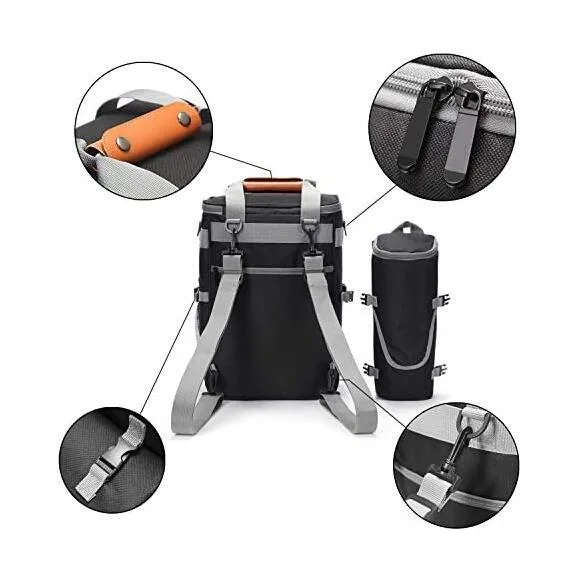
Grab handles come first: two handles at the top that meet in the middle, usually with a wrap. They should be padded or wrapped, because the load is high - a 12 kg animal in a duffle is a real weight - and they should be anchored through a reinforcement that runs into the body rather than stopping at the top seam. A wrap should be fixed rather than loose, because a loose wrap slides and looks cheap.
The shoulder strap is second and it should be detachable. On a duffle the strap is used for longer carries and removed for stowage, so the attachment needs to be robust and quick: a trigger clip on a webbing loop, rated well above the load. Strap width of 38-50 mm with a sliding pad is the comfortable specification at this weight.
The third mode is the one most often forgotten - carrying the unit by its ends, one hand at each end, which is how people actually move a loaded duffle out of a car. That means end grab handles, or at least a reinforced end panel that can be gripped, and it is a ten-cent addition that makes the product feel considered.
A fourth option, worth discussing even if it is not adopted, is backpack conversion. It adds cost and complexity, and on a duffle it usually produces a mediocre harness. Most programmes are better served by keeping the duffle a duffle and pointing customers who want hands-free carry to the backpack silhouette instead.
Weight distribution deserves a note: a duffle carried by top handles has the load hanging below the hand, which is stable and uncomfortable in equal measure. Keeping the empty weight under about 1.5 kg is what makes the difference tolerable.
Structure: soft, but not that soft
A duffle is a soft bag by definition, but a pet duffle needs more structure than a sports duffle, because the contents are heavy, low and mobile. Three components provide it.
The base board is the first and it is non-negotiable. A framed panel of 6-10 mm, bonded or sleeved, running the full floor length, gives the animal a flat surface and stops the barrel from sagging into a banana. On a 50 cm duffle the board should run at least 85 percent of the floor length, because a board that stops short creates a soft spot at one end where the animal will not settle.
End panels are the second and they are what make the shape readable. A structured end - a bonded interlining or a light moulded panel behind the face fabric - keeps the circular profile standing and prevents the ends from collapsing inward. Without it the duffle looks deflated on a shelf and the compartments lose their volume.
The third is the top edge. A U-zip puts a long seam across the upper body with nothing to hold it, so a stiffened band along the zip route keeps the opening from bowing. This is the same principle applied to purse construction and it matters here for the same reason: a bowing top edge reads as poor quality even when everything else is right.
Compression is the test. Load to rating, set the unit down, and look at it from the end. The profile should remain a flattened circle rather than settling into a wide oval. If it settles, the end panels are too light.
Finally, feet. Four small feet or a reinforced base strip keep the underside off wet ground and protect the board from abrasion - which on a travel product happens in car boots, on station platforms and on airport floors.
Materials and the travel-wear requirement
A travel bag takes a specific kind of abrasion that pet carriers in general do not: it is dragged, stacked, strapped and slid. Material choice should reflect that rather than follow the softer preferences of a fashion-led shape.
Coated polyester in the 600-900D range is the default. It resists abrasion, it holds colour, and it wipes clean. The coating matters as much as the base fabric: a PU coating gives water resistance, and a heavier coating gives more but adds weight and stiffness.
Ballistic and ripstop weaves are worth considering at the top of the range. Ripstop limits tear propagation, which is a genuine advantage on a product that gets caught on things, and it reads as technical and travel-appropriate.
The base should be a heavier grade than the body, or should carry a coated panel. It is the surface that touches the ground and the one that fails first; localising reinforcement there is far cheaper than upgrading the whole shell.
Lining should be dark, wipe-clean and, ideally, removable at the floor. Travel use means accidents happen away from home, and a product that cannot be dealt with at a hotel sink becomes a product that does not get used again.
Colour should be chosen with travel in mind. Mid-tones hide airport and car-boot grime; very light colours look good for one trip. Two colourways - one neutral, one with character - covers both the practical and the gifting buyer at MOQ 500 each, with references to Pantone standards and approved lab dips so trim, webbing and body agree.
Travel context: airlines, cars and the luggage relationship
A duffle is bought for journeys, and journeys impose requirements that a house or a paw shape never encounters. Designing for them is what separates a travel product from a shaped bag.
Air travel is the most demanding. Cabin carriage is governed by the airline, not by the product, and the industry framework that carriers work from is the Live Animals Regulations maintained by IATA. A duffle is rarely the right shape for under-seat carriage - it is too long and too round - so the honest positioning for most duffle programmes is car and rail travel, or checked and hold baggage where permitted. Stating that clearly is better than implying cabin compliance the product cannot deliver.
Car travel is the primary use and the easiest to serve: a flat non-slip base, a footprint that fits a boot or a footwell, and securement points. A pair of webbing loops allowing a seatbelt to pass across the body converts the product from luggage to secured cargo, and it is the same principle described in the vehicle-shaped programme.
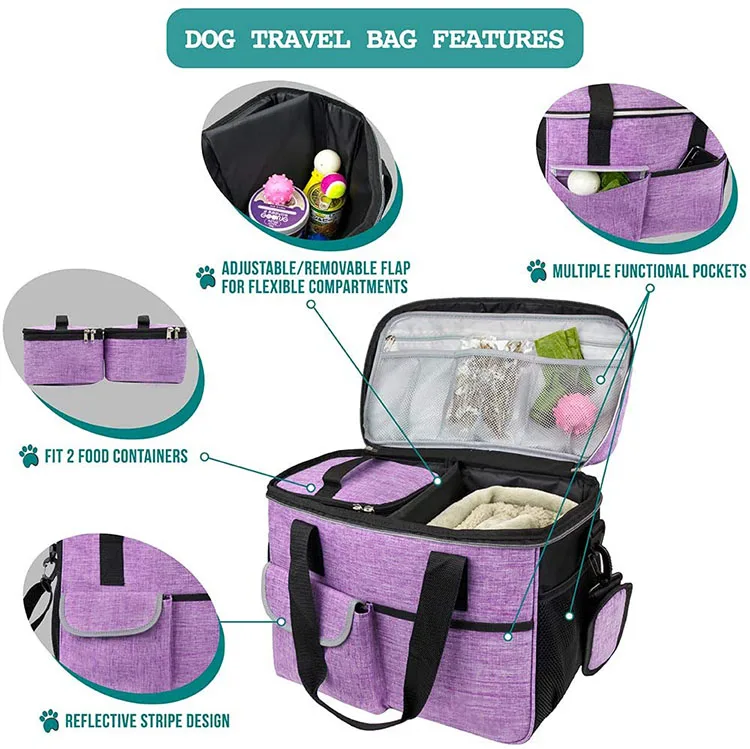
The luggage relationship is the third context and the most overlooked. A traveller with a suitcase wants the carrier to attach to it. A trolley sleeve on the back panel - a simple fabric panel that slides over an extending handle - costs little, and it transforms how the product works in an airport or station. It is the single highest-value travel feature available on this shape.
Documentation and labelling should follow: a luggage tag or a card sleeve for identification, and a care card with the honest statement about airline carriage.
Finally, consider a fold-flat bowl in one end compartment. It is a small inclusion, it is exactly what a travelling owner forgets, and it turns a feature into a reason to choose the product.
Branding on a barrel: ends, band and the long run
A cylindrical body gives an unusual branding geometry: there is no large flat front, only a long curved surface with two defined ends. That changes where a mark can go and how it reads.
The end panels are the best brand position on the entire product. They are flat, circular, visible from the front when the bag is set down, and they are not broken by zips or compartments. A mark centred on one end, or a repeated mark on both, is the most effective placement available - which is why luggage brands have used end-cap branding for decades.
The centre band is the second position. A horizontal band around the body, either a printed stripe or a narrow webbing strap, reads as a duffle convention and gives a colour placement that follows the shape rather than fighting it. It also hides the seam that runs under it.
Long-run printing on the curved body is possible but rarely worth it. Graphics distort on a curve, they are partially hidden by the strap, and they date quickly. Keep the body surface clean and let material and colour do the work.
Technique should suit a curved, abrasion-prone surface. Heat transfer flexes with the fabric and handles gradients; embroidery works well on the flat end panels and poorly on the curve; woven labels and rubber patches are best placed on the end or on the strap pad where they are seen at close range.
Two placements is the practical maximum. One on the end, one on the strap pad or the zip puller. A duffle with branding on the end, the band, the strap and the body reads as a promotional item rather than as a product, and at this price point that costs more than it returns.
Cost drivers and the seasonal rhythm
Duffle programmes fail on cost more often than on design, because the shape invites additions. Understanding where the money goes allows a designer to spend deliberately.
The zip route is the largest single variable, as the table earlier showed - a twin-slider U-zip with a storm flap costs roughly twice a straight top zip. It is also the component most directly associated with satisfaction. Spend here before spending on pockets.
End panels are second. A structured end costs more than a soft one and it is the difference between a duffle that stands and one that slumps on a shelf. This is the second place to spend.
The base board is third and, like elsewhere in this series, should not be cut. A thinner board saves cents and creates the product's most visible quality problem.
Pockets are fourth and are where budgets are wasted. Four pockets are useful; eight are cost, weight and visual noise. Decide which four by asking what a traveller actually reaches for: lead, waste bags, bowl, phone.
At MOQ 500 expect roughly USD 11.60-17.80 per unit, moving toward USD 7.90-12.40 at 5,000. A three-size range sharing zip specification, strap hardware and end-panel construction recovers pattern development quickly, which is the same platform logic that works across every carry form.
Seasonality is pronounced: travel products sell before summer and before the year-end travel period, so sampling should be scheduled backwards from those windows. Third-party verification through SGS is available where an account requires an independent laboratory, and incoming production is inspected to AQL 2.5 with zip separation and strap anchorage defined as critical defects.
Order and quality terms
- MOQ 500 pieces per colourway; samples in 6-10 working days
- Bulk production 35-50 days after approval; AQL 2.5 inspection standard
- T/T 30/70 terms, FOB Xiamen, full document set per shipment
People Also Ask
Why does my duffle slump on the shelf?
Unstructured end panels. A bonded interlining or light moulded panel behind each end face keeps the profile standing and preserves compartment volume.
Are end compartments worth the cost?
Yes - they are the only storage on a carrier that does not compete with the animal, and outside access means the pet is not disturbed.
Should I add a storm flap over the zip?
For travel programmes yes. It keeps rain off a long horizontal seam, hides the zip and gives a place for a branded puller.
How do I stop the U-zip binding?
Generous corner radii of 40-60 mm and a heavier gauge chain. Test loaded rather than flat, since tension is what separates the chain.
Is a shoulder strap necessary?
Yes, and it should be detachable. A duffle at 10-12 kg is carried on the shoulder for distance and by the handles for manoeuvring.
Can a duffle double as the owner's weekend bag?
Partly, which is a selling point. One end compartment for owner items and a clean, dark lining make the dual use plausible without compromising the pet space.
Does colour choice matter for travel products?
Yes. Mid-tones hide airport and car-boot grime; very light colours look good for one trip. Offer one neutral and one character colourway.
Frequently Asked Questions
How much does a duffle pet carrier cost?
Roughly USD 11.60-17.80 per unit at MOQ 500 depending on zip specification and end-panel structure, moving toward USD 7.90-12.40 at 5,000 units.
What size should a pet duffle be?
45-55 cm long with a height to width ratio of about 0.7-0.8. That gives roughly 34-38 cm of usable floor after two end compartments, suiting a medium dog to about 12 kg.
How deep should the end compartments be?
8-14 cm, accessed from outside so the animal is not disturbed. One for pet items, one for owner items or a spare liner.
Should the U-zip have two sliders?
Yes for travel programmes. Twin sliders allow a partial opening for a check without exposing the whole animal, and they reduce strain at the corners.
Can a duffle be taken in an aircraft cabin?
Rarely. It is too long and too round for most under-seat allowances. Position it for car and rail travel, or for hold baggage where permitted, and say so honestly.
Is a trolley sleeve worth adding?
Yes - it is the highest-value travel feature on this shape. A simple panel that slides over an extending luggage handle changes how the product works in an airport.
Should the duffle convert to a backpack?
Usually no. It adds cost and produces a mediocre harness. Point hands-free customers to a dedicated backpack shape instead.
How much structure does the base need?
A framed board of 6-10 mm running at least 85 percent of the floor length. A board that stops short creates a soft spot where the animal will not settle.
Where should the logo go?
On the end panels - flat, circular, visible when the bag is set down - with a second placement on the strap pad or zip puller at most.
What fabric suits travel use?
Coated polyester in the 600-900D range, with a heavier or coated panel at the base. Ripstop is worth considering where tear resistance matters.
How many pockets should it have?
Four that are used, rather than eight that are not. Lead, waste bags, bowl, phone covers the realistic need.
What fails first on a duffle?
Zip separation at the U corners, then strap attachment, then base sag. Test the zip loaded, fifty cycles, before approval.
How long does development take?
Samples with a loaded U-zip and strap test in 6-10 working days, then 35-50 days bulk from approved sample, with the three-sided zip on the critical path.
Talk to QUANZHOU JUNYUAN BAGS about a pet carrier program: MOQ 500 pieces per colourway, samples in 6-10 working days, bulk production in 35-50 days under AQL 2.5 inspection.
Get a free quote Request a sample