Weekend Shape Pet Carrier: Overnight Bag Design
A weekend or overnight pet carrier is a structured, compartment-organised carrier sized for one to two nights away, typically 46-56 cm long with a usable floor of 38-46 cm and a rating of 9-13 kg. It needs a framed base, at least three separated compartments and a wipe-clean lined interior, and at MOQ 500 it costs roughly USD 13.40-19.60 per unit.
The weekender is the most demanding carry form in this series because it is asked to do two jobs at once: be a proper carrier and be overnight luggage. Every design decision is a negotiation between them - space for the animal against space for the trip, softness for comfort against structure for packing, ventilation against weather resistance. Programmes that succeed are the ones that decide early which job wins in each specific conflict, write those decisions down, and do not revisit them every time a new feature is proposed. Programmes that fail try to be equally good at both and end up as a heavy carrier with pockets nobody can reach.
- Sampling: pattern with a loaded overnight pack-through test in 6-10 working days.
- Minimums: MOQ 500 pieces per colourway; lining, webbing and hardware shared across the size range.
- Schedule: bulk runs 35-50 days from approved sample, with lining and hardware the longest-lead items.
- Quality: compartment panel attachment, strap anchorage, base board fit and lining finish inspected to AQL 2.5.
- Terms: T/T 30/70, FOB Xiamen, boxed with internal support so the structured body keeps its shape.
A private label pet carrier keeps the buyer artwork on the panel while the compliance text and country-of-origin marking follow the destination market.
What actually separates a weekender from a duffle
On a shelf they look similar, and the distinction is worth making precisely because it changes the specification. A duffle is a general travel bag: one big volume, soft body, end compartments. A weekender is organised luggage: multiple separated compartments, a structured body, and a shape intended to be packed and unpacked rather than thrown in a boot.
The first difference is compartment count and intent. A weekender has three or more distinct spaces with different purposes - pet space, clean items, used or damp items - and the separation is functional rather than incidental. A duffle has two end pockets that happen to be useful.
The second is structure. A weekender holds its shape when empty, because it is packed and carried rather than slung. That means bonded panels throughout rather than a framed base alone, which adds cost and weight and is the main reason a weekender costs more than a duffle of similar size.
The third is finish. A weekender is seen in hotel rooms and in the homes of people who travel, so lining quality, hardware finish and interior detail are judged more closely than on any utility shape in this series.
The fourth is duration. A duffle is for a journey; a weekender is for a stay. That difference drives the requirements that matter most here: cleanability, odour control and somewhere to put things at the destination rather than in transit.
Knowing which of the two a programme is building prevents the most common specification drift - a duffle brief that acquires weekender features and ends up expensive without being premium.
Where a range includes both, keep them visibly different: the duffle soft and round, the weekender structured and compartmented. Two similar products at two price points confuse a buyer and cost more in lost sales than they return in choice.
Capacity bands and the overnight test
Overnight capacity is not a litre figure; it is whether the trip actually works. The practical way to specify it is to run the trip in reverse: list what a two-night stay with a medium dog requires and check the product holds it without compromise to the animal's space.
The pet space is fixed and non-negotiable. A usable floor rectangle of 38-46 cm by 26-32 cm with 28-34 cm of headroom covers a medium dog to roughly 13 kg, and every centimetre given to compartments comes out of this. The discipline is to size the animal's space first and let the luggage capacity be whatever remains - the reverse approach produces carriers that technically fit and are never used.
Luggage capacity of 12-18 litres is the realistic remainder at this size. That sounds small and it is genuinely sufficient: a change of clothes for one person, a wash bag, a folded bowl, food for two days, a lead and waste bags. Designers who expect more are usually designing a bag that cannot carry a pet.
| Class | Usable floor (cm) | Pet rating | Luggage capacity | Cost at 500 (USD) |
|---|---|---|---|---|
| Compact weekender | 34 x 24 | 7 kg | 8-11 L | 13.40 |
| Standard weekender | 42 x 28 | 10 kg | 13-16 L | 15.80 |
| Large weekender | 48 x 32 | 13 kg | 17-22 L | 19.60 |
Food is the item most often forgotten in capacity planning. Two days of food for a 10 kg dog occupies roughly a litre and a half, and it needs to be separated from clothing - which is an argument for a dedicated compartment rather than for more total volume.
The overnight test is simple and worth doing at sampling: pack the product for a real two-night trip, including the animal's items, and carry it for twenty minutes. If anything has to be left behind or carried separately, the capacity band is wrong.
Compartments that earn their place
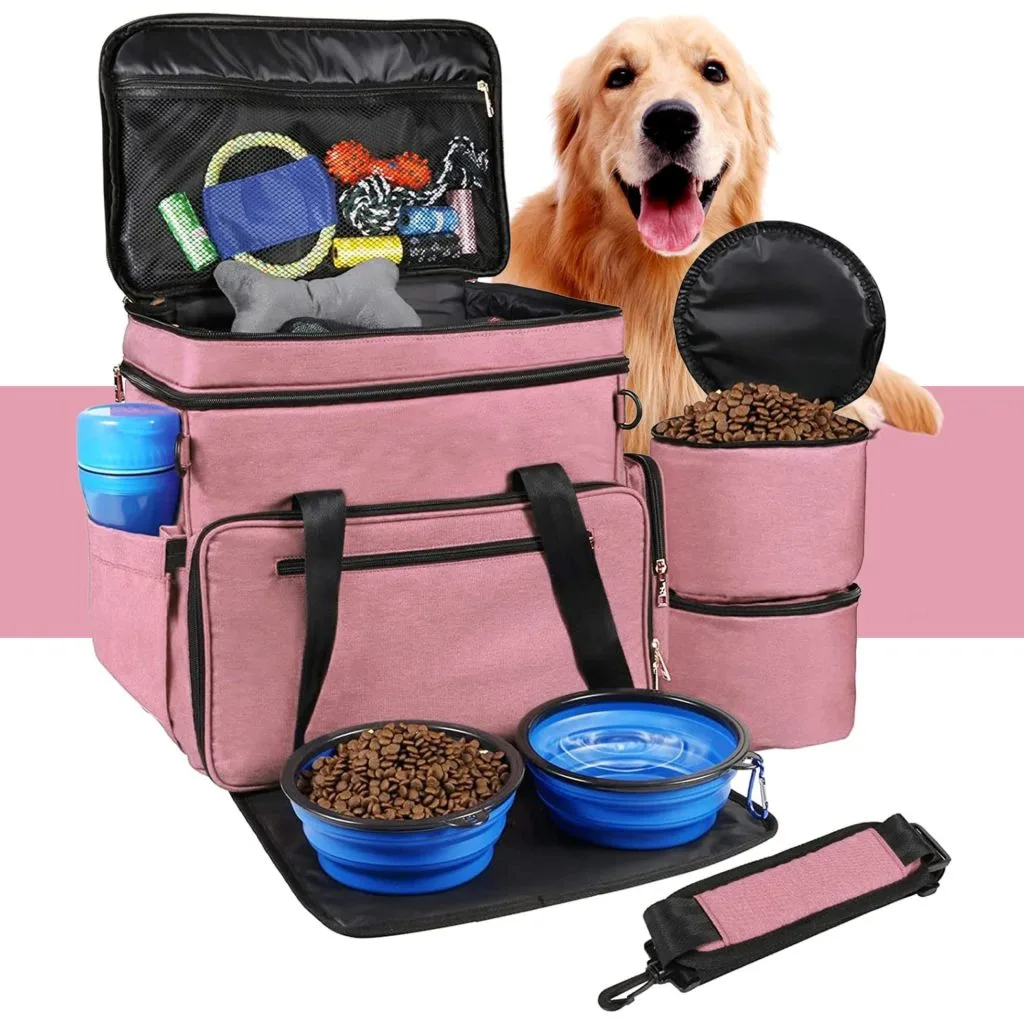
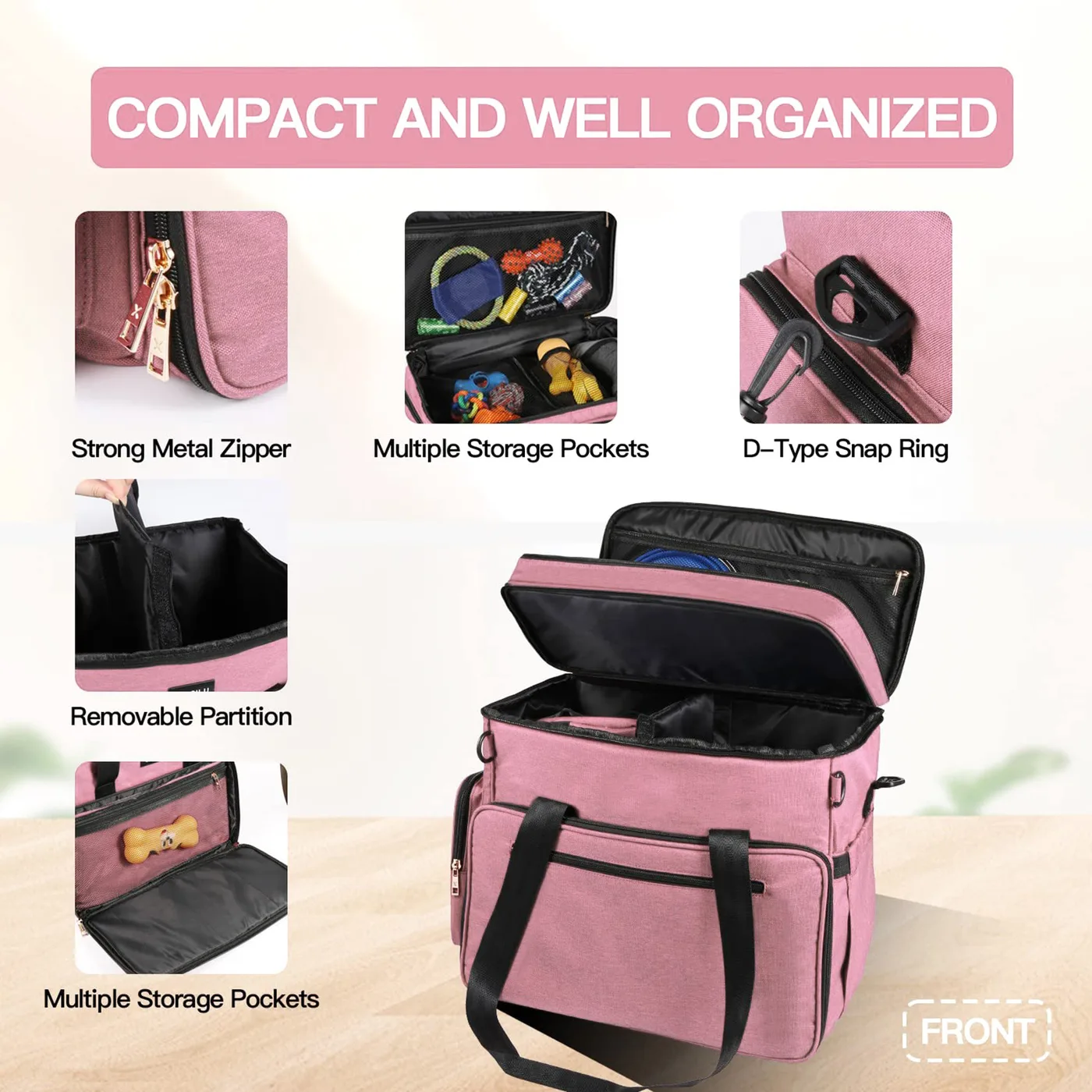
Every compartment on a weekender has to justify itself against the pet's space, and the justification is usually separation rather than storage. Three compartments earn their place consistently; a fourth sometimes does.
The first is the clean compartment, accessed from outside, for clothing and personal items. It must be fully separated from the pet space by a sewn panel rather than a loose divider, because pet hair migrates through anything less and a customer who finds hair on a clean shirt does not buy again.
The second is the damp or used compartment, ventilated and wipe-clean, for a wet lead, a used bowl or a damp towel. It should have a mesh panel and a coated floor, and it should be the compartment nearest the base so any leakage drains to a surface that can be wiped rather than into the lining.
The third is the food and treat compartment, ideally rigid enough to hold a container upright and sized for two days of food. It is the compartment that makes the difference between a bag and travel luggage for a pet.
A fourth - a flat document or tablet sleeve - sometimes earns its place because a traveller needs somewhere for a booking confirmation and a phone. It costs almost nothing as a slip pocket and it should be on the outside face rather than inside the pet space.
Access direction matters more than compartment count. A compartment that can only be reached by opening the pet space is not a compartment; it is a pocket. Every compartment on a weekender should be reachable with the animal inside and settled.
Finally, keep compartment closures simple. Zips on every pocket add cost, weight and failure points; a slip pocket or a magnetic tab is sufficient for most, with a zip reserved for the food compartment where containment actually matters.
Structure: choosing between soft, structured and hybrid
Structure is the decision that most affects both cost and how the product is perceived, and there are three legitimate answers.
A soft weekender uses a framed base and light interlining on the walls. It packs well, it weighs least, and it reads as a bag rather than as luggage. Its weakness is that compartments collapse into each other when partially filled, which is most of the time, and the product looks untidy in a hotel room.
A structured weekender uses bonded panels throughout, so every wall holds its plane whether or not it is full. It looks considerable, it photographs beautifully, and it costs more in material and labour. It also protects the pet space from being compressed by packed compartments, which is a functional argument as well as an aesthetic one.
The hybrid is usually the right commercial answer: structured walls around the pet space and the outer faces, soft compartments that can compress. The animal's volume is protected, the luggage volume flexes, and the cost sits between the two extremes.
Base specification should not vary between the three. A framed board of 7-10 mm running the full floor, bonded rather than sleeved, because a weekender is set down on hotel floors and station platforms and a removable board in that context reads as a cost saving rather than as a feature.
Feet are worth specifying here. Four feet on a structured product protect the base board from abrasion and lift it off wet surfaces, and on a product that will be placed on a bathroom floor they are functionally useful rather than decorative.
Compression testing should be done packed rather than empty. Fill the compartments, load the pet space to rating, set the unit down and check that the pet space has not been squeezed inward by its neighbours.
The personal-item question and honest dimensioning
Weekenders invite a comparison customers make automatically: will this count as my personal item, and will it go in the overhead bin? Answering honestly is more valuable than answering optimistically, because the customer who discovers the truth at a gate writes the review.
Overhead bin dimensions are reasonably consistent across short-haul fleets and a structured weekender near the compact end of the range will usually fit. Anything at the large end will not, and the product page should say so rather than rely on a customer's optimism.
Personal-item allowances are far tighter and a pet weekender rarely qualifies. Positioning the product as cabin luggage is therefore a claim to avoid; positioning it as car, rail and hotel travel is accurate and still commercially strong, since that is where most pet travel actually happens.
Weight matters in the same conversation. A structured weekender is heavier than a soft carrier, and empty weights above roughly 1.9 kg start to be a problem when an owner is also carrying their own bag. Publish the empty weight; it is the number that prevents the mismatch.
Labelling and documentation should reflect the honest position: external dimensions printed on the product or the card, a clear care instruction, and no implication of airline approval. Consumer product expectations in the US market are overseen by the Consumer Product Safety Commission, and labelling accuracy is part of operating properly in that market rather than an optional nicety.
One positive claim is safe and useful: that the product is designed for car and rail travel and for hotel use, with securement loops and a wipe-clean interior. That is true, specific and defensible.
Materials, lining and the second-night reality
The second night is where material decisions get tested. A carrier that survives one night and smells on the second one has failed, and the failure is almost always a lining specification rather than a fabric one.
The lining should be coated and wipe-clean, dark, and sewn rather than stapled. A coated polyester or a TPU-laminated knit wipes down at a hotel sink and dries quickly; an untreated lining absorbs and holds odour. The cost difference is small and the difference in customer satisfaction over a two-night trip is large.
The floor needs separate treatment: a framed board under a coated panel with sealed seams, so a liquid accident does not reach the board. On a weekender the board is structural and bonded, which means a leak that reaches it cannot be dealt with by removing anything - sealing is the only protection available.
A removable liner over the floor is still worth including, because it takes the majority of the soiling and can be dealt with immediately. It should be dark, fixed at four points so it does not bunch, and machine washable, since a two-night trip is exactly the situation where washing happens away from home.
Outer fabric should be chosen for the places the product goes: coated polyester in the 600-900D range resists the abrasion of boot floors and station platforms, and a mid-tone colour hides it. Very light colours look good in photography and poor after one weekend.
Ventilation should not be traded away for weather resistance. A weekender used outdoors still needs 25-35 percent open area across the sides and top; a coated shell with small vents is a compromise that fails both jobs, and it is better to specify generous mesh with a roll-down cover than to reduce the mesh.
Substance documentation should be prepared routinely, with certification through OEKO-TEX standards held on file for the retailer questionnaires that follow any product intended for overnight use near people and animals.
Hardware, closure and the two-strap decision
Hardware on a weekender sits between the utility end of the range and the fashion end, and the specification should reflect that: durable first, finished second.
The main closure should be a robust zip with two sliders and a grab loop at each end, because a weekender is opened and closed repeatedly at a destination rather than once in transit. A locking slider prevents the pet-space zip being worked open from inside, which is a real behaviour in an animal left settled for an hour.
Compartment closures should be lighter. A magnetic tab or a short zip on the food compartment, slip pockets elsewhere. Every full zip on the product adds cost and a failure point, and on a weekender the compartments are opened constantly, so simplicity pays.
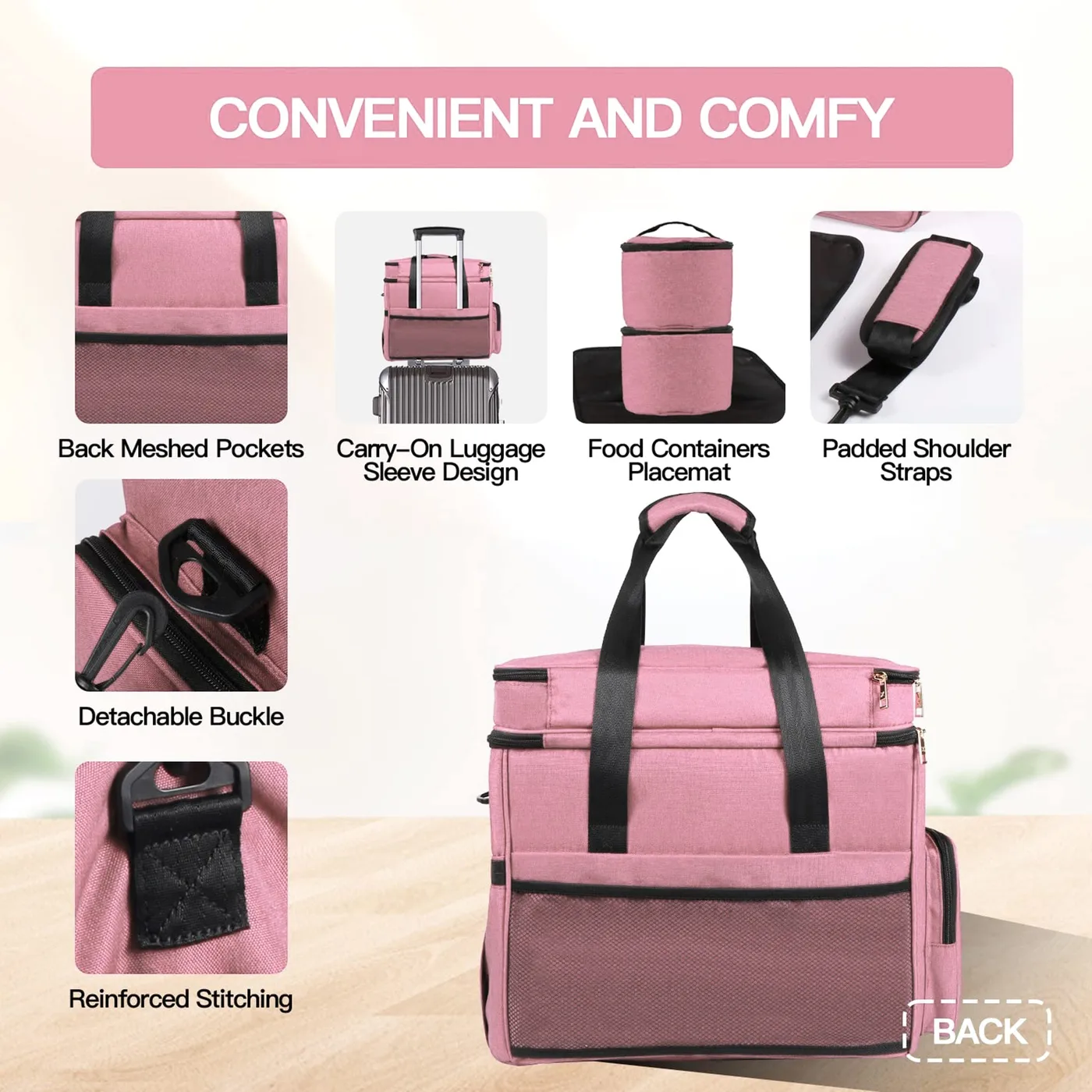
The strap decision is the significant one. A weekender needs two modes: a shoulder strap for carrying from car to room, and grab handles for manoeuvring. Both are required, and the strap should be detachable so it does not snag when the bag is stowed.
| Carry configuration | Cost add at 500 (USD) | Empty weight impact | Practical verdict |
|---|---|---|---|
| Grab handles only | baseline | lowest | Awkward over distance |
| Handles plus fixed strap | +1.20 - 1.90 | +90 g | Snags when stowed |
| Handles plus detachable strap | +1.70 - 2.60 | +120 g | Recommended |
| Adds trolley sleeve | +0.90 - 1.40 | +60 g | Best travel upgrade |
A trolley sleeve is the single best addition on a weekender, because the dominant use case is walking through a station or a hotel lobby with a suitcase. It costs little, it adds almost no weight, and it is the feature reviewers mention.
Finally, feet and a luggage tag loop. Both are small, both are used, and both make the product read as luggage rather than as a carrier - which is exactly the positioning a weekender is aiming for.
Presentation: gifting, retail and the unboxing
A weekender sits at a price point where presentation begins to matter, and it is also a strong gift product - pet-owning travellers receive these for birthdays and housewarmings more often than any other carrier shape.
Retail presentation should lead with the dual function, because that is the reason for the price. One side of the pack copy for the pet - size, rating, ventilation - and one side for the travel - compartment list, capacity, trolley sleeve. Two arguments, clearly separated, rather than one blended paragraph.
Photography should include at least one packed shot showing the compartments in use. It is the only way to communicate capacity without text, and it answers the customer's first question, which is always whether their trip will fit.
Packaging should protect structure. A bonded body creased in transit cannot be corrected, so internal support and a box rather than a mailer is the right specification at this price. The same reasoning applies across the structured families in this series, where the structure is what the packaging exists to protect.
For gift positioning, one inclusion is disproportionately effective: a small packing card listing what to bring for a pet's first night away. It costs almost nothing to print, it is genuinely useful, and it is the kind of detail that turns a product into a present.
Finally, keep the branding consistent with the rest of the range. A weekender is usually the most expensive item a brand sells in this category, and it should look like it belongs to the same family rather than like a separate acquisition.
One more channel note is worth recording, because it changes the product slightly. Weekenders sell well through pet-friendly travel and hospitality partners - hotel groups, railway-adjacent retailers, and boutique travel stores - where the buyer is not a pet specialist. That buyer needs the compartment story told visually on the pack, and they will not ask technical questions about mesh or board specification. A pack design that communicates capacity and separation in one image sells into those accounts; a feature list does not, and the difference is a packaging decision rather than a product one.
Range architecture and the disciplined second season
A weekender belongs at the top of a carry-form range, above a tote and a backpack and beside a duffle. Its job in the architecture is to justify the brand's highest price, which means the products below it must be visibly simpler.
Three sizes is the sensible range: compact, standard and large, as the capacity table showed. Sharing lining, webbing, hardware and compartment logic across all three recovers development cost quickly, and the size story is easy for a retailer to merchandise because it maps to pet size rather than to trip length.
Two colourways per year is the right cadence at this price - one carry-over neutral and one seasonal - because the product is expected to last and because each colourway is a full MOQ 500 commitment at a high unit cost.
The discipline for season two is the same as across the whole series: freeze the construction. Base board, panel bonding, compartment layout and hardware suite stay constant; only colourway, lining colour and small trim details rotate. A programme that does this reaches its third season with a proven, cost-stable product.
Documentation is what makes that possible: a construction file recording fabric, lining coating, board specification, mesh open area and hardware ratings, maintained under ISO 9001 frameworks, so that a reorder is a confirmation rather than a redevelopment.
Incoming production is inspected to AQL 2.5 against that file, with compartment panel attachment, strap anchorage, base board fit and lining finish as the checks that predict how the product behaves on its second night - which is the only real test a weekender ever faces.
Why brands source here
- Pet carrier programs run since 2014; founding team in sewn goods since 2004
- SGS-verified production floor of 4,950 m² with 137 workers across 7 lines
- Monthly capacity of 200,000 units, audited to BSCI and ISO 9001
People Also Ask
Why does my weekender smell after one trip?
Almost always an untreated lining. A coated, wipe-clean lining with sealed floor seams plus a removable washable liner is the specification that survives a second night.
Can one bag really carry both a pet and weekend luggage?
Yes, at 12-18 litres of luggage capacity alongside a proper pet space - but only if the pet space is sized first and the compartments take the remainder.
Should compartments be zippered?
Only the food compartment. Slip pockets and magnetic tabs are sufficient elsewhere, and they reduce cost, weight and failure points.
Is a structured body worth the extra cost?
Yes for the pet space, because packed compartments otherwise compress it. A hybrid with soft compartments gives most of the benefit at lower cost.
Will it count as airline cabin baggage?
Rarely as a personal item, sometimes as overhead bin baggage at the compact end. Say so honestly rather than implying cabin approval.
What is the best small inclusion for gifting?
A packing card listing what to bring for a pet's first night away. It costs almost nothing and it turns a product into a present.
How do I stop pet hair reaching clean clothing?
Full sewn panel separation between compartments. Hair migrates through loose dividers, and a customer who finds it once does not buy again.
Frequently Asked Questions
How much does a weekender pet carrier cost?
Roughly USD 13.40-19.60 per unit at MOQ 500 depending on size and structure level, moving toward USD 9.20-13.80 at 5,000 units.
What size should a weekender be?
A usable floor of 38-46 cm by 26-32 cm with 28-34 cm headroom for the standard class, rating around 10 kg. Size the pet space first and let luggage capacity be the remainder.
How much luggage capacity is realistic?
12-18 litres at standard size. That covers a change of clothes, a wash bag, a folded bowl, two days of food, a lead and waste bags.
How many compartments should it have?
Three that earn their place - clean items, damp or used items, and food - plus optionally a flat document slip pocket. Each must be reachable with the animal inside.
Should the body be structured or soft?
Hybrid is usually best: structured walls around the pet space and outer faces, compressible compartments. It protects the animal's volume and keeps cost between the two extremes.
Will it fit in an overhead bin?
A compact weekender usually will; a large one will not. Personal-item allowances are far tighter and a pet weekender rarely qualifies, so avoid positioning it as cabin luggage.
What lining is needed for overnight use?
Coated, wipe-clean, dark and sewn rather than stapled, over a sealed floor panel, with a removable machine-washable liner taking most of the soiling.
Should the shoulder strap be detachable?
Yes. It is needed for carrying from car to room and it should come off for stowage, where a fixed strap snags.
Is a trolley sleeve worth adding?
Yes - it is the best upgrade on this shape. The dominant use case is walking through a station or lobby with a suitcase.
How much ventilation is needed?
25-35 percent open area across sides and top. Do not trade mesh area for weather resistance; use a roll-down cover instead of smaller vents.
What should the packaging be?
A box with internal support rather than a mailer, because a bonded body creased in transit cannot be corrected.
How many colourways per year?
Two - one carry-over neutral and one seasonal. Each is a full MOQ 500 commitment at a high unit cost.
How long does development take?
Samples with a loaded overnight pack-through test in 6-10 working days, then 35-50 days bulk from approved sample, with lining and hardware the longest-lead items.
Talk to QUANZHOU JUNYUAN BAGS about a pet carrier program: MOQ 500 pieces per colourway, samples in 6-10 working days, bulk production in 35-50 days under AQL 2.5 inspection.
Get a free quote Request a sample