Detachable Shoulder Strap: Multiple Carry Options for Brands
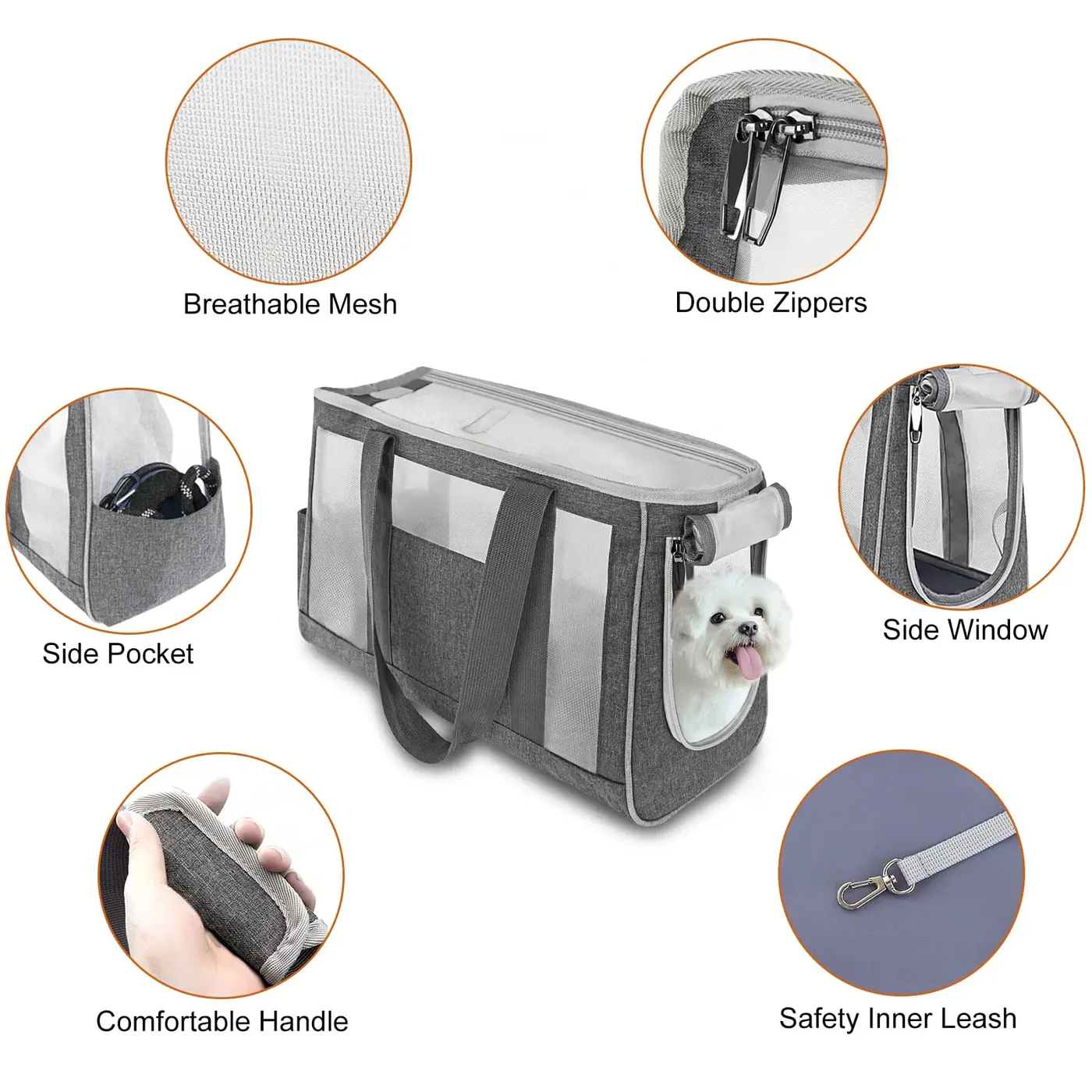
A detachable shoulder strap connects to a pet carrier through swivel hooks or trigger snaps engaging reinforced D-rings, letting one body be carried by hand, on the shoulder or crossbody. The hardware and reinforcement add roughly USD 1.40-3.90 per unit at MOQ 500, and the same attachment points can later accept a backpack harness or a trolley strap, which is what makes the interface worth standardising.
Carry mode is the most under-managed variable in pet carrier design. Customers do not choose a carrier by dimensions alone; they choose it by how it will feel on the way to the vet, through an airport and across a car park - and those are three different carrying problems. A detachable strap system answers all three from one body, and it does so with hardware that is cheap, visible and brandable, which is a rare combination. The discipline required is to specify the attachment as a standard rather than as a feature of one product.
- Sampling: engineered strap sets with production webbing and hardware in 6-10 working days.
- Minimums: MOQ 500 units per colourway; jacquard-woven or custom-dyed webbing carries its own loom minimum.
- Schedule: bulk production in 35-50 days after sample approval and deposit.
- Quality: strap tensile strength, hardware engagement, stitch integrity and colour fastness inspected to AQL 2.5.
- Terms: T/T 30/70, FOB Xiamen, strap sets coiled and bagged with hardware protected from abrasion.
Private label pet bags put the buyer name on the label, the barcode and the carton print while our production team holds the pattern and any tooling.
Carry mode is a purchase decision, not a detail
Ask a customer why they returned a pet carrier and the answer is rarely size. It is much more often that it was awkward - awkward to lift into a car, awkward to hold while opening a door, awkward across a long walk. Carry mode is therefore not a specification line to be settled late; it is a primary reason the product is chosen, and a brand that offers several modes from one body removes the most common source of buyer hesitation.
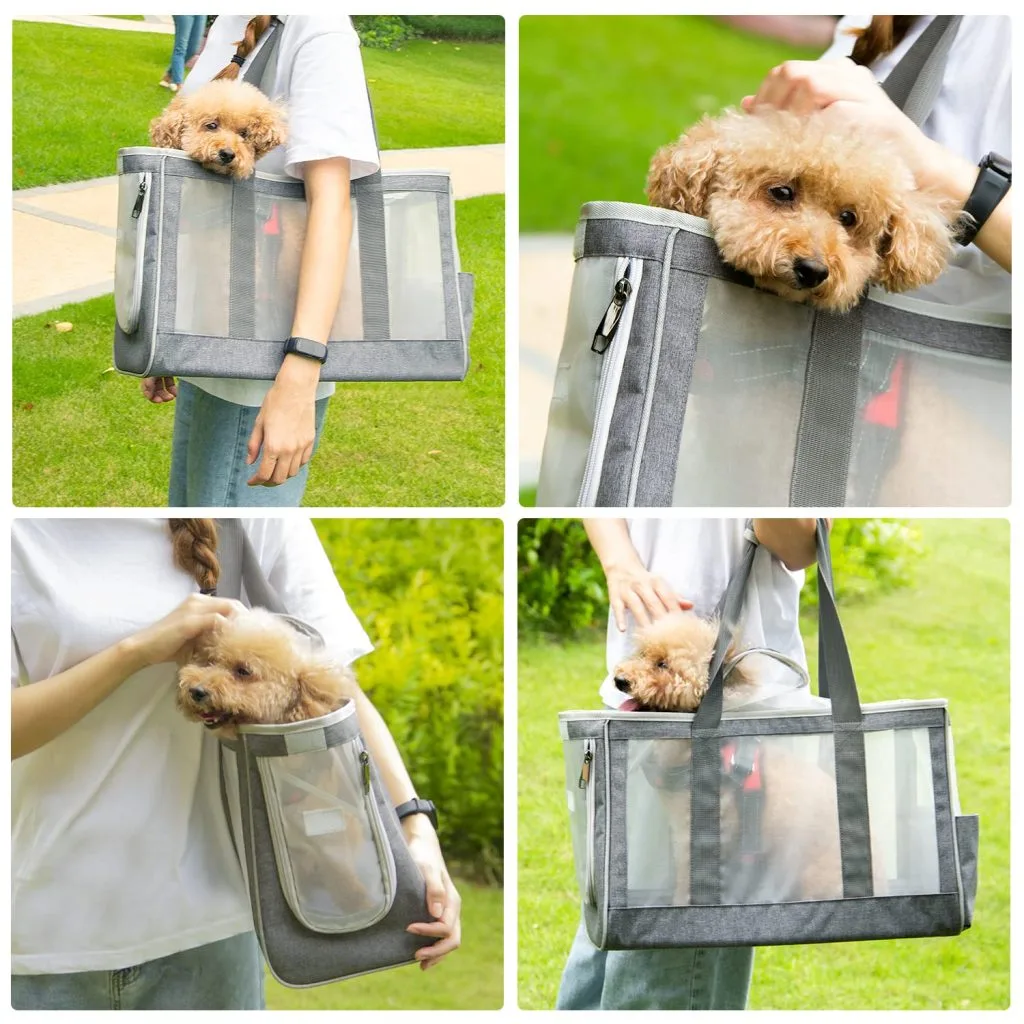
Three modes cover almost all real use. Hand carry is for short transfers - car to vet, floor to table - and it needs a comfortable, load-spreading handle rather than a thin webbing loop. Shoulder carry is for medium distances and is the mode most people default to, because it frees one hand. Crossbody is for longer distances and for anyone who needs both hands; it is also the mode that reads most like a fashion bag, which matters enormously for a label positioning itself as design-led.
A detachable strap is what allows one product to serve all three, and the commercial consequence is significant: the product photographs in three different ways, it answers three different customer questions on a product page, and it justifies a price point above a single-mode competitor. Our production team routinely advises brands to shoot all three carry modes for launch imagery, because a still of one product in three configurations communicates range without adding a single SKU.
There is a second, quieter benefit. A detachable strap is the part most likely to be damaged, lost or simply worn out, which makes it the single best spare-part line in the category. Sold at accessory margin, with a branded jacquard weave, a replacement strap is both a revenue item and - because it carries the brand's mark across the customer's body - a piece of walking advertising.
Attachment hardware: hooks, snaps and what actually holds
The strap is only as good as what connects it to the body, and this is where budget programmes most often fail visibly. Two hardware families are in play, and they are not interchangeable.
Swivel hooks, also called bolt snaps or lobster claws depending on the pattern, are the premium choice. The swivel matters more than the clip: it stops the strap twisting into a rope under load, which is the difference between a strap that lies flat on the shoulder and one that digs. They are available in a wide range of finishes - polished, matte, gunmetal, brass, rose - and that finish range is a genuine design tool, because hardware colour is one of the fastest ways to shift a product from sporty to luxurious without changing a panel.
Trigger snaps and side-release clips are cheaper and flatter, and they suit technical or sport-led languages. Their weakness is that a side-release clip under sustained load can be opened by an accidental press, so for anything above roughly 8 kg of pet load our production team specifies either a swivel hook or a side-release with a secondary locking gate.
The receiving half is just as important as the hook. A D-ring sewn into a fabric tab is the standard, but a D-ring sewn into a single layer of shell fabric will tear out. The correct construction is a reinforced tab - typically a doubled webbing loop with a bar-tack stitch and, for loads above about 8 kg, a hidden internal reinforcement plate that spreads the pull into the body panel or the frame. This reinforcement is invisible in the finished product and is the single cheapest insurance against the most damaging kind of field failure.
Hardware finish durability deserves a specification of its own. Plated hardware on a pet product sees sweat, rain and abrasion, and a finish that dulls in a season undermines a premium position. Salt-spray and abrasion testing to recognised methods maintained by ASTM International is the standard check, carried out through the SGS-verified production base used across the programme.
Webbing: width, weave and the brand surface nobody uses properly
Webbing is the most under-exploited branding surface in the entire product. Most carriers ship with plain webbing in black or a matching colour, when the same component could be carrying the brand name in a woven jacquard, a contrast stripe, or a repeat pattern that makes the strap recognisable at twenty metres. For a label built on identity, that is free advertising space that is already being paid for.
Width is the functional decision underneath the branding. A 25 mm strap on a 9 kg load will cut into the shoulder; the same load on 38-50 mm webbing is comfortable without padding. The rule our production team applies: strap width in millimetres should be at least 4 mm per kilogram of rated pet load for unpadded webbing, and at least 2.5 mm per kilogram if the strap is padded. It is a blunt rule but it holds up, and it prevents the most common comfort complaint in the category.
Weave type matters for feel and for print method. Flat woven polyester is the workhorse - cheap, strong, colourfast and accepts sublimation printing well. Jacquard woven webbing carries the design in the weave itself, which is far more durable than any print and looks substantially more expensive; it carries a loom minimum that typically starts around 1,000-3,000 metres, which a single MOQ 500 order will not consume, so it is a decision to make at range level rather than per product. Tubular webbing is softer in the hand and is the right choice for a strap that sits directly on the neck, though it is less stable under load.
Colour fastness on webbing is worth specifying explicitly, because a strap is subject to abrasion against clothing and to sweat, and both are conditions where a marginal dye will fail. Test methods for rubbing and perspiration fastness are published by AATCC, and specifying a grade against those methods converts a vague expectation into something that can be checked at goods-in.
Designing the strap as an accessory line
Once the strap detaches, it can be sold - and a strap is an unusually good accessory because it is cheap to make, easy to ship, high margin, and genuinely desirable in multiple colours. Three approaches work.
The colour drop is simplest: the same strap construction in a seasonal palette, priced to encourage buying two. It works because a strap is the part of the product the customer sees most often and the part they are most willing to swap, and because at typical accessory price points the purchase is impulsive rather than considered.
The construction upgrade is more profitable: a padded or wider strap sold as a comfort upgrade for customers who bought the base product and found the flat strap uncomfortable on longer walks. This converts a potential complaint into a second transaction, and it is worth planning for explicitly - the base strap should be adequate but not luxurious, so the upgrade has a reason to exist.
The crossbody conversion is the most interesting. A longer strap that converts the carrier to crossbody wear changes how the product is used rather than how it looks, and it appeals strongly to urban customers who need both hands free. It is also the accessory most likely to be photographed and shared, because it makes the product look like a bag rather than a pet container - which, for a design-led brand, is the whole point.
Packaging for strap accessories should show the strap on the body and on a person. A strap photographed coiled on white reads as a spare part; the same strap photographed across a shoulder reads as a fashion item and supports a considerably higher price. This is one of the highest-return photography decisions available in the category.
Load paths: where the strap pulls and how the body takes it
A shoulder strap concentrates the whole weight of the product into two small points on the body, and everything about the internal structure has to acknowledge that. When a carrier is carried by its handles, the load path is vertical and forgiving. When it is slung over a shoulder, the load path is angled, and the body experiences a combination of vertical pull and inward squeeze.
The inward squeeze is the part that gets missed. A soft carrier slung from two D-rings will deform, narrowing the interior and pressing against the animal. It also makes the product look wrong - collapsed inward at the top - which is a visual quality signal customers pick up instantly even if they cannot articulate it. The mitigation is a structural top: either a moulded or composite frame member across the upper opening, or a reinforced webbing cradle that runs under the panel and ties the two attachment points together.
Both approaches work, and the choice is a design one. A frame member is stiffer and better for larger products; a webbing cradle is lighter, cheaper and nearly invisible, and it is sufficient for most products up to about 10 kg. Our production team specifies the cradle as standard on soft carriers with shoulder attachment, because it costs relatively little and prevents both the deformation and the associated complaint.
The attachment points themselves should be positioned above the loaded centre of gravity. If they sit below it, the product will rotate as it is carried - tipping away from the body - and the customer will spend the whole walk fighting it. Getting this position right by 20-30 mm is often the entire difference between a carrier that hangs comfortably and one that swings.
Specification table for strap and hardware options
The table below compares the common strap configurations with the numbers that decide them. Read the rated load column first, then the comfort column, then cost - because a strap that is cheap but cuts into the shoulder will generate returns that cost far more than the saving.
| Configuration | Webbing width | Hardware | Rated load | Cost at MOQ 500 |
|---|---|---|---|---|
| Flat polyester webbing, plain | 25 mm | Swivel hook, nickel finish | 6 kg | USD 1.40-2.10 |
| Flat polyester webbing, sublimation print | 32 mm | Swivel hook, matte gunmetal | 8 kg | USD 2.20-3.10 |
| Jacquard woven branded webbing | 38 mm | Swivel hook, custom finish | 10 kg | USD 3.10-3.90 |
| Padded sandwich mesh shoulder pad | 50 mm | Swivel hook, custom finish | 12 kg | USD 4.10-5.60 |
| Crossbody length with slider adjuster | 38 mm | Two swivel hooks | 10 kg | USD 3.60-4.80 |
Two things stand out. First, moving from 25 mm to 38 mm webbing roughly doubles the comfortable load for a modest cost increase - it is the best value change available on almost any strap. Second, jacquard webbing is not as expensive as brands expect once the loom minimum is amortised across a range, and because it carries the brand permanently rather than as a print that can abrade, it is often the right choice for a label whose identity matters more than its unit cost.
The padded row is the one to be careful with. Padding adds bulk that can look sporty rather than refined, and it does not solve a width problem: a narrow padded strap still concentrates load. Pad the strap only after the width is correct, never instead of it.
The crossbody row also deserves a note, because its cost is driven by the second hook rather than by the webbing. Any crossbody configuration needs hardware at both ends, and that doubling is easy to miss when a range is being costed from a single-hook reference. Budget it explicitly, and if the cost pressure is real, consider shipping the crossbody strap as the accessory rather than as the in-box item, which moves the expense into a revenue line instead of a cost line.
Finally, treat hardware finish as a line item in its own right rather than as part of the strap cost. Standard nickel or black is effectively free; custom-matched or premium finishes carry setup and minimum lot charges that behave very differently from the webbing costs and are best quoted separately from the start.
Testing, compliance and what to check on the line
Strap testing is unusually straightforward and unusually revealing, which makes it a good place to be strict. Three checks cover the risk.
Tensile and stitch integrity. The strap assembly - webbing, hardware and the reinforced tab - is pulled to a multiple of rated load, typically 4-5 times, and must fail in the webbing rather than at a stitch or a hardware joint. Failing at a stitch means the construction is the weak link, which is a design problem rather than a material one, and it should be fixed rather than accepted.
Cycle and abrasion. Attaching and detaching the strap several hundred times, plus abrading the webbing against a standard abrasive, confirms the hardware gate still operates and the webbing has not fuzzed or pilled. This is also the test that reveals whether a printed design will survive; a sublimation print that survives abrasion testing will generally survive ownership, and one that does not will be a warranty issue by the second month.
Colour fastness. Rubbing and perspiration fastness are assessed to published AATCC test methods, and any dyed component that contacts skin or clothing should meet a defined grade. This is both a quality issue and, for European and Californian markets, a compliance one: our partner facilities document conformity to REACH requirements and maintain Proposition 65 awareness for the substances that commonly appear in dyed textiles and plated hardware.
At goods-in, the practical checks within the AQL 2.5 plan are hardware finish consistency, gate operation on every sampled strap, and stitch density at the reinforced tab. The last is worth measuring rather than eyeballing, because bar-tack stitch count is the single best predictor of whether a strap will hold.
One further check belongs on programmes that ship into humid or coastal markets: corrosion pairing. When a plated steel hook sits against a dissimilar metal D-ring, galvanic corrosion can appear within a season even if each part passes salt-spray testing alone. Specifying matched or compatible finishes for the two halves of the interface costs nothing at MOQ 500 and removes a failure that is otherwise very hard to diagnose after the fact.
Standardising the interface across a range
The most valuable decision a brand can make about detachable straps is not which strap to specify, but to specify one attachment standard and keep it. A single D-ring geometry, a single hook size, a single reinforcement construction - documented, and applied to every product in the range - converts straps from product-specific parts into a platform.
The payoff compounds. Accessories fit across products, so a strap launch serves the whole range rather than one SKU. Spare parts become manageable, because there is one part number rather than six. And future products can be designed knowing the carry interface is already solved, which shortens development and removes a whole category of sampling risk.
The corresponding discipline is to resist the temptation to change it. A designer who wants a slightly different ring on a new product is making a small aesthetic gain at the cost of the platform, and that trade is almost never worth it. Our production team maintains the interface drawing as a controlled document precisely so that this argument can be settled by reference rather than by opinion.
For launch, the practical recommendation is to ship each carrier with one strap and list two others as accessories from day one. The availability of alternatives at launch is what makes the mechanic legible to the customer; a strap accessory announced six months later reads as an afterthought and sells accordingly.
The same logic applies to strap length. A standardised interface is undermined if each product in the range needs a different strap length, because the accessory line fragments into variants. The practical resolution is to specify one generous length with a slider adjuster across the whole range, accepting a little surplus webbing on the smallest product in exchange for a single accessory part number. Surplus webbing can be managed with a keeper loop; fragmented inventory cannot be managed at all.
It is also worth documenting the standard in the customer-facing material rather than only internally. A simple statement that straps are interchangeable across the range gives the customer a reason to buy a second strap and gives the brand a defensible platform story that competitors with product-specific parts cannot make.
Merchandising multiple carry modes at retail and online
Multiple carry is a story that has to be told, because it is invisible in a single product shot. The retail and digital assets should be built around the mechanic from the beginning, not assembled from whatever imagery exists.
At shelf, the strongest device is a three-image sequence on the side panel: hand, shoulder, crossbody. It takes very little space and it answers the question every pet carrier shopper is actually asking, which is how this will feel when I am carrying it. Where packaging allows a window or a cut-out, showing the strap actually attached is worth more than any written claim.
Online, the equivalent asset is a short clip of the strap being detached and reattached. It demonstrates the mechanism, it removes the fear that a detachable part is flimsy, and it is the kind of asset that gets reused in paid social, where a mechanism shot consistently outperforms a static product shot.
For the retail buyer, the argument should be framed in attachment rate rather than features. A carrier with accessory strap options generates a second purchase from a meaningful share of buyers, and that incremental basket value is a number a category manager can work with. Framing the conversation that way - rather than describing the strap - is usually what secures the additional facing.
There is one merchandising trap worth avoiding. Do not sell the strap by listing its specifications on the packaging. Width in millimetres, webbing composition and hardware finish are meaningful to a product developer and close to meaningless to a shopper, and packaging space spent on them is space not spent on the one thing that actually motivates purchase: how the product will feel and look in use. Put the specifications on the product page for the minority who want them, and keep the packaging about the experience.
Finally, price the accessory so that it is bought rather than admired. Strap accessories priced too high become a signal that the core product was incomplete; priced well, they become an easy second item in the basket and, because they carry the brand visibly, a recurring source of recognition. The reference band most programmes land in is a modest fraction of the carrier price rather than a premium over it.
Why brands source here
- Pet carrier programs run since 2014; founding team in sewn goods since 2004
- SGS-verified production floor of 4,950 m² with 137 workers across 7 lines
- Monthly capacity of 200,000 units, audited to BSCI and ISO 9001
People Also Ask
What makes a shoulder strap detachable on a pet carrier?
Swivel hooks or trigger snaps on the strap ends engaging reinforced D-rings on the body, allowing the strap to be removed for hand carry, washing or replacement without tools.
Which carry mode is most comfortable for a pet carrier?
Crossbody for distance, shoulder for medium trips and hand for short transfers. Offering all three from one body is the practical advantage of a detachable strap system.
How wide should a pet carrier strap be?
32 mm for small formats and 38-50 mm for medium and large ones, using roughly 4 mm of width per kilogram of rated load for flat webbing and 2.5 mm per kilogram when padded.
Can I buy a replacement strap later?
Yes, provided the attachment interface was standardised. Brands that freeze one D-ring geometry and hook size enable accessory and replacement sales across the whole range.
Are printed logos on webbing durable?
Sublimation prints on polyester are acceptably durable and are verified by abrasion testing. Jacquard weaving is substantially more durable because the design is part of the weave rather than a surface layer.
Does a padded strap help more than a wider one?
No. Width does the load-spreading work; padding adds comfort on top of adequate width but cannot compensate for a strap that is too narrow, and it adds bulk that can look sporty rather than refined.
How much weight can a detachable strap safely carry?
Correctly specified assemblies are rated to 6-12 kg depending on webbing width and hardware, and are pull tested to 4-5 times their rated load so that failure occurs in the webbing, never at a stitch or hardware joint.
Frequently Asked Questions
Can a shoulder strap be added to any pet carrier?
Only if the body has reinforced attachment points built in. A D-ring needs a doubled webbing loop with bar-tack stitching and, above about 8 kg, an internal reinforcement plate that spreads the load into the panel or frame.
What strap width should be specified for a given pet weight?
At least 4 mm of width per kilogram of rated load for flat webbing, or 2.5 mm per kilogram if the strap is padded. In practice 32 mm for small formats and 38-50 mm for medium and large ones.
Are swivel hooks better than trigger snaps?
Swivel hooks are usually better because the swivel prevents the strap twisting into a rope under load, which is the main cause of a strap digging into the shoulder. Trigger snaps are flatter and cheaper and suit technical designs.
Can the webbing carry our logo?
Yes, either as a sublimation print on flat polyester or, more durably, as a jacquard weave where the design is woven in. Jacquard carries a loom minimum and is best planned at range level rather than per product.
How much does a detachable strap add to unit cost?
Between USD 1.40 and 5.60 per unit at MOQ 500 depending on webbing width, weave type, hardware finish and whether a shoulder pad is included.
What is the minimum order for custom webbing?
MOQ 500 units per colourway for the carrier programme. Jacquard or custom-dyed webbing carries a separate loom or dye-lot minimum, typically measured in the low thousands of metres.
How long do sampling and production take?
Engineered strap sets with production webbing and hardware take 6-10 working days. Bulk production runs 35-50 days after sample approval and deposit, with inspection to AQL 2.5.
Will the carrier deform when carried on the shoulder?
It will without internal structure. A reinforced webbing cradle or a moulded frame member across the top prevents the inward squeeze that narrows the interior and makes the product look collapsed.
Should attachment points sit above the centre of gravity?
Yes. Points below the loaded centre of gravity cause the product to rotate away from the body while being carried, which the user fights for the whole walk. Twenty to thirty millimetres is often the whole difference.
Can straps be sold separately as accessories?
Yes, and they are among the best accessory lines in the category - cheap to produce, easy to ship, high margin, and desirable in multiple colours. Launch with the base strap plus two alternatives available immediately.
How is hardware finish durability assessed?
By salt-spray and abrasion testing to recognised ASTM methods, carried out through the SGS-verified production base. Pet products see sweat, rain and abrasion, so a finish that dulls quickly undermines a premium position.
Do detachable straps create a safety hazard?
They can if hardware is small enough to detach and be ingested, so hooks are specified at a size that cannot present a hazard and retain positively under load. Straps on carriers for very small pets are kept short for the same reason.
Talk to QUANZHOU JUNYUAN BAGS about a pet carrier program: MOQ 500 pieces per colourway, samples in 6-10 working days, bulk production in 35-50 days under AQL 2.5 inspection.
Get a free quote Request a sample