Sports Team Pet Carriers: Team Colour Programs
A team colour pet carrier program works when colours are matched to a Delta E of 2.0 or less across shell, webbing and trim, executed in two or three brand colours plus one accent. Because shell fabric, webbing and hardware each absorb dye differently, matching three separate substrates is the actual technical challenge rather than the design itself.
Our production team develops team-inspired programs from 500 pieces per colourway, with physical samples available in 6-10 working days.
Executive Summary
Sports merchandise succeeds on identity rather than on function, and that changes every subsequent decision. Fans buy belonging, which means colour accuracy, placement confidence and recognition from ten metres away matter far more than marginal specification improvements nobody will notice in a stadium car park.
Operationally these programs run on tighter calendars than ordinary retail work. Minimum quantity is 500 pieces per colourway, samples issue from our production team within 6-10 working days of approved colour references, and bulk closes in 35-50 days. For season-driven merchandise, that means artwork and substrate decisions should realistically be locked four months before the first fixture rather than closer to the peak.
Quality terms are settled early rather than negotiated late. Every bulk shipment is inspected to AQL 2.5, with colour deviation beyond the agreed tolerance, poor embroidery density and hardware faults all counted as major defects, so acceptance rests on measurement rather than opinion.
The single most productive investment up front is agreeing one physical colour standard across every component. When colours are called out against that shared reference rather than described verbally, disputes disappear and reorder cycles shorten dramatically, which matters enormously when a surprise playoff run creates sudden demand.
A bespoke pet carrier brief is built from a tech pack: dimensions, fabric, hardware finish and the test standard the finished bag has to meet.
Why fan identity transfers so well to pet travel goods
Sports merchandise is one of the few categories where the customer's emotional involvement precedes the product entirely. Nobody needs a pet carrier and then considers whether it should carry their team colours; they want to express team membership and then discover that the carrier is an available canvas for it.
That difference has practical consequences. Because the purchase is emotionally driven, tolerance for ordinary price comparison collapses and fans routinely pay substantial premiums over functionally equivalent goods. In our experience, team-inspired carriers sustain higher unit pricing than generic equivalents with almost no additional construction cost.
Game-day behaviour determines what actually gets used. Products are carried into stadium precincts, set on concrete, exposed to weather and handled repeatedly by people watching rather than looking where they step. Durable construction and wipe-clean surfaces therefore matter more here than in any lifestyle channel, despite the emotional positioning.
The tailgating and viewing-party context widens the range considerably. Beyond the carrier itself, companions such as mats, water-bottle sleeves and treat pouches all participate in the same ritual, Extend the range deliberately once the carrier is established, beginning with the two companions customers most often mention, and treat each additional item as another moment for the same visual language to reinforce itself. This makes it one of the most extendable pattern categories available to a private-label brand.
Finally, fan merchandise rewards speed and consistency over novelty. A colourway that sold well last season can usually be reissued with minimal change, whereas constant redesign actively undermines recognition. Treating team-inspired goods as a stable annual program rather than as a rotating fashion line is the single most profitable structural decision available here.
Range extension follows naturally from that stability. Because core components remain unchanged across seasons, adding a companion mat, toy pouch or water-bottle sleeve requires only artwork decisions, and those accessory lines typically carry better margin than the carrier that anchors them.
Regional loyalty also tends to spread through social sharing, since products expressing team identity get photographed far more often than generic equivalents. That organic reach lowers acquisition cost for brands willing to invest in recognisable colourway design rather than in extra advertising.
Two practical habits improve every subsequent season. Keep a retained reference swatch for each colourway away from daylight, and record every approval decision in the shared tech pack, so that a fast reorder can move straight to bulk without reopening colour discussions that were already settled.
Rights and boundaries: colours, marks and what you can actually use
Before any design work begins, the boundary between permissible inspiration and infringement has to be understood. It is narrower than many brand teams assume, and getting it wrong is expensive in ways that no subsequent success will offset.
Team colours themselves generally sit outside protection in most jurisdictions, which is why unbranded merchandise in recognisable combinations exists legally. However, combining those colours with a city name, a nickname, a mascot reference or anything approximating a protected logo moves decisively into infringement territory, regardless of how much alteration is applied.
The safe commercial route is either a proper licence or a deliberately generic approach. A licence brings recognition and usually higher volume, at the cost of royalties and approval cycles similar to those described in our guide to licensed character programs. The generic route sacrifices named properties but retains full creative and pricing freedom.
A useful middle path that many branded clients adopt is tribal rather than literal targeting. Instead of naming a team, design for the idea of Saturday afternoon fandom, using colour combinations and kit-inspired geometry that read as belonging without replicating protected identity. This is both commercially effective and considerably safer.
One caution deserves emphasis. Local interpretation varies, and some rights holders take an aggressive position on anything resembling their colour combinations in market-adjacent categories. Obtaining written advice in each target territory before committing production spend is inexpensive insurance against a far larger loss.
Documentation also protects you when rights questions arise later. Keeping records showing independently developed artwork, sourced from generic references rather than from trademarked style guides, demonstrates good faith and substantially improves your position in any subsequent discussion.
Where a licence is genuinely wanted, begin the conversation several months earlier than feels necessary. Rights holders in professional sport typically work through central merchandising programmes, and their lead times follow league calendars rather than yours, which catches unprepared brands every season.
Matching one team palette across completely different materials
Matching colour is easy when everything shares one substrate and very difficult when it does not. A single carrier typically combines printed or dyed shell fabric, webbing possibly from a different fibre, mesh panels, zip tape, binding and metal hardware, each with different dye affinity and surface reflection.
The technical starting point is a numeric tolerance rather than a visual impression. The industry works in Delta E units measuring difference from a reference; below 2.0 is generally imperceptible to most observers, 2.0 to 4.0 is acceptable for most soft goods, and above 4.0 becomes obvious when components sit adjacent on the same product.
| Component | Typical material | Achievable Delta E | Colour yield | Risk |
|---|---|---|---|---|
| Shell panel | 600D polyester | 1.0-1.8 | High | Low |
| Strap webbing | Nylon or polyester | 1.5-2.5 | Medium | Medium |
| Ventilation mesh | Polyester knit | 2.0-3.0 | Low | High |
| Binding tape | Polyester twill | 1.5-2.5 | Medium | Medium |
| Metal hardware | Anodised alloy | 3.0-5.0 | Very low | High |
Anodised metal deserves special mention because it cannot be matched to fabric at all in most cases. Rather than attempting impossible exactness, the professional approach deliberately contrasts hardware, selecting gunmetal or matte black as an intentional accent rather than as a failed colour match. Intentionality resolves the problem that accuracy cannot.
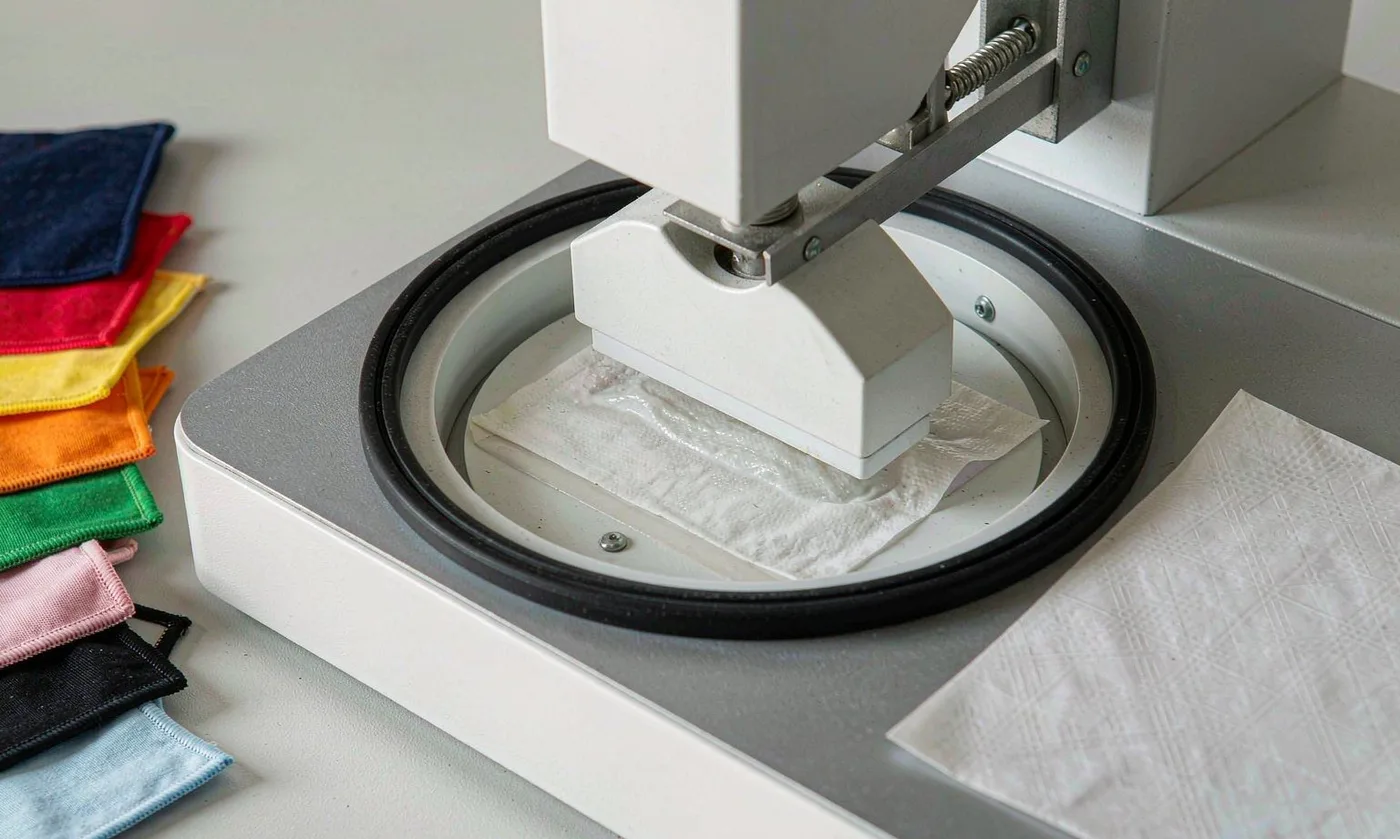
The most reliable process is to develop from a single reference first. Our production team receives one approved colour standard, produces lab dips for each substrate against it, and reviews all dips together under consistent lighting rather than sequentially. Side-by-side comparison catches divergence that sequential approval misses every time.
Working from Pantone reference standards anchors this process, but the physical signed swatch is what ultimately governs. Screens drift, lighting shifts and memories fade; a retained standard is the only defensible reference one season later.
Metamerism deserves one practical safeguard. Dark team colours frequently shift noticeably between daylight and stadium floodlighting, which is exactly where these products are carried. Approving colours under two different light sources, rather than one, prevents awkward surprises at the first match.
Kit-inspired design language without copying any actual kit
The translated strategy is to borrow the grammar of sports apparel rather than any specific uniform. Blocking, striping, numbering and badge placement are all universal structural devices, and using them thoughtfully produces merchandise that reads authentic without referring to a protected design.
Colour blocking is the strongest device available. Dividing a panel into two or three fields using the team palette creates immediate visual identity, and because blocking proportions rather than decals carry the message, the result also survives long-term wear far better than applied graphics.
Striping takes three forms borrowed directly from apparel grammar. A shoulder stripe mirrors jersey shoulder panels; a side stripe along the gusset echoes training wear; and a narrow stripe down the centre front repeats the placket tradition. Each translates effectively to soft goods and each costs essentially nothing beyond cutting precision.
Numbering is the most emotionally loaded element in sports design, and also the most legally exposed when replicating a specific player's number. Generic numerals used decoratively, or a script wordmark related to the pet rather than the team, deliver the same emotional cue without referencing anyone specific, which is both safer and often more charming.
- Blocking: anchor the body in the darkest colour, then use accent fields sparingly.
- Striping: match stripe width to the panel scale, not to the source garment.
- Badging: use your own crest shape rather than borrowed silhouettes.
- Numerals: choose numbers meaningful to pet owners rather than to a roster.
Restraint is what separates considered design from merchandise pastiche. Two strong colours plus one accent will outperform five competing ones on almost every measure, including shelf recognition, and it keeps production practical when volumes need to be reordered quickly under time pressure.
Finally, decide early whether the design references home or away traditions. Most fan merchandise succeeds by anchoring to the darker, more dominant colour rather than to the lighter accent, because darker fields read better both on shelf and after several seasons of real use.
Scale matching deserves the same rigour, since a stripe that works across a large body can overwhelm a small pocket panel. Preparing a reduced version at roughly 55 to 65 percent of the hero width keeps the relationship convincing across every item in the range.
Logo execution: embroidery, patches and print compared
How marks are applied determines both the perceived quality and the durability of the finished product. Each route has genuinely different characteristics, and the right choice depends on the intended price point and expected wearing conditions rather than on habit.
| Route | Unit premium | Perceived value | Durability | Best use |
|---|---|---|---|---|
| Embroidery | USD 0.60-1.80 | High | Excellent | Front panel crests |
| Woven label | USD 0.15-0.40 | Medium | Good | Side seams, webbing |
| Printed transfer | USD 0.25-0.55 | Low | Fair | Large photographic art |
| Rubber or TPU badge | USD 0.55-1.20 | Very high | Excellent | Hero placement |
| Metal plate | USD 0.90-2.00 | Highest | Excellent | Premium gift tier |
Embroidery is the category standard and remains the best overall compromise. Thread catches light three-dimensionally, which reads expensive, and stitched marks survive abrasion better than anything applied to the surface. The main constraints are cost scaling with stitch count and difficulty reproducing very fine detail.
Rubber and TPU badges are the strongest contemporary option, popular across sportswear for good reason. They hold crisp edges, can be produced in matte or gloss finishes, and create a technical impression that suits performance-led branding. Attachment is typically stitched rather than heat-applied for soft goods bearing loads.
Printed transfers are the economical route for large artwork but should be used with care here. Surface-applied marks tend to crack under repeated flexing, and this category subjects products to worse treatment than almost any other, so the positional saving is rarely worth the returned goods.
Finally, consider where the mark sits rather than only how it is made. A logo positioned where the eye naturally lands when the product is carried, typically the upper third of the front panel, gains disproportionate recognition compared with a technically superior mark placed low and obscured by the owner's arm.
Scaling the mark correctly across a range deserves equal care. A crest sized for a large carrier will overwhelm a small accessory, so our design team prepares a secondary reduced version, typically at 55-65% of the hero size, keeping proportional harmony across every item in the collection.
Interior colour deserves a deliberate choice as well. Linings in the darker of the two palette colours hide soiling far better through a long season, and since owners notice interior condition every time they open the bag, this decision influences satisfaction more than most decorative ones.
Woven labels deserve more use than they get, particularly for secondary positions. Applied along a side seam, inside a pocket or on webbing, they deliver precise colour reproduction at low cost, and they can carry secondary palette accents that would be impractical to embroider.
Durability under real fan conditions
Merchandise worn or carried into stadium environments faces conditions that ordinary retail testing rarely replicates. Sunlight, ground abrasion, spilled drinks and repeated loading into vehicles all concentrate onto a product that fans expect to last several seasons, because the emotional attachment demands it.
Ground contact is the most destructive factor. Concrete and gravel abrade the base rapidly, so a darker solid base panel is strongly recommended regardless of what happens elsewhere in the design. It also improves appearance longevity and is one of the cheapest protective choices available.
Colour retention under sun exposure is the second. Dark team colours absorb heat and fade measurably faster, particularly reds and deep blues. Specifying the appropriate dye class and rating the fastness before booking gives predictability, and this is where testing against recognised AATCC test methods provides genuine protection.
Liquid exposure deserves deliberate design attention too. Spills are inevitable in this usage context, so specifying a wipe-clean coating on printed panels and choosing dark or patterned lining covers practically all realistic scenarios. Interior protection is generally more important than exterior, since cleaning the inside is considerably harder.
Finally, plan hardware for abuse rather than for elegance alone. Carriers in this context get dropped, dragged and overloaded, so metal hardware and reinforced strap anchors are worth their modest premium. Failed hardware generates more negative sentiment than almost any other single fault in merchandise categories.
Warranty thinking should be applied deliberately here. Because emotional attachment is high, customers replace rather than repair only when replacement is easy, so agreeing a simple defects process with the production team before launch prevents the disproportionate reputational damage that failures in fan merchandise tend to cause.
Strap attachment is the failure point worth specifying with care. Because excited owners pick up loaded carriers by whichever strap comes to hand, reinforced bar-tack anchoring and box stitching on every load-bearing strap prevents the field failures that damage confidence most.
Season calendar, reorder speed and inventory strategy
Sports merchandise operates on externally dictated timing that ignores your planning convenience entirely. Fixtures, season openings and playoff runs all create demand spikes, and programs either align with that rhythm or miss the opportunity completely.
The practical calendar works backwards from the season opener. Allow roughly four weeks for concept and colour development, 6-10 working days for physical sampling, then 35-50 days for bulk followed by freight. That means locking decisions about four months ahead of the first fixture, which many first-time buyers find uncomfortably early.
Reorder capability deserves particular attention because unexpected demand is normal rather than exceptional. A team performing better than forecast creates sudden volume, and the ability to respond inside weeks rather than months is often what determines whether a season was genuinely profitable.
- Keep the colour standard retained and light-protected so reorders can match without new lab dips.
- Freeze the tech pack after approval so nothing has to be redeveloped under time pressure.
- Hold capacity provisionally during known peak periods rather than booking reactively.
- Plan two waves rather than one, preserving flexibility if early sell-through indicates change.
Inventory strategy should accept that some colourways will outperform dramatically and others will not. Preparing a simple contingency plan, including which components are shared across colourways so that slow movers can be converted, protects cash far better than hoping for balanced performance.
Communication discipline supports the whole plan. Sharing the production calendar with retail partners early, including realistic reorder windows, sets expectations accurately and prevents the overselling that otherwise turns a successful spike into a customer-service problem.
Air freight becomes relevant here more often than in most categories. When unexpected success creates urgent demand, the additional freight cost is usually trivial against the margin lost by missing the remaining fixtures, so agreeing the cost model in advance saves valuable time later.
Personalisation, packaging and retail execution
Personalisation is the highest-margin opportunity in this entire category, because emotional involvement makes customers willing to pay more for a name or number. Adding embroidery of a pet's name or a favourite numeral typically costs little while supporting substantially higher retail pricing.
The operational caveat is significant though. Personalised units disrupt batch efficiency, requiring either dedicated capacity or a late-stage finishing step. Discussing this structure during quoting prevents the common situation where personalisation economics look excellent on paper and disappointing in practice.
Packaging should support the ritual rather than fight it. Because the purchase is celebratory, presentation matters, so a cloth drawstring bag, a colour-matched hangtag and simple care card coordinate well without adding much cost. Fully printed boxes are rarely necessary and add shipping volume.
Retail partners differ sharply in how they handle this category. Stadium-adjacent stores and regional independents often outperform national chains because their customers are already primed; online channels work best where search terms capture regional rather than generic intent. Choosing one clear route beats spreading thinly.
Finally, remember that this category depends on repeat behaviour more than most. A fan who buys one item often returns for accessories if the first experience was positive, so quality consistency across every piece, including small items, is what converts a single purchase into an annual habit.
Accessory pricing deserves a final note, because it is where this category quietly outperforms. Items sharing the same visual language but costing a fraction of the carrier often generate stronger repeat behaviour and introduce new customers at a lower entry cost, supporting the wider program across several seasons.
Why brands source here
- Pet carrier programs run since 2014; founding team in sewn goods since 2004
- SGS-verified production floor of 4,950 m² with 137 workers across 7 lines
- Monthly capacity of 200,000 units, audited to BSCI and ISO 9001
People Also Ask
Why do team colours look different on webbing than on fabric?
Different fibres hold different quantities of dye and reflect light differently, which changes perceived colour even when the same reference is used. Matching is achieved by developing lab dips for each substrate against one physical standard and reviewing them together.
What is Delta E and why does it matter?
Delta E is a numeric measure of difference from a reference colour. Below 2.0 is imperceptible to most people, 2.0 to 4.0 is acceptable in soft goods, so specifying it converts colour arguments into measurable terms.
Are embroidered crests better than printed logos?
Almost always for this category. Thread catches light three-dimensionally and survives abrasion far better than surface-applied marks, which tend to crack under the flexing that getting carried around subjects them to.
How early should we plan for a season launch?
About four months before the first fixture. Allow time for colour development, 6-10 working days of sampling, then 35-50 days of bulk production plus freight, all of which sit ahead of the selling window.
Can several colourways share one production run?
Yes, provided shared components such as hardware and lining are specified identically. Sharing those elements also allows slow-moving colourways to be converted later rather than discounted.
Does personalisation affect minimum quantities?
Personalisation itself does not change the 500-piece minimum, but it does add a finishing step. Planning it as a separate late-stage operation keeps the main production run efficient and predictable.
Frequently Asked Questions
What minimum quantity applies to team colour carriers?
The minimum is 500 pieces per colourway. Because colour matching across several substrates involves lab dips for each component, splitting one colourway across multiple products keeps development efficient.
How long does colour development take?
Once a reference standard is approved, physical samples arrive within 6-10 working days. Lab dips for each substrate usually run concurrently, so shell, webbing and trim for review arrive together rather than sequentially.
Can you match our team colours exactly?
Across most fabric components yes, typically within a Delta E of 2.0 or better. Anodised metal hardware cannot be matched to textile at all, so we deliberately contrast those components rather than attempting an impossible match.
What Delta E should we specify?
Specify 2.0 maximum for adjacent components and 3.0 where parts sit far apart. Anything above 4.0 becomes visible to most observers when the components appear together on the same assembled product.
Are printed logos durable enough for this category?
Usually not for the hero position. Printed transfers can crack under the flexing this usage creates, which is why embroidery, rubber badges or metal plates are recommended where the product will genuinely be used.
Do you offer embroidery for names and numbers?
Yes. Personalisation is common in this category and supports much higher retail pricing, though it does disrupt batch efficiency, so we plan it as a late finishing step and discuss those economics during quoting.
Which hardware finish suits team-inspired ranges?
Gunmetal and matte black offer intentional contrast against almost any palette and maintain appearance under heavy use. Bright chrome reads budget, and speciality finishes tend to wear badly in this usage environment.
How do dark team colours hold up outdoors?
Deep blues and reds fade measurably faster than mid-tones under sun exposure. We specify appropriate dye classes and can rate light fastness before bulk so expectations are clear and documented.
Can we add a jacket-style stripe down the side?
Certainly. Shoulder, gusset and centre-front striping are all straightforward, since they mostly affect cutting precision rather than adding significant material or processing cost.
What interior specification do you recommend?
A wipe-clean coating and a darker patterned lining, because cleaning interiors is considerably harder than cleaning exteriors and spills are effectively inevitable in this usage context.
How quickly can a reorder be turned around?
With colour standards retained and the tech pack frozen, bulk closes in 35-50 days. Retaining an approved physical swatch removes the lab dip stage entirely, which is usually the largest available saving.
Is it legal to use team colours without permission?
Generally colours alone are not protected, but combining them with names, nicknames or logo-like marks crosses into infringement. We recommend written advice per territory before committing to production spend.
What packaging works best for fan merchandise?
A cloth drawstring bag, colour-matched hangtag and simple care card. These support the celebratory purchase without adding the shipping volume and cost that rigid printed boxes introduce.
What are the trading terms?
T/T 30/70 against FOB Xiamen with a complete document set per shipment. Every consignment is inspected to AQL 2.5, with colour deviation beyond the agreed Delta E counted as a major defect.
Talk to QUANZHOU JUNYUAN BAGS about a pet carrier program: MOQ 500 pieces per colourway, samples in 6-10 working days, bulk production in 35-50 days under AQL 2.5 inspection.
Get a free quote Request a sample