Plastic Buckle vs Metal: Durability
Engineering-grade acetal (POM) buckles release cleanly at roughly 45-90 newtons, weigh about one-fifth of an equivalent zinc alloy fitting, and cannot corrode — making them the default for strap adjustment and quick-release points. Metal buckles cost 2-4 times more and add weight, but resist ultraviolet ageing better and read as luxury. Specify acetal for function, metal for visible hero fittings. Both are offered at MOQ 500 per colourway with AQL 2.5 inspection.
Executive Summary
Few components divide designers as sharply as closures. One camp reads plastic as practical and modern; the other reads metal as quality and everything else as compromise. Both positions contain truth, and the useful answer is usually not choosing one but allocating each material to the places where its strengths actually apply.
This guide compares acetal — the engineering polyoxymethylene used in almost every quality side-release buckle — against metal alternatives in zinc alloy or aluminium. We examine release force and how to specify it, ultraviolet ageing, temperature behaviour, cold-impact performance, creep under sustained load, colour matching, sensory differences and total cost, then set out the placement strategy most programmes adopt. Terms throughout: MOQ 500 units per colourway, pre-production samples in 6-10 working days, bulk production in 35-50 days, final random inspection to AQL 2.5. Development runs with our production team through SGS-verified partner facilities under ISO 9001 process frameworks. Each recommendation below reflects what we see working across live private-label programmes rather than laboratory theory alone, including the trade-offs nobody enjoys discussing at quotation stage.
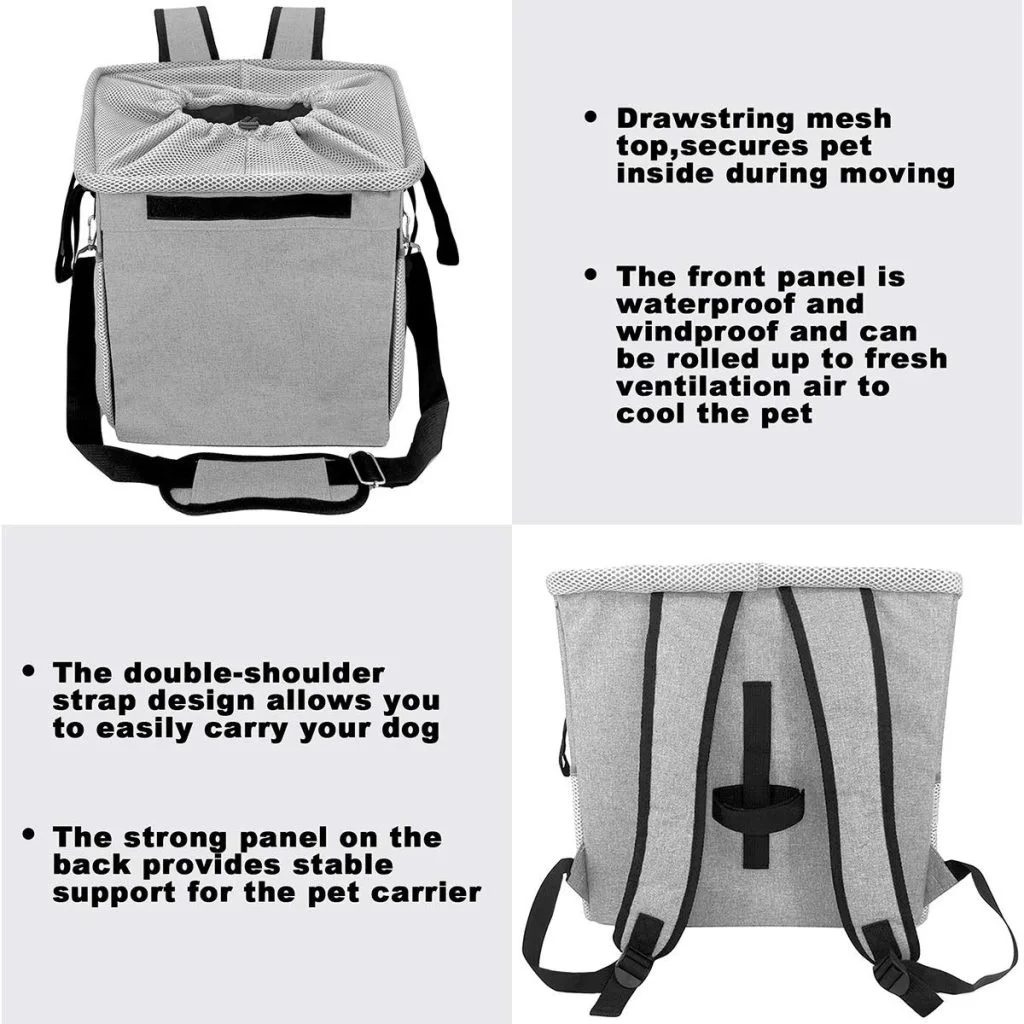
For a custom pet tote or backpack carrier, strap geometry is the first thing to fix - width, padding and load-lifter position decide how the bag carries.
Two Philosophies of Closure
Every closure on a pet carrier answers the same brief differently: hold reliably under load, release when asked, and survive years of outdoor exposure. Plastic answers it with elastic deformation — moulded features flex and spring back. Metal answers it with rigidity — shape does the work, and nothing needs to bend.
Those two approaches generate quite different failure signatures. Plastic degrades gradually: it loses gloss, becomes brittle under ultraviolet exposure, occasionally creeps under sustained load. Metal tends to be binary: it works until plating fails or a feature deforms, then it fails relatively suddenly.
Neither is superior in the abstract, and the better performing choice depends on what the component has to do. A side-release buckle opened daily benefits enormously from plastic's elastic design — nothing wears because nothing moves against friction in the same way a pivoting metal latch does. A decorative handle fitting benefits from metal's rigidity and permanence.
- Plastic strength: elastic design, low friction, corrosion-proof, light, quiet
- Metal strength: rigidity, permanence, ultraviolet stability, premium tactile and visual read
- Plastic weakness: ultraviolet embrittlement over years, creep under sustained load
- Metal weakness: weight, noise, corrosion if plating is compromised, higher cost
The most common mistake is treating this as a quality hierarchy where metal represents an upgrade. It does not. There are many applications where substituting metal for acetal would make the product objectively worse — heavier, noisier, slower to operate, potentially colder to touch on a winter morning.
Closure frequency makes the same case even more strongly. Components customers operate several times daily favour materials that do not wear at their contact surfaces, and polymer's self-lubricating behaviour gives it a genuinely longer functional life in exactly those positions, whatever either material costs.
The second most common mistake is the reverse: plastic everywhere in the interest of cost, including visible hero fittings where customers expect substance. Buyers feel closures. Weight and cool contact are not quantifiable specifications, but they influence listing decisions more than most datasheets.
Begin with function and let appearance arbitrate only where function is indifferent. That single rule resolves most of these decisions in about thirty seconds.
Acetal: What Engineering Plastic Actually Delivers
The acetal used in quality buckles is polyoxymethylene, often known by the trade name POM or polyacetal. It is not the same family as the polypropylene or nylon used in cheap fittings, and specifying acetal explicitly is the difference between a component that lasts a decade and one that does not.
Its defining properties are high stiffness, low friction, excellent dimensional stability and good fatigue resistance. Low friction matters because release mechanisms must slide against each other thousands of times without generating wear debris or becoming stiff. Dimensional stability matters because a buckle that swells with humidity changes its release force.
Manufacturing is by injection moulding, which permits complex geometries impossible in metal: integrated spring arms, captive pivots, contoured backs that sit comfortably against the body. Tooling is expensive but exceptionally durable, and cycle times are short, so unit cost falls steeply with volume.
Nylon buckles sit below acetal in price and performance — they absorb more moisture, change dimension more with humidity, and generally feel less precise. Some applications do not care, but where release force consistency matters, acetal is worth the modest premium.
Recycled content options are increasingly available in moulded components and worth considering where a programme carries sustainability commitments. Confirm availability early, since recycled resins sometimes differ slightly in stiffness and colour, which affects both release feel and matching.
- POM / acetal: precise, stable, low friction — the quality standard for buckles
- Nylon: cheaper, absorbs moisture, less consistent release force
- Polypropylene: economy grade; noticeably less fatigue resistance
- Glass-filled variants: increased stiffness, used where creep must be minimised
Specify the polymer by name rather than accepting generic engineering plastic. It costs nothing to state and prevents the quiet substitution that erodes performance by season three.
Wherever possible, single-source each critical component. Two suppliers producing nominally identical parts will differ in tool wear behaviour and resin lots, and running them side by side makes year-over-year comparison considerably harder than it needs to be.
One further specification habit pays off: state the expected service temperature range. Polymers are far more temperature-sensitive than metals, and knowing whether a product will live in a Canadian vehicle or a Singapore hallway changes which grade is appropriate.
Metal Buckles: Where the Premium Buys Something Real
Metal earns its place in specific circumstances, and knowing which ones prevents both overspending and misplaced economy. Rigidity is the first: where a closure must not flex under load at all, metal delivers something polymers cannot match without significant bulk.
Ultraviolet stability is the second. A metal fitting left outdoors for a decade loses maybe some gloss; a polymer fitting in the same conditions becomes measurably more brittle. Products marketed around hiking, beaches or extended outdoor life genuinely benefit.
Abrasion resistance is third. Webbing sliding across a metal bar during daily adjustment wears the webbing rather than the metal; with plastic, both wear and eventually the moulded edge rounds off. Where adjustment is frequent and precise — harness-style applications particularly — metal adjunct hardware reduces a wear point.
Then there is perception, which is not trivial. Weight, temperature and sound communicate quality in ways customers register without vocabulary. A metal fitting on a hero SKU influences the hand-feel assessment that happens in the first ten seconds of evaluation.
The genuine costs are worth listing honestly: substantially higher unit cost, several times the weight, audible contact noise against the shell and zippers, cold contact temperature in winter climates, and a plating requirement if base corrosion is to be avoided.
Alloy choice then matters. Zinc alloy die castings give fine detail and reasonable weight; aluminium gives light weight with good corrosion behaviour; steel gives maximum strength at maximum weight. Most quality programme hardware uses zinc alloy, which balances those properties well.
Where corrosion risk is real — coastal distribution, humid storage, products owners hose down — stainless steel deserves consideration despite its cost and weight. It removes the plating dependency entirely, and unlike plated alternatives, scratches do not initiate progressive failure.
Durability Compared: UV, Temperature, Creep and Impact
Ultraviolet exposure is plastic's principal ageing mechanism. Radiation breaks polymer chains at the surface, producing chalking, colour shift and eventually micro-cracking. This is measurable and predictable, and it is why serious outdoor programmes specify ultraviolet-stabilised grades with additional stabiliser packages.
Practically, expect several years of acceptable appearance from a quality stabilised acetal fitting in temperate conditions, and noticeably less in high-insolation climates without appropriate stabiliser. Specifying it costs very little and extends useful life substantially — one of the best value additions available in the category.
Temperature cuts both ways. Cold makes polymers stiffer and somewhat more brittle, which matters most for impact: a buckle dropped onto concrete in freezing conditions can fracture where the same buckle at room temperature shrugs it off. Heat accelerates oxidation and, above roughly 100°C — far above normal service — properties change rapidly.
Creep is the least discussed and most relevant. Under sustained load, polymers deform slowly over time. A buckle holding tension continuously, year after year, gradually changes shape and may eventually release or distort. Metal does not creep meaningfully at these loads.
| Stressor | Acetal / POM | Zinc alloy | Aluminium |
|---|---|---|---|
| Ultraviolet ageing | Chalks and embrittles without stabiliser | Finish dulls; substrate unaffected | Surface oxidises cosmetically |
| Cold impact | More brittle below freezing | Stable | Stable |
| Sustained load creep | Deforms slowly; grade dependent | Negligible | Negligible |
| Corrosion | Immune | Requires plating | Forms protective oxide |
| Weight for equal function | 1.0 baseline | Around 5x | Around 2x |
| Release force stability | Excellent with acetal, fair with nylon | Excellent | Excellent |
| Cost index | 1.0 | 2.0-4.0 | 2.5-4.0 |
Where ultraviolet exposure dominates, specify stabilised acetal rather than switching wholesale to metal. It retains every other benefit and removes the principal weakness for a small incremental cost.
Accelerated ageing testing settles these questions reasonably quickly. Standard ultraviolet exposure cabinets compress several years of sunlight into weeks, and a short run comparing stabilised against unstabilised grades typically ends the discussion more convincingly than any datasheet.
Release Force and Load Behaviour: How to Specify
Release force is the load at which a closure disengages, and it sits at the centre of a genuine design tension. Too high and customers struggle to operate it, particularly one-handed or with cold fingers. Too low and an animal leaning against it could release it unintentionally.
Reasonable targets for side-release buckles in this category fall around 45-90 newtons, with hand strength comfortably above that for most adults and well clear of incidental load during ordinary transport. Adjust slightly upward for designs aimed at larger animals, and downward where accessibility is a stated priority.
Specify a range rather than a single number, because manufacturing variation exists and a tolerance band is enforceable in a way that a target is not. Testing simply involves pulling the assembled product until the closure releases and recording the result across several samples.
- Test the assembled product, not the isolated buckle — webbing geometry affects release behaviour substantially
- Test after ultraviolet ageing rather than only when new
- Test at temperature extremes your distribution actually experiences
- Record across at least five samples; variation tells you more than the average
Webbing interaction deserves attention here because it is frequently overlooked. A buckle that releases beautifully with one webbing specification behaves differently with a thicker or stiffer webbing, so changing straps means re-verifying closures rather than assuming compatibility.
Finally, consider accidental release geometry. Closures with a low profile and recessed release buttons resist snagging on furniture and vehicle seats far better than prominent ones, and this is often the difference between a rare incident and a recurring complaint.
Dual-release mechanisms, requiring two simultaneous actions, address this convincingly where animals are large enough to apply sustained pressure. They cost marginally more and take slightly longer to operate, which is why most programmes reserve them for heavy-duty SKUs.
Verification is straightforward. Standardised test procedures covering many of these mechanical assessments are maintained by organisations such as ASTM International, and referencing a method rather than an outcome makes results comparable across suppliers.
Record those results and keep them attached to the purchase order rather than to a project folder nobody revisits. When a future lot behaves differently, the original numbers are what make the conversation about evidence rather than interpretation.
Colour Matching Plastic to Fabric: Easier, but Not Easy
Moulded components offer an advantage fabric lacks: colour is compounded into the material, so there is no dye lot variation in the conventional sense. Masterbatch formulation is repeatable within a tight tolerance, and a retained reference chip remains valid for the life of the programme.
That said, matching across materials remains imperfect. Plastic has surface gloss where fabric scatters light, so a perfectly matched plastic reads slightly darker or richer than the adjacent textile. The difference is small and usually attractive, but it should be evaluated rather than assumed.
Metallic finishes on plastic present the hardest challenge. Metal-flake masterbatches and vacuum metallised coatings both approximate metal at lower cost; both look convincing in photography and less convincing in the hand, because weight gives metal away immediately. Use them thoughtfully.
Two-tone moulding — a rigid body with a softer elastomer overmoulded at contact points — permits both functional and chromatic sophistication in one part. It costs additional tooling and is often reserved for premium programmes, where it reads distinctly.
Economics favour this route more than its reputation suggests. Because colour is inherent to the material rather than applied, there is nothing to abrade away, so a coloured moulded component maintains its appearance considerably longer than a coated metal one in the same position.
Beware one specific trap: requesting a colour match to a metal finish rather than to a textile reference. Metal finishes vary enormously in perceived tone across lighting conditions, and chasing them usually produces a plastic component that looks correct in one environment and wrong in every other.
Retain physical chips alongside all other reference materials, since colour can be reproduced reliably for years from the same masterbatch. Approve under daylight rather than showroom lighting and note that gloss level differences between materials are normal rather than defective.
Sensory Differences: Noise, Touch and Temperature
Customers do not analyse these properties; they experience them constantly. Metal conducts heat away from skin quickly, so it feels cold on contact — pleasant in summer, unpleasant in winter. Plastic feels neutral immediately, which is why it appears across most strap contact points regardless of tier.
Noise is the more consequential difference. Metal fittings contact each other, the zipper puller and surrounding surfaces during transport, producing a jingling that owners find annoying and stores find distracting. Products carried close to the body amplify this noticeably.
Plastic is nearly silent. Where silence is a design value — and for anything carried against clothing it should be — this is a decisive functional advantage rather than a side effect of cost reduction.
Operation sound also differs. A well-made acetal buckle produces a confident click on engagement, which is reassuring feedback. Metal latches either produce a heavier clunk or nothing at all, and the absence of feedback leaves owners uncertain whether closure completed.
Consider what this means for your brand's sensory signature. Some premium programmes deliberately include one metal fitting precisely because its sound communicates substance; most others systematically avoid it for the opposite reason.
Test senses rather than reasoning about them. Walk a prototype across a hard floor, shake it lightly beside your ear, and handle it with cold hands. Disciplines like this take minutes and consistently produce conclusions that no amount of discussion in a meeting room reaches.
There is one further sense worth including: smell. Polymers occasionally carry a faint odour when new, particularly if packaged hot and sealed immediately, while metal presents none. Where unboxing is a central part of the brand experience, this is worth evaluating alongside everything else in this section.
Cost, Weight and a Practical Placement Strategy
Acetals win on cost by roughly two to four times per unit, depending on the metal alternative and finish, and win on weight by an even larger margin. Across a product with eight or ten fittings, those differences accumulate into both unit cost and shipping weight bands.
Yet blanket economising is rarely right. A considered allocation spends where customers notice and saves where they do not, delivering better perceived quality for less total cost than either uniform choice.
- Acetal throughout: strap adjusters, side-release buckles, hidden internal closures, anything contacting the body
- Metal at hero points: the top-handle fitting, front logo plate, visible latch on the flagship SKU
- Metal where tension is sustained: applications holding continuous load where creep is a genuine concern
- Stabilised acetal outdoors: anything with an outdoor narrative, avoiding both metal weight and ultraviolet weakness
The most effective pattern we see uses one metal family consistently: the same alloy, the same finish, appearing at two or three deliberate points. That reads as designed restraint, and it costs a fraction of fitting metal everywhere.
Finally, plan standardisation across the range. Fewer distinct mouldings means better purchasing leverage, faster line training and more consistent product. Most successful catalogues use two or three buckle sizes across everything they sell.
Weight also intersects with online selling in a way that becomes visible quickly. Parcel shipping uses breakpoints, and closures — positioned at strap ends where they add nothing to perceived dimensions — are among the easiest places to remove grams without any customer noticing the difference.
Specification Checklist and Verification Discipline
Most closure failures trace to specifications that omitted something rather than selected wrongly. A complete closure specification needs surprisingly few lines, and each corresponds to a failure we have watched happen.
- Polymer by name, with ultraviolet stabiliser stated where relevant
- Release force range in newtons, tested on the assembled product with the actual webbing
- Expected service temperature range, particularly if either extreme is realistic
- Colour reference with retained physical chip and gloss expectation
- For metal: alloy, plating sequence, topcoat and salt spray hours with method
- Sample size and test frequency agreed before production rather than negotiated after
Verify then, rather than trusting. Test release force across five units, test again after ultraviolet exposure, and test at both temperature extremes. Batch variation reveals itself through spread rather than through averages, so recording five results means considerably more than recording one.
Where documentation matters to a buyer or retail compliance team, ask for it early. Independent confirmation of mechanical and material performance can be arranged through accredited laboratories operating within frameworks such as those published by the International Organization for Standardization, and arranged during sampling it costs far less than assembled under deadline.
Reread the whole allocation once it is written down, because printed together the decisions usually reveal one inconsistency — a metal fitting where comfort matters, or a polymer one next to metal with no reason behind either. That review takes five minutes and consistently improves the result.
Close with the commercial calendar. Samples arrive in 6-10 working days, bulk follows approval in 35-50 days, and goods clear AQL 2.5 inspection before release, with closure-specific checks for operation, appearance, colour against retained references and absence of flashing or sharp edges.
Review every year, regardless. Tooling wears, resin lots change, and the only reliable defence against gradual drift is a physical standard kept from day one.
Order and quality terms
- MOQ 500 pieces per colourway; samples in 6-10 working days
- Bulk production 35-50 days after approval; AQL 2.5 inspection standard
- T/T 30/70 terms, FOB Xiamen, full document set per shipment
People Also Ask
Are plastic buckles durable enough for pet carriers?
Yes, when specified in acetal rather than economy polymers. Acetal offers excellent dimensional stability, low friction and good fatigue resistance, and it cannot corrode. Immunise it against ultraviolet exposure with a stabilised grade and it suits outdoor positioning comfortably.
Is metal hardware always an upgrade?
No. Metal adds weight, noise and cold contact, and can promote webbing wear at adjustment points. It earns its place at visible hero fittings and where sustained load makes polymer creep relevant, but substituting it everywhere usually worsens the product.
What release force should I specify?
Around 45-90 newtons suits most companions, higher for larger animals and lower where accessibility leads. Specify a range rather than a single figure, and test the assembled product with the actual webbing rather than the isolated buckle.
Does plastic go brittle in sunlight?
Unstabilised polymers do, chalking and eventually micro-cracking after prolonged exposure. Specifying an ultraviolet-stabilised grade costs very little and removes the principal weakness, making wholesale substitution of metal unnecessary.
Can plastic components be colour matched to fabric?
Reasonably well, since masterbatch colour is compounded into the material and repeats tightly. Expect a slight difference in perceived depth because plastic holds gloss where fabric scatters light, and evaluate that difference rather than assuming it away.
Which is quieter when the product is carried?
Plastic, decisively. Metal contacts other metal and produces a jingle that owners find irritating and that worsens when a product is carried against the body. This is a functional advantage rather than merely a cost consequence.
Frequently Asked Questions
What is the minimum order quantity?
MOQ is 500 units per colourway for moulded closures in stock tooling and for standard metal fittings. Custom-moulded colours may carry a masterbatch minimum, which we confirm at quotation rather than after scheduling.
How long does closure sampling take?
Pre-production samples take 6-10 working days with stock components. Custom moulding renders first approval parts in roughly three to five weeks including tooling, after which repeat runs require no additional lead time.
What is the bulk production lead time?
Bulk production runs 35-50 days following sample approval and deposit. Custom colours or newly cut moulding tools occasionally extend earliest runs, which we build into scheduling rather than discovering mid-programme.
How are closures inspected before shipment?
Final random inspection follows AQL 2.5 for major defects. Closure-specific checks cover smooth release and engagement, absence of flashing or sharp edges, colour against the retained reference, and functional operation through the full range.
Can you supply ultraviolet-stabilised grades?
Yes, and we recommend them for any programme with outdoor positioning or high-insolation distribution. The additional cost is modest and it addresses plastic's single principal ageing mechanism directly.
Does online selling change this decision?
It does slightly, because returns are more expensive in direct channels and damage in transit is more likely. Foldable resilience and low weight count for more, which tends to favour acetal for the majority of closure points.
Can I get my logo moulded into a buckle?
Yes, either moulded in relief or recessed, depending on the effect wanted. Tooling is charged once and held for your programme, and logos moulded rather than printed survive indefinitely because there is nothing applied to wear off.
Are metal fittings a safety concern in cold climates?
They become cold to touch, which is a comfort rather than safety issue, and they transfer more heat during outdoor winter use. Most of the contact points that matter already use polymer for exactly this reason.
What causes a buckle to release unexpectedly?
Usually accidental pressure on a prominent release button from furniture or a vehicle seat, or gradual creep reducing effective engagement. Low-profile recessed designs substantially reduce the first cause; specifying adequate section reduces the second.
Can closures be nickel-free or hypoallergenic where relevant?
Moulded polymers raise no such concerns at all. For metal components, nickel-free plating systems are available and appropriate where European market access involves skin contact considerations.
Do you test with third-party laboratories?
Yes. Mechanical testing including release force and ultraviolet ageing assessment can be arranged through independent laboratories, and additional verification through SGS is available where a retailer requires it.
Is nylon webbing compatible with acetal buckles?
Yes, and it is the standard combination. Where specifications change to a thicker or stiffer webbing, re-verify release force, since buckle behaviour is measurably affected by strap geometry rather than just by strap strength.
Should I standardise across my collection?
Almost always yes. Using two or three closure sizes across an entire range improves purchasing leverage, speeds line training and produces a noticeably more coherent collection when everything is photographed together.
What if a component becomes unavailable?
We identify an equivalent specification and submit it for physical approval before it enters production. Retaining reference samples and test reports from each approved lot is what makes that substitution quick rather than a fresh development cycle.
Talk to QUANZHOU JUNYUAN BAGS about a pet carrier program: MOQ 500 pieces per colourway, samples in 6-10 working days, bulk production in 35-50 days under AQL 2.5 inspection.
Get a free quote Request a sample