Custom Treat Bag: Training Accessory
A custom treat bag program runs at MOQ 500 units per colourway, with a sewn sample in 6-10 working days. The build that trainers actually keep using is a 1.2-1.8 litre pouch with a stiffened, stay-open mouth, a wipeable food-safe liner, and a closure that opens and closes with one hand while the other holds a leash. Bulk production takes 35-50 days after sample approval.
Executive summary. A treat bag is judged in the first ten minutes of a training session and abandoned just as quickly if it fails, which makes it one of the few accessories where ergonomics outrank appearance. Our production team specifies it around three constraints: one-hand access, a liner that survives grease and moisture, and hardware that matches the rest of the range. Terms are MOQ 500 per colourway, samples 6-10 working days, bulk 35-50 days, release at AQL 2.5.
The brand opportunity sits in the hardware and the colourway rather than in a large logo panel. A treat bag is worn on the body, seen at close range, and photographed constantly, so a metal clip finished in the brand's hardware tone and a shell in an existing Pantone-matched colourway do more recognition work than a printed wordmark. Decoration is then chosen for durability against grease and friction, not for the size of the mark.
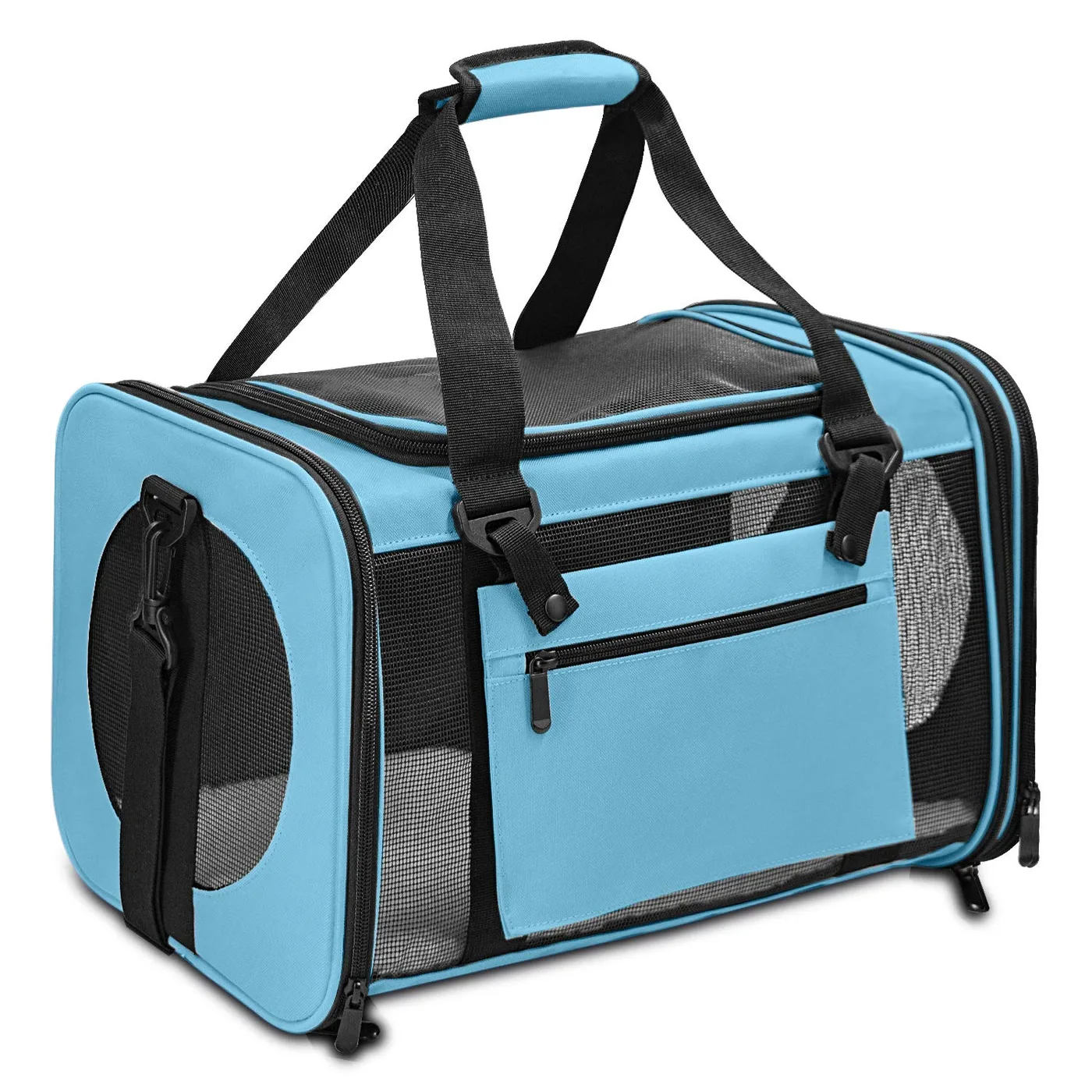
Custom dog carrier programmes usually run three size platforms at MOQ 500 pieces per colourway, with sizes mixed inside one style to reach the threshold.
Designing for the training loop rather than for the walk
A treat bag is not a small bag. It is a piece of equipment used in a repetitive loop — reward, mark, reset, reward — that may run forty times in a fifteen-minute session. Anything that slows that loop gets abandoned, and the product ends up in a drawer regardless of how it looked on the shelf.
The loop has three physical steps: open, reach, close. Opening must be possible with the same hand that is holding the pouch rim, reaching must not require looking, and closing must be automatic enough that the handler's attention stays on the animal. A magnetic closure satisfies all three; a drawstring satisfies none of them; a stiffened rim plus a magnetic bridge satisfies all three and adds structure that keeps the pouch open when it is set down.
Volume follows from the loop rather than from the treat. A 1.2 litre pouch holds a training session's worth of small rewards without becoming a heavy pendulum on the hip; 1.8 litres suits a longer class or a walk with two dogs. Anything larger changes the way the pouch sits and swings, and the swing is what makes handlers take it off.
Designing for the loop also means designing for the hand that is not free. Everything a handler needs during a session — treat access, a poop bag slot, a clip for the clicker or keys — must be reachable without releasing the leash. Map those reach zones before drawing the pattern, and the panel layout will follow.
Ergonomics: belt, clip, and how the pouch sits
Carry method decides comfort. A belt loop with a wide webbing pass-through is the most stable and the most adjustable, and it suits a class or a long session. A swivel clip is the fastest to attach and detach and suits a handler moving between dogs or between pockets. A waist strap with a buckle is the most secure for running or hiking and the slowest to remove.
Ride height matters more than most briefs acknowledge. A pouch that sits too low bounces against the thigh; one that sits too high interferes with the arm. The workable default is a pouch whose top edge sits roughly at the iliac crest, which keeps the mouth at a natural hand height and puts the weight on the hip rather than on the soft tissue below it.
Back panel construction finishes the job. A flat webbing strap on a loaded pouch rolls and digs; a contoured, lightly padded back panel with a breathable mesh face distributes the load and stops the pouch from rotating. Specify a non-slip face on the panel as well, because a pouch that slides around a hip during a session is a pouch that gets taken off.
The final ergonomic variable is swing. A pouch hanging from a clip behaves as a pendulum, and anything above roughly 700 grams filled begins to swing noticeably when the handler walks. Either keep the loaded weight below that figure or add a stabilising strap, because a swinging pouch distracts the handler and, on a training session, distracts the animal as well.
The two-handed test
Before approving a sample, run one test: hold a leash in your left hand and complete twenty reward cycles without shifting the pouch or looking at it. Any hesitation is a design defect, and it will be found by the customer in the first session rather than by you on the bench.
Belt versus clip in practice
The carry method is decided by how the handler moves, not by which option looks better on a specification sheet. A handler running a class stands still, bends, and reaches repeatedly; a belt pass-through keeps the pouch in exactly the same place through all of it, and that consistency is what makes the reward loop fast. A handler walking a dog puts the pouch on and takes it off several times; a swivel clip wins that contest by a wide margin.
Offering both is the better answer and it costs very little. A wide webbing pass-through with a removable clip gives one product that serves both handlers, and it removes the need to forecast two SKUs. The clip should be specified on a webbing tab rather than directly on the body, so that the load path runs through the webbing and the stitching rather than through the face fabric.
Whichever is used, test the attachment under load. Clip the pouch on loaded, then walk, bend, and sit for ten minutes. A pouch that rotates, slides, or needs repositioning more than once in that period will be repositioned constantly in the field, and constant repositioning is the behaviour that ends with the pouch being left at home.
Fabric and cleanability in a pouch that meets food
A treat bag meets grease, moisture, and crumbs every single time it is used, and it is washed far less often than it should be. The shell therefore needs to be wipeable and the liner needs to be genuinely cleanable, not merely coated.
A coated polyester or TPU-laminated shell wipes clean and holds its shape, which is what keeps the mouth open. A nylon shell is lighter and softer but absorbs oil over time and begins to smell, which is a product-ending failure in this category. A recycled shell is increasingly expected by retailers and performs the same as virgin material if the coating is specified properly.
The liner is the part that needs the most attention. A wipeable, food-safe liner with sealed rather than stitched seams is the difference between a pouch that can be turned out and wiped in ten seconds and one that accumulates residue in the seam allowance. Test the liner against grease for at least 48 hours before approval, because residue absorbed into a seam cannot be removed and will be noticed.
Seam and liner construction
The seam is where a treat bag fails. A liner with stitched seams collects grease in the needle holes and in the turned allowance, and no amount of wiping removes it; within a month the pouch smells, and the customer replaces the product without ever identifying the cause. A liner with welded or sealed seams wipes clean in seconds because there is nowhere for residue to go.
Specify the seam type on the drawing rather than leaving it to the sample. Radio-frequency or heat welding works on coated fabrics and TPU laminates; it does not work on every shell, so the liner material has to be chosen with the welding method in mind rather than after it. If welding is not available for the chosen laminate, a bound seam is the next best answer, because it covers the raw edge completely.
The mouth is the second construction detail worth specifying precisely. A raw turned edge at the rim absorbs whatever the treats leave behind, while a bound or turned-and-topstitched edge can be wiped. On a product handled dozens of times a day, the difference between a bound and a raw rim is the difference between a pouch that lasts a season and one that lasts for years.
Hardware as a brand signature
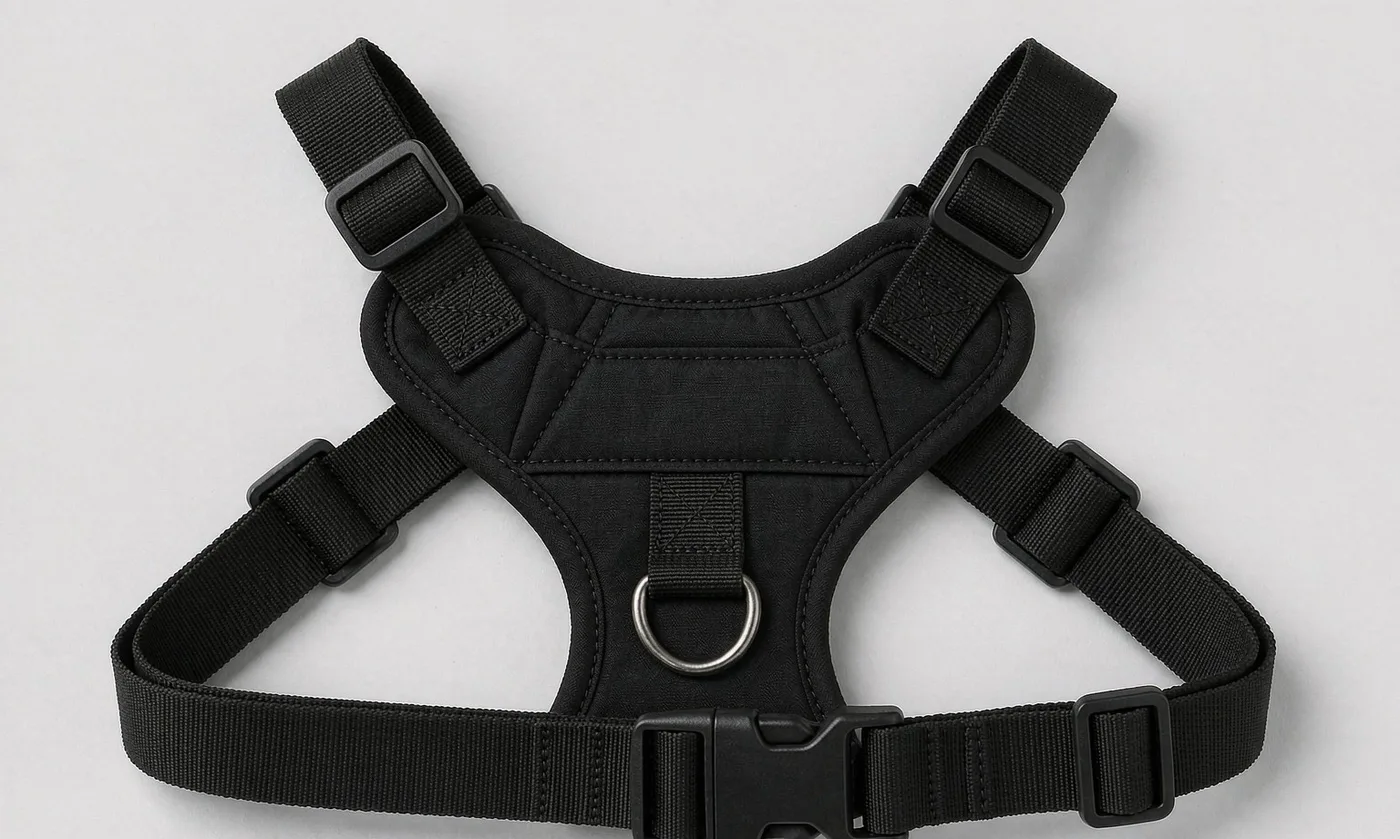
Hardware is the most under-exploited branding surface on any soft good, and on a treat bag it is the surface the customer touches most. A swivel clip, a D-ring, a magnetic closure, and an eyelet can all be specified in a consistent finish — matte black, gunmetal, brushed gold, or antique brass — and that consistency reads as a brand even before the wordmark is seen.
Choose the hardware tone once and hold it across the range: carrier, treat bag, collar, leash, and keychain. A brand with one hardware tone looks like a system; a brand with three looks like a catalogue. The cost of consistency is negligible at 500 units and the visual return is disproportionate.
Magnetic closures deserve a specific note. Specify the pull force in newtons rather than by feel, because a magnet that is too weak lets the pouch fall open when the handler bends, and one that is too strong makes one-hand opening impossible. Test with a loaded pouch on a moving body, which is the only condition that matters.
Logo craft on a pouch that gets greasy
Decoration on a treat bag is selected against grease and abrasion rather than against looks. Embroidery gives the most premium hand and survives washing, but it absorbs oil and darkens over time on a pouch used daily for fatty treats. A woven label is the most durable and the quietest, and it resists both oil and friction. A TPU or rubber patch gives the boldest mark and wipes completely clean. Screen printing is the most flexible for artwork and the most vulnerable to cracking at a flex point.
Placement should avoid the flex zones. A pouch that opens and closes hundreds of times a week develops creases at the mouth and at the belt attachment, and any decoration crossing those lines will fail first. Put the mark on the flat front panel below the mouth line, where the fabric barely moves.
Size should be modest. A treat bag is worn on the body, photographed at close range, and seen by the handler dozens of times a session; a large mark reads as promotional. A 45-60 mm mark on a pouch of this scale is enough, and it reads as considered rather than shouted.
Noise, rustle, and the training signal
A treat bag makes a sound every time it is opened, and that sound becomes part of the training signal whether the brand intends it or not. Dogs learn the rustle of a crinkly liner within a few sessions and begin anticipating the reward before the hand moves, which sounds like an advantage and is usually a problem: the animal starts responding to the packaging rather than to the handler.
The design answer is to reduce accidental noise. A soft liner rather than a crinkly one, a magnetic closure rather than a hook-and-loop one, and no loose hardware that clinks against the clip all reduce the cues the animal did not need. Hook-and-loop in particular should be avoided on a training pouch, because the tear sound is loud, unavoidable, and impossible to unlearn.
What remains should be deliberate. A single consistent click from the magnet closing is fine, because it marks the end of the reward rather than announcing it. Design for one intentional sound and remove the rest, and the handler keeps control of the timing, which is the thing that actually makes training work.
Treat bag specification matrix
| Spec line | Everyday trainer | Class and long session | Light walk |
|---|---|---|---|
| Volume | 1.2 litres | 1.8 litres | 0.8 litres |
| Mouth | Stiffened rim, magnetic bridge | Stiffened rim, wide opening | Elasticated rim |
| Carry | Swivel clip on webbing loop | Wide belt pass-through | Swivel clip only |
| Shell | Coated polyester, wipeable | Recycled coated polyester | Nylon ripstop |
| Liner | Food-safe wipeable, sealed seams | Food-safe wipeable, removable | Wipeable coating only |
| Mark | Woven label, 50 mm | TPU patch, 55 mm | Woven label, 45 mm |
| Hardware tone | Matte black | Gunmetal | Brushed nickel |
| Inspection focus | Magnet pull force | Belt pass-through strength | Clip swivel and gate |
The three columns are a price ladder and a usage ladder at the same time, and they share one pattern family, one hardware tone, and one logo placement. That sharing is what lets a brand run all three without the range looking like three separate suppliers made it.
Photographing a pouch that is worn
A treat bag is bought online more often than in person, and the images decide the sale. Three shots are needed and most brands shoot only one. The first is worn on a body at waist height, which establishes scale and ride position. The second is open, showing the mouth and the interior, which is the only way to prove the one-hand claim. The third is a hand reaching in, which shows the aperture at working size.
Shoot the worn image on a real waist rather than on a flat lay with a strap hanging. A flat lay cannot show ride height, and ride height is the single most common reason a pouch is returned as uncomfortable. Show the pouch from the side as well as the front, because the side view is what reveals how far it stands off the body.
Keep the model's clothing neutral and the background uncluttered, because the customer is reading a black shape against a mid-tone. Colour accuracy matters more here than in any other product shot in the range, since the whole proposition is that the pouch matches something she already owns.
Colour system and the matching-set logic
Colour is where a treat bag earns its place in a wider range. A pouch in a carrier's exact colourway, with the same hardware tone, is a matching set — and matching sets are bought together at a materially higher rate than standalone accessories. The mechanism is simple: a customer who has already committed to a colour wants the system to be complete.
Hold the shell colour to the same reference as the carrier fabric with a written delta-E tolerance, normally 2.0 for hero colours. Textile colour is measured differently from ink and resin, so specify a fabric standard retained by both sides rather than a printed chip. You can anchor the reference to the system published by Pantone, and you should verify each dye lot against the retained standard rather than against the previous lot.
Two further checks belong in the specification. Colour fastness to rubbing and to washing should be tested to methods published by AATCC, because a pouch worn against dark clothing that crocks is a return rather than a complaint. And because the liner and shell sit against an animal's nose and mouth repeatedly, a textile safety certification from OEKO-TEX is a credible answer to the question a reviewer will eventually ask.
Dye-lot control and the retained standard
Textile colour drifts more than any other substrate in a pet range, because a dye lot depends on the water, the temperature, the dye concentration, and the fabric batch that went into it. Two lots that are both commercially acceptable can sit noticeably differently when the pouch is clipped next to a carrier in the same colourway, and the customer sees both objects together every day.
The control is a retained fabric standard, cut from the approved sample, held by both sides, and compared under a stated light source at each reorder. Measure it rather than eyeballing it: a delta-E figure recorded each run builds a trend, and the trend tells you when a mill's process is moving before the number crosses tolerance.
Where a matching set is the selling proposition, go one step further and require a shadow-board approval: the pouch fabric and the carrier fabric laid side by side and signed off together at each production run. It takes five minutes, it prevents the single most damaging failure a matching set can have, and it costs nothing but discipline.
Packaging and merchandising next to the carrier
A treat bag merchandises best attached to something. Clipped to a carrier strap on a fixture, it is seen in context, its scale reads correctly, and it becomes an add-on rather than a separate decision. Supply a short webbing loop or a clip card that lets a retail partner attach it in seconds, and the attach rate goes up without any staff involvement.
For online channels, the pack should carry a scale reference. A pouch photographed alone gives no sense of volume, and a customer who guesses wrong returns it. A printed belly band with a hand in the photograph, plus a stated litre capacity on the front, is the cheapest way to set expectations correctly.
Shipper planning is straightforward here because the pouch nests flat. Use that: a flat-packed pouch with a folded card ships at a fraction of the cost of a boxed one, and if the brand is direct-to-consumer the saving is better spent on the hardware finish than on the carton.
Sampling, the AQL 2.5 gate, and launch cadence
Sampling a treat bag means sampling it loaded and worn. A sewn sample is produced in 6-10 working days, and the approval should be based on a session rather than a photograph: fill it, clip it on, and run the two-handed test described earlier. Approving on appearance alone is the most common cause of a second sampling round, which costs more time than the first.
Release is at AQL 2.5, general inspection level II, with defect classes agreed before the run. Critical defects are a failed closure magnet, a broken clip gate, and a liner that is not sealed. Major defects include a misplaced mark beyond 1.5 mm, hardware finish mismatch, delta-E outside tolerance, and a stiffener that distorts the mouth. Minor defects are loose threads and light shell marks.
Launch the pouch after the carrier, in the same colourway, with a bundled price. That sequencing does three things at once: it gives the accessory a context, it raises the average order value without discounting the hero product, and it creates the first matching-set moment in the range — which is the moment that pulls the next three accessories along behind it.
Production capability
- SGS-verified production space of 4,950 m², 149 machines, 7 assembly lines
- Pet carrier and pet bag output since 2014 from a 137-person team
- 200,000 units shipped monthly under BSCI and ISO 9001 systems
People Also Ask
Why do trainers abandon treat bags?
Because the pouch slows the reward loop. If opening needs two hands, if reaching requires looking, or if closing is fiddly, the handler stops using it within one session regardless of how it looked on the shelf.
What is the best treat bag closure?
A magnetic closure over a stiffened rim. It supports one-hand open and close, keeps the mouth open when set down, and needs no fine motor control.
Should a treat bag be worn on a belt or clipped?
Belt for a long class or a run, where stability matters; swivel clip for everyday use, where speed of attachment matters. Both should sit with the mouth near the iliac crest.
How do I keep a treat bag from smelling?
Specify sealed rather than stitched liner seams, use a wipeable coated shell rather than absorbent nylon, and test residue absorption before approval. Once oil is in a seam it cannot be removed.
What size logo works on a small pouch?
Around 45-60 mm on the flat front panel below the mouth line. Larger reads as promotional, and any decoration crossing a flex zone will fail first.
Does a matching set actually sell more?
Yes. A customer who has committed to a colourway wants the system complete, so a pouch in the carrier's exact colour with the same hardware tone converts as part of a set rather than as a separate decision.
Frequently Asked Questions
What is the MOQ for a custom treat bag?
MOQ 500 units per colourway, covering the pouch, hardware, decoration, and retail pack. A sewn sample is produced in 6-10 working days and bulk runs 35-50 days after approval.
What size should a training treat bag be?
1.2 litres for an everyday session, 1.8 litres for a class or a long outing with two dogs, and around 0.8 litres for a light walk. Above that the pouch begins to swing and gets taken off.
Which closure works best for one-hand use?
A stiffened rim with a magnetic bridge. It opens and closes with the same hand that holds the rim and stays open when set down; a drawstring fails every requirement in the reward loop.
Can the pouch liner be food-safe?
Yes. Specify a wipeable food-safe liner with sealed rather than stitched seams, and test it against grease for at least 48 hours before approving the sample.
Which logo method survives daily treat use?
A woven label or a TPU patch. Embroidery looks premium but absorbs oil and darkens over time on a pouch used with fatty treats, and screen print cracks at flex points.
Should the hardware match my carrier hardware?
Yes. Choose one hardware tone — matte black, gunmetal, brushed gold, or antique brass — and hold it across carrier, treat bag, collar, leash, and keychain. One tone reads as a system; three reads as a catalogue.
How is the magnet strength specified?
In newtons, not by feel. Too weak and the pouch falls open when the handler bends; too strong and one-hand opening becomes impossible. Test with a loaded pouch on a moving body.
Can the pouch match an existing carrier colour?
Yes. Hold the shell to the same reference as the carrier fabric at delta-E 2.0 for hero colours, verified against a retained fabric standard and checked per dye lot rather than lot-to-lot by eye.
What inspection standard applies?
AQL 2.5, general inspection level II. Critical defects are a failed magnet, a broken clip gate, and an unsealed liner; major defects cover mark placement, hardware mismatch, and colour outside tolerance.
How should the pouch be merchandised in a store?
Clipped to a carrier strap. It is then seen in context and at the right scale, and it converts as an add-on without staff involvement.
Does the pouch ship better flat or boxed?
Flat. It nests flat, so a flat pack with a folded card costs a fraction of a boxed one, and for direct-to-consumer the saving is better spent on the hardware finish.
What are the commercial terms?
T/T with a 30 percent deposit and a 70 percent balance before shipment, quoted FOB Xiamen.
Talk to QUANZHOU JUNYUAN BAGS about a pet carrier program: MOQ 500 pieces per colourway, samples in 6-10 working days, bulk production in 35-50 days under AQL 2.5 inspection.
Get a free quote Request a sample