Custom First Aid Kit: Emergency
A custom first aid kit program runs at MOQ 500 units per colourway, with a sewn and packed sample in 6-10 working days. The build that works is a structured pouch with elastic retention, a colour-coded interior, a reflective or high-visibility exterior mark, and a contents card that tells an untrained owner what to do in the first ninety seconds. Bulk production takes 35-50 days after sample approval.
Executive summary. A first aid kit is the one accessory where the bag is the product and the contents are the proof. Our production team treats the pouch as a piece of soft-goods engineering — panel layout, retention geometry, zip hardware, and a mark that can be found in a dark car boot — and the contents as a curated list with a documented reason for each item. Terms are MOQ 500 per colourway, samples 6-10 working days, bulk 35-50 days, release at AQL 2.5.
Two design decisions decide whether the kit is trusted. The first is interior legibility: elastic loops and a colour-coded layout that let a shaking hand find the right item without unpacking everything. The second is the insert card, which is the only part of a kit that is read in an emergency and therefore the only part that must be designed for stress rather than for sale. Everything else — fabric, print method, carton — follows from those two.
A custom dog carrier brief starts with the weight band, not the colour: strap width, base board thickness and mesh ratio all follow from how heavy the dog actually is.
The kit as a branded object rather than a commodity bundle
Most first aid kits on the market are a plastic box containing a generic assortment. That is a commodity, it competes on price, and it gives a brand nothing to own. The alternative is to treat the kit as a bag: a purpose-built soft-goods object whose layout, material, and hardware express the same design language as the carrier it sits beside, with a curated contents list that justifies the price.
The commercial case is strong. A kit is bought once, kept for years, and taken everywhere — car, hike, boarding kennel, holiday. That is an unusual amount of exposure for a branded object, and it is exposure at exactly the moments a pet owner is most attentive to her animal. A kit that performs once becomes an object she will not replace with a cheaper one.
That permanence is also why the kit should not be the cheapest item in the range. A customer who has relied on a product in a frightening moment does not want to be reminded that she economised on it, and a kit priced too low reads as a token rather than as equipment. Price it as the serious member of the family and let the wash products carry the value end of the shelf.
It is also the strongest cross-sell in the range. A kit belongs inside a carrier, inside a car seat cover, and inside a travel tote, and it is the item that makes a travel bundle feel complete rather than assembled. Merchandised next to a carrier, it lifts the basket without discounting the hero product.
The design risk is over-stuffing. A kit with thirty items looks thorough on a line sheet and becomes unusable in practice, because nobody can find anything. Fifteen well-chosen items in a legible layout outperform thirty in a pouch, and the brand that edits earns more trust than the brand that lists.
Pouch architecture: layout, retention, and one-hand access
Layout is the whole product. Design the pouch open, flat, and fully populated, before designing it closed. The standard architecture is a two-panel clamshell: one panel carrying elastic retention loops in descending widths, the other carrying a zip mesh pocket for flat items and a slip pocket for the card. When the pouch opens, everything should be visible at once without removing anything.
Retention geometry matters more than the number of loops. Loops should vary in width by item category — narrow for instruments, medium for bandage rolls, wide for a wrap or a bottle — and each loop should be sized so the item is held firmly but released with one hand. A loop that is too tight defeats the purpose in an emergency, and one that is too loose empties its contents every time the pouch is opened.
Closure choice follows use rather than fashion. A two-way zip allows the pouch to be opened from either end and laid flat, which is the fastest configuration under stress; a single zip with a wide pull is cheaper and adequate for a home kit. Webbing pull tabs should be long enough to be grabbed with wet or gloved hands, and the slider should carry a branded pull rather than a bare metal tab.

Planning for a shaking hand
Every specification decision should be tested against a single scenario: an owner at the roadside, in poor light, with an animal that will not hold still. Anything that needs two hands, fine motor control, or good light fails that test, and it should be redesigned rather than accepted.
Zip, pull, and slider specification
The zip is the most-used mechanical component in a kit and the one most often specified by habit. Three properties decide whether it works: gauge, pull, and slider type. A number 5 coil is the right default for a pouch of this size — lighter looks refined and jams when the pouch is over-packed, heavier looks utilitarian and refuses to turn the corner at the base.
The pull is where function and brand meet. A webbing pull long enough to be grabbed with a gloved hand is a functional requirement, and it is also the cheapest place to put a woven brand mark on the whole product. A moulded rubber pull with the mark integrated is the most durable and the most tactile, and it survives the pulling, snagging, and washing that a kit endures in a car.
Specify an auto-lock slider on any kit that will be carried in a bag, because a non-locking slider walks open under vibration and empties the pouch. Test it by filling the kit, closing it, and shaking it inverted twenty times; a slider that creeps open in that test will open on a hike, and the contents will be scattered across the bottom of someone's bag.
Material, colour coding, and emergency legibility
Colour does two jobs in a kit and they pull in opposite directions. On the outside, the kit should be visible: a high-visibility accent, a reflective piping or pull, and enough contrast to be found in a dark boot. On the inside, the kit should be calm and light-coloured, because a light interior makes small items visible and a dark interior swallows them.
The usual resolution is a dark or saturated exterior with a light liner, and that liner is the most under-designed surface in the category. A pale grey or warm sand interior makes a pair of tweezers findable in seconds; a black interior makes the same tweezers disappear. Specify the liner colour deliberately and require it on the sample, not on the line sheet.
Material selection follows from the environment. A coated polyester shell wipes clean and resists the fluids a kit will meet; a nylon ripstop saves weight for a hiking or travel kit; a recycled shell supports a sustainability claim that is increasingly a listing requirement. Whichever is chosen, the interior should be wipeable rather than absorbent, and the seams should be bound rather than raw.
Logo craft on the pouch: label, embroidery, patch, and reflectives
A pouch offers more decoration routes than any bottle in the range, and the choice should be made by what the mark has to survive. A woven label is the quietest and most durable option and reads as considered at close range; embroidery gives depth and a premium hand but adds stiffness to a panel that benefits from being soft; a rubber or TPU patch gives a bold, modern, high-contrast mark that survives abrasion; a metal badge gives the most expensive read and the most weight.
For a kit, the highest-value decoration is not the mark at all — it is the reflective element. A reflective print, piping, or zip pull turns the pouch into something findable in the dark, and it is a functional feature that a customer will notice and remember. Put the brand wordmark into the reflective element if the artwork allows, and the functional detail becomes the brand detail.
Placement should be tested on the packed pouch rather than the empty one. A mark centred on an empty panel often ends up distorted or half-hidden once the loops are filled and the pouch is under tension. Approve placement from a photograph of the fully packed sample, and require the same photograph at inspection.
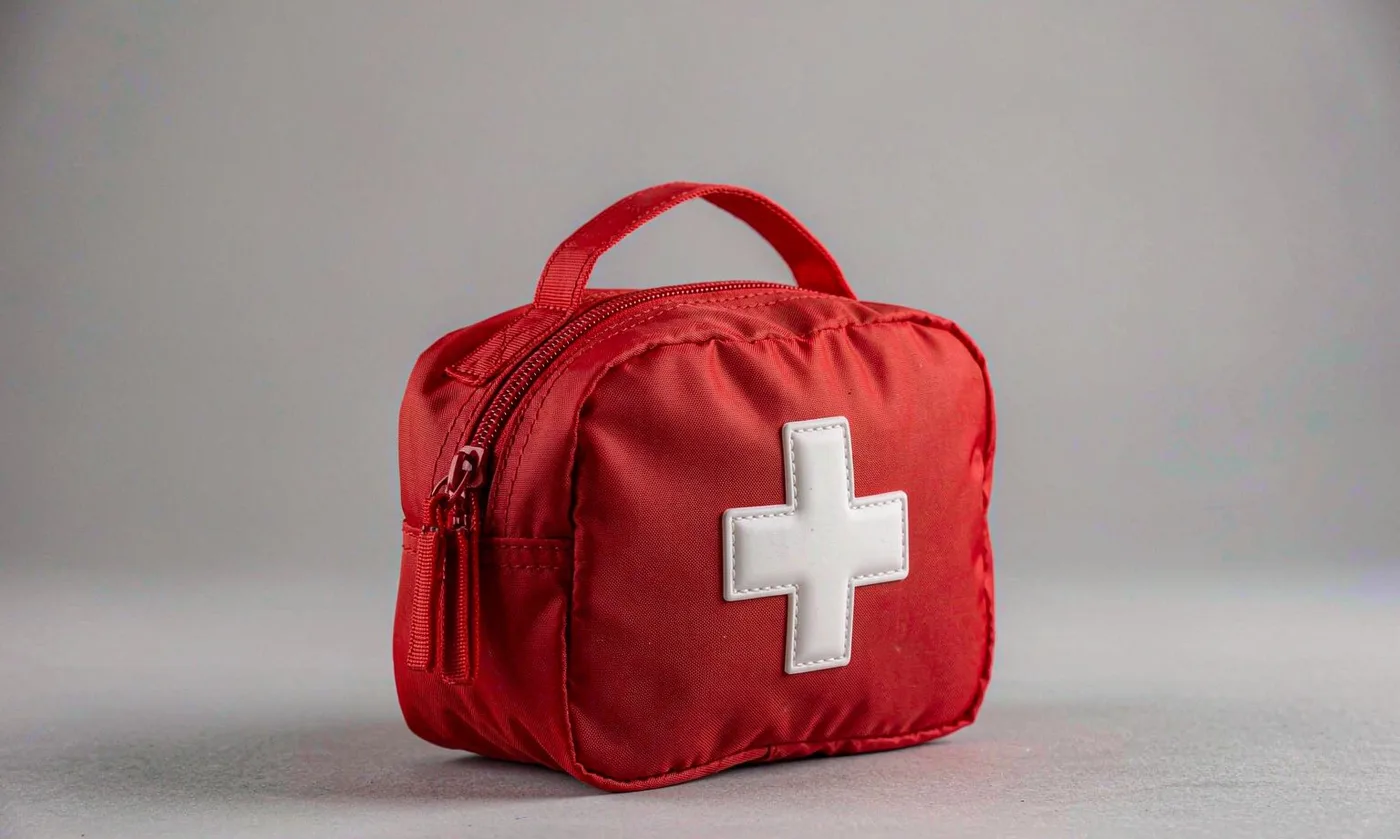
Panel count and pattern complexity
A kit pouch looks simple and is not. Every panel is a seam, every seam is an operation, and every operation is both a cost and a potential failure point. A four-panel build with a gusset is cheaper to sew, easier to inspect, and stronger at the corners than a six-panel build with decorative piecing, and on a product whose value is in the layout rather than in the shape, the simpler build is the better one.
Spend the complexity budget on the interior instead. A shaped elastic panel with graded loop widths is genuinely difficult to make and genuinely improves the product, while decorative exterior panelling improves nothing that a customer values in an emergency. That inversion — plain outside, engineered inside — is what separates a kit that works from a kit that photographs well.
Binding is worth specifying carefully because it is the most visible quality signal on a soft good. A bound internal seam looks finished, resists fraying, and wipes clean; a raw overlocked seam looks cheap and collects residue. On a product that will be inspected by a buyer who turns it inside out, the binding is the first thing she will check.
First aid kit specification matrix
| Spec line | Travel kit | Home kit | Hike and adventure kit |
|---|---|---|---|
| Pouch size | 200 x 130 x 70 mm | 260 x 180 x 90 mm | 180 x 120 x 60 mm |
| Shell | Coated polyester, wipe-clean | Coated polyester with structured base | Nylon ripstop, lightweight |
| Liner | Warm sand, high contrast | Pale grey | Pale grey with mesh pocket |
| Closure | Two-way zip, branded pull | Wide single zip, webbing pull | Two-way zip with glove-friendly pull |
| Retention | 8-10 mixed elastic loops | 12-14 loops plus two slip pockets | 6-8 loops, minimal weight |
| Exterior mark | Woven label plus reflective piping | Rubber patch | Reflective print wordmark |
| Card | Laminated tri-fold, 3 steps | Full A5 laminated card | Waterproof synthetic card |
| Target inspection | AQL 2.5 plus loop tension check | AQL 2.5 | AQL 2.5 plus weight check |
Note that the item count is deliberately lower in the hike kit. Weight is the constraint there, and a kit that is carried is more useful than a comprehensive one left in a cupboard. The same logic applies to every variant: design to the carrying condition, not to the maximum contents.
Expiry, rotation, and the service cycle
Any kit containing dated components has a service cycle, and a brand that acknowledges it earns more trust than one that ignores it. Establish the shortest expiry in the contents list, set the stated kit life against it, and print the date convention on the card so a customer can check her own kit without contacting anyone.
Then build the commercial opportunity. A dated kit is a kit that must be refreshed, and a refresh is a reorder with a reason attached. Sell a dated replacement pack for the perishable items rather than a whole new kit, price it at a fraction of the kit, and the product generates a second purchase on a schedule the brand controls.
Keep the pouch out of the cycle. If the pouch is built to last — bound seams, a good zip, a permanent mark — then the refresh is a small parcel rather than a replacement product, and the branded object stays on the shelf in the customer's car for years rather than being discarded with the contents.
Contents sourcing and the insert card
Contents should be curated by scenario rather than by category. A travel kit needs wound care, a wrap, tick removal, and a saline vial; a home kit adds a larger dressing and a thermometer; a hike kit reduces everything and adds a foil blanket. Write the list as a scenario, and the resulting kit will look considered instead of generic.
Every item needs a documented reason for being there. A reviewer at a retail account will ask why a particular inclusion is justified, and "it seemed useful" is not an answer that survives. A one-line rationale per item, kept in the technical file, turns the contents list from an assortment into a specification.
The insert card is the most important printed item in the program. Design it for a stressed reader: three steps, largest possible type, no more than twelve words per step, and a clearly separated "call a vet immediately" block. Laminate it or print it on synthetic stock, because paper in a kit that holds fluids will be unreadable the one time it is needed.
Choosing contents by scenario
The fastest way to build a credible contents list is to write the scenario first and let the list follow. A travel kit serves a journey: wound care, a self-adherent wrap, tick removal, a saline vial, and a card. A home kit serves an evening: a larger dressing, a thermometer, and a pair of scissors that can actually cut fur. A hike kit serves distance: a reduced set, a foil blanket, and a means of carrying water.
Each scenario implies a different failure, and the list should be built around that failure rather than around a generic first-aid template. A travel kit fails when something happens far from a vet, so it prioritises stabilisation and cleanliness. A home kit fails when a minor wound is managed badly for a day, so it prioritises dressing and observation. A hike kit fails when weight discourages carrying it, so it prioritises reduction.
Write the rationale into the technical file in one line per item. A reviewer will ask why each inclusion is justified, and a documented reason converts an assortment into a specification. It also makes future edits far easier, because a list with reasons can be revised deliberately rather than by accretion.
Compliance, documentation, and the AQL 2.5 release gate
A kit sits in an awkward regulatory space: it is a consumer product containing items that may individually be regulated. The practical approach is to document each component separately and to keep claims about outcomes out of the copy entirely. State what is in the kit and what it is for; do not state what it will achieve.
Quality systems matter here more than in most accessory programs because a kit is assembled from many components. Documented process control under ISO 9001 and independent verification through a body such as SGS give a retail reviewer something to check that is not a promise. For the United States, consumer product obligations sit with the U.S. Consumer Product Safety Commission, and any component with an expiry date needs a documented rotation convention.
Release is at AQL 2.5, general inspection level II, with defect classes agreed first. Critical defects are a missing or illegible card, a missing high-risk contents item, a zip that fails, and a needle or sharp item loose in the pouch. Major defects cover loop tension outside range, a misplaced mark, a stained liner, and a count error against the contents list. Minor defects are loose threads and light shell marks.
Packaging, shipper, and channel fit
A kit ships well, which is unusual for a soft good, and that opens channels a bag cannot reach. It is a subscription item, a gift-with-purchase, a corporate or shelter-donation item, and an impulse counter item, and each needs a slightly different pack.
For retail, a printed belly band over the pouch with the contents list on the reverse is the cheapest and most informative option; it leaves the pouch visible and answers the buyer's question on the shelf. For gifting, a rigid carton with the pouch nested inside lifts the perceived value substantially at a modest unit cost. For subscription or donation channels, a plain shipper with a single insert is right, because the presentation budget belongs in the pouch itself.
Whichever pack is used, state the contents on the outside. A kit is the one product where the customer's first question is not "is it nice" but "what is in it", and answering that on the pack removes the single biggest barrier to purchase.
Corporate, shelter, and donation channels
A kit is one of the few products in a pet range with a genuine non-retail channel. Corporate gifting, shelter donation programmes, and rescue fundraising all want an object that is useful, visible, and brandable, and they buy in quantities that make a 500-unit minimum comfortable rather than brave.
The specification for those channels is different in three ways. Branding should be more prominent, because the objective is visibility rather than shelf conversion. Documentation should be simpler, because there is no retailer's technical review. And the contents should be reduced, because the recipient will not have read the card and the items most likely to be misused are the ones to leave out.
The commercial advantage is timing. These channels order against their own calendars — a corporate year end, a shelter's adoption season — which are usually offset from retail peaks. Filling a production slot that would otherwise be idle is worth more than the margin on the units themselves, and it keeps the line and the team working between retail runs.
Launch cadence and the kit as a seasonal hero
Kits launch best against a calendar moment rather than into a flat month: holiday travel, summer hiking, or a back-to-school boarding season. Each gives a buyer a reason to place the product and gives your own channels a story that is not a discount.
Sequence it after the carrier range is established, because the kit's strongest selling position is next to a bag. Plan the pouch colourway to match an existing carrier colour rather than introducing a new one; a kit in a palette the customer already owns looks like part of a system, and a kit in a new colour looks like a separate purchase.
Build the reorder around component lead times rather than sewing capacity. Contents with expiry dates and printed cards are usually the long poles, so set the trigger earlier than you would for a simple pouch: sampling takes 6-10 working days and bulk runs 35-50 days, and the contents should be procured in parallel rather than after the pouch is approved.
Why brands source here
- Pet carrier programs run since 2014; founding team in sewn goods since 2004
- SGS-verified production floor of 4,950 m² with 137 workers across 7 lines
- Monthly capacity of 200,000 units, audited to BSCI and ISO 9001
People Also Ask
What should a pet first aid kit contain?
Curate by scenario rather than by category: wound care, a wrap, tick removal, and a saline vial for travel; a larger dressing and a thermometer for home; a reduced set plus a foil blanket for hiking. Every item should have a written reason for inclusion.
Why is a soft pouch better than a plastic box?
A pouch can be laid flat with everything visible at once, it packs into a carrier or a car compartment, and it can carry the same design language as the bag it sits beside. A box competes on price and gives a brand nothing to own.
How do I design a kit for an emergency rather than for a shelf?
Test every decision against one scenario: an owner at the roadside, in poor light, with an animal that will not hold still. Anything needing two hands or fine motor control should be redesigned.
What makes a first aid kit look trustworthy?
A legible layout, a light interior, a contents list on the pack, a laminated instruction card, and documented quality control behind the assembly.
Can a first aid kit be a gift item?
Yes. It is bought once and kept for years, it ships well, and it is perceived as high value relative to its cost, which makes it effective as a gift-with-purchase or a seasonal hero.
Should the kit be sold next to pet carriers?
Yes. A kit belongs inside a carrier and inside a travel tote, and merchandised there it lifts the basket without discounting the hero product.
Frequently Asked Questions
What is the MOQ for a custom first aid kit?
MOQ 500 units per colourway, covering the pouch, contents, insert card, and retail pack. A sewn and packed sample is produced in 6-10 working days and bulk runs 35-50 days.
How many items should a kit contain?
Fewer than most brands expect. Fifteen well-chosen items in a legible layout outperform thirty in a pouch, because the kit is used under stress and everything needs to be findable at once.
Can the pouch match my existing carrier colours?
Yes, and it should. Plan the colourway against an existing carrier colour so the kit reads as part of a system rather than as a separate purchase.
What is the best decoration method for a kit pouch?
A woven label or rubber patch for the mark, plus a reflective element — piping, print, or zip pull — which turns a functional feature into the most memorable brand detail on the product.
Should the kit interior be light or dark?
Light. A pale liner makes small instruments findable in seconds while a dark interior swallows them, and that difference matters most in exactly the situation the kit is bought for.
What goes on the insert card?
Three steps, largest possible type, under twelve words each, plus a clearly separated emergency block. Print it on synthetic or laminated stock, because paper in a kit holding fluids will be unreadable when needed.
Do contents have expiry dates?
Some do. Establish a documented rotation convention for any dated component and state it in the technical file; reviewers ask, and an undocumented answer is a failed review.
What inspection standard applies?
AQL 2.5, general inspection level II, with defect classes agreed before the run. Critical defects include a missing or illegible card, a missing high-risk item, a failed zip, and a loose sharp item.
Can the kit be sold as a gift-with-purchase?
Yes. It ships well, is perceived as high value relative to cost, and is one of the few accessories that lifts a carrier basket without discounting the hero product.
Should contents be listed on the outside of the pack?
Yes. The customer's first question about a kit is what is inside, and a printed belly band with the contents list on the reverse answers it on the shelf.
How should I sequence the launch?
After the carrier range is established and against a calendar moment such as holiday travel or summer hiking, so the kit has both a neighbouring product and a reason to be placed.
What are the commercial terms?
T/T with a 30 percent deposit and a 70 percent balance before shipment, quoted FOB Xiamen.
Talk to QUANZHOU JUNYUAN BAGS about a pet carrier program: MOQ 500 pieces per colourway, samples in 6-10 working days, bulk production in 35-50 days under AQL 2.5 inspection.
Get a free quote Request a sample