Custom Collar: Coordinated Set Design for Private Label Brands
A custom collar coordinated set costs $1.60-$6.80 per unit at 500-5,000 pieces, and the specification that drives both price and perceived quality is the webbing: 16-25 mm polyester jacquard for small breeds, 25-38 mm for medium and large. Match the collar webbing to the carrier handle webbing and the set reads as designed rather than assembled. Our production team samples collars in 6-10 working days and runs bulk in 35-50 days, inspected to AQL 2.5.
This executive summary covers collar development inside a coordinated private label set. MOQ 500 pieces per colourway across the size run is the standard entry point, because jacquard loom set-up, hardware procurement and dye-lot minimums are fixed costs that only amortise across volume. Sampling takes 6-10 working days from approved artwork and includes physical webbing in the intended weave, a fitted hardware sample and a size-run grading check. Bulk production runs 35-50 days after sample sign-off, with custom-dyed webbing and bespoke hardware finishes at the longer end. Finished goods are inspected to AQL 2.5 under documented ISO 9001 procedures at our SGS-verified production base, and shipments move FOB Xiamen on T/T 30/70 terms. Settle the size run before artwork is finalised, because collar width changes the maximum logo height and the minimum legible type size. Lock the hardware finish first of all, since it carries the longest procurement tail and every other item in the set inherits it. Where the set uses dyed webbing, plan one dye lot across collar, leash and harness so the items reach shelf as a genuine match rather than three close approximations.
A bespoke pet carrier brief is built from a tech pack: dimensions, fabric, hardware finish and the test standard the finished bag has to meet.
The Coordinated Set: Why the Collar Carries the Range
In a coordinated pet range the collar does more commercial work than its price suggests. It is worn daily, it is photographed more often than the carrier, and it is the item most likely to be seen by other pet owners. That daily visibility is the reason a collar is usually the second product a brand develops after the carrier, and the reason it should be designed at the same time rather than bought in later.
The word coordinated has a specific technical meaning here. A coordinated set shares a colourway, a hardware finish, a webbing or material family and a logo treatment across every item. Sharing those four attributes is what allows a customer to recognise the range in a single glance on a shelf or in a lifestyle image. Brands that develop the collar separately - a different red, a different buckle, a different logo scale - end up with two products that sit awkwardly together, and the set-completion purchase never happens.
There is also a price architecture argument. A carrier is a considered purchase; a collar is an accessible one. A customer who is not ready to buy the carrier this season will often buy the collar, which puts the brand into the household and makes the carrier purchase more likely later. Accessories are the entry point to a range far more often than brand owners expect, and the collar is the most effective entry point because it is the one accessory that every pet owner uses.
Replacement frequency is the final commercial argument. Collars wear, are washed, are lost and are replaced when a pet grows. A collar therefore generates repeat purchase at a rate that a carrier never will, and because the design and tooling are already paid, reorder margin improves with every cycle. Planning core colourways as permanent catalogue items rather than seasonal drops is the single decision that captures that repeat revenue.
The merchandising consequence is worth planning for early. Because the collar is the most photographed item in the range, it should be designed to read at social media scale - a clear colourway, a legible wordmark and hardware that catches light. A collar that looks refined in a product shot but anonymous on a dog has failed its main marketing job, which is to be recognisable in the photographs customers post themselves.
From a design perspective, the collar also sets the visual rhythm for everything that follows. Once the webbing width, hardware finish and logo treatment are fixed on the collar, the leash, the harness and the bandana follow naturally. That is why our brand teams specify the collar first and then cascade, a sequence that also applies to custom leash matching sets, which inherit the collar specification almost entirely.
Webbing and Material Selection for Collars
Webbing is the structural and visual core of a collar, and it determines handfeel, durability, print capability and price. Four families cover the category, with a fifth used for premium programmes.
Polyester webbing is the default. It holds colour well, resists moisture and mildew, dries quickly, and has a smooth, dense surface that takes both jacquard weaving and dye-sublimation printing. It is the right choice for the great majority of coordinated sets, and it is the material most customers already associate with quality pet gear. Nylon webbing is softer and has a slightly higher sheen, which some brands prefer, but it absorbs more water and fades faster in sunlight. Cotton webbing brings a natural, matte, heritage feel and is comfortable, but it stretches when wet and stains more readily, so it suits lifestyle brands rather than performance lines.
TPU-coated webbing is the technical answer. A thermoplastic polyurethane coating over a polyester core makes the collar waterproof, wipe-clean and odour-resistant, which is exactly what a customer wants after a walk in the rain. It costs more and it cannot be sublimation printed, so logos on coated webbing are typically applied with a silicone label, a woven label or a laser mark.
For premium programmes, a fabric-covered or leather-collared construction changes the category entirely. A bridle leather collar with a branded lining, or a webbing core wrapped in the same printed fabric used on the carrier, produces the strongest possible material match with the main product. The cost is higher and the lead time longer, but the perceived value jump is substantial.
| Material | Handfeel | Water behaviour | Logo capability | Cost index |
|---|---|---|---|---|
| Polyester webbing | Smooth, dense | Quick drying | Jacquard, sublimation | 1.0x |
| Nylon webbing | Soft, slight sheen | Absorbent | Jacquard, sublimation | 1.1x |
| Cotton webbing | Matte, natural | Stretches when wet | Print, woven label | 1.3x |
| TPU-coated webbing | Rubbery, technical | Waterproof, wipe clean | Silicone label, laser | 2.0x |
| Leather or fabric-wrapped | Structured, premium | Varies with finish | Deboss, foil, lining print | 2.9x |
Width and thickness are the specification pair that customers actually feel. A 16 mm width suits cats and toy breeds, 20-25 mm suits small and medium dogs, and 25-38 mm suits large breeds. Thickness between 1.0 and 2.2 mm is the working range; below that the collar feels flimsy under load, and above that it resists the curve of the buckle and sits awkwardly on a small neck.
Edge finish completes the handfeel. A plain cut edge is acceptable on polyester; a turned and stitched edge, or a bound edge in a contrasting colour, reads as designed. On premium sets, matching the edge binding colour to the carrier lining colour is a small touch that customers notice.
Hardware: Buckles, D-Rings and Finish Specification
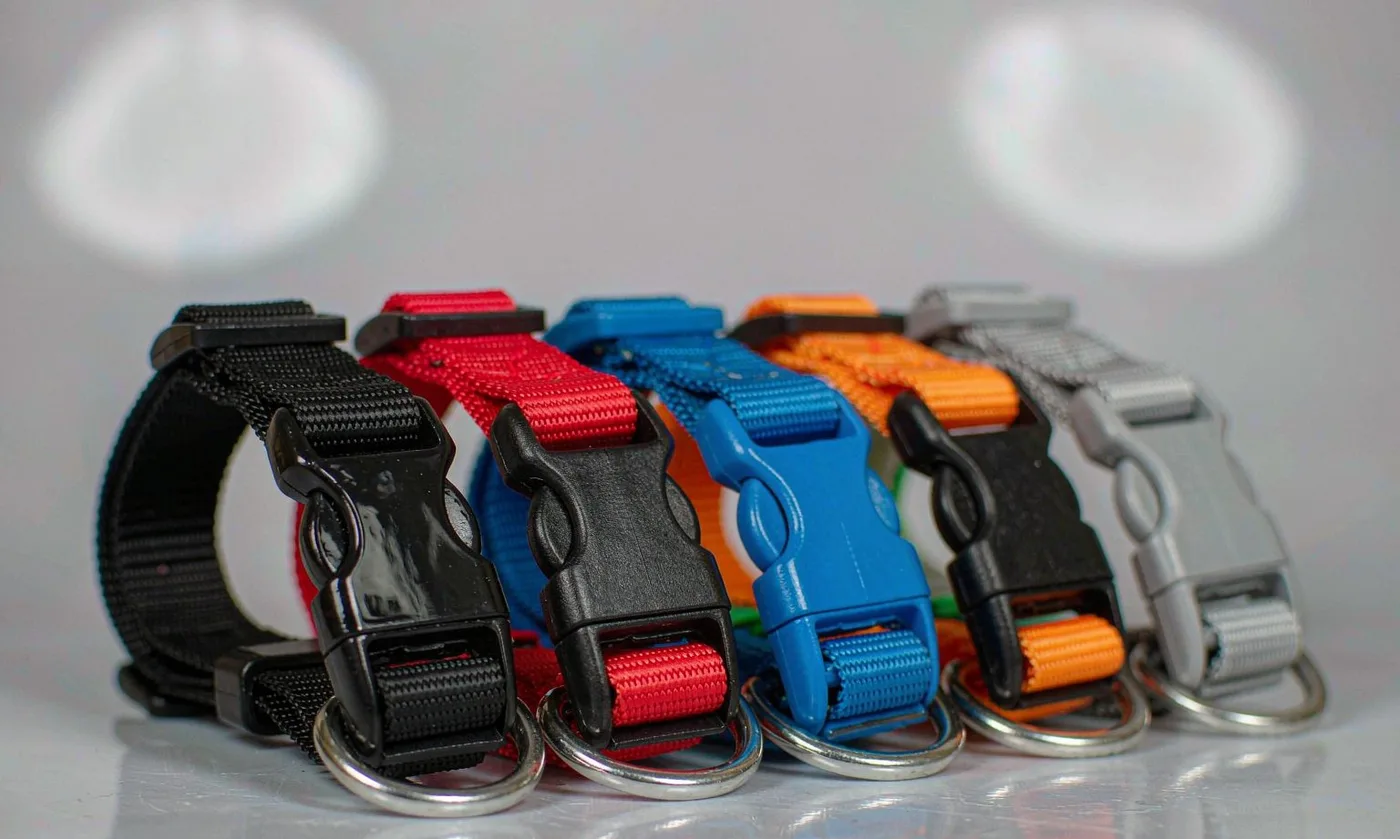
Hardware carries the load and the brand impression simultaneously, which is why it deserves its own specification block rather than being left to the line to choose.
Buckles come in three main families. A side-release plastic buckle in acetal or nylon is light, quiet, corrosion-proof and inexpensive, and it is the standard for everyday collars. Its weakness is perceived value: a plastic buckle signals an entry product regardless of how good the webbing is. A metal side-release or a traditional pin buckle in zinc alloy or solid brass signals quality immediately and adds real weight. Between them sits the hybrid: a metal-look coated plastic buckle that keeps the weight down while reading as metal at a distance.
D-rings and weldments are the safety-critical components. A welded D-ring is stronger than a stamped, folded one, and the weld should be specified and inspected on every batch. For large breeds, specify a ring with a documented breaking strength and a comfortable margin above realistic loads. The attachment of the ring to the webbing - usually a bar-tack or a box stitch - is more often the failure point than the ring itself, so specify the stitch pattern and the thread type.
Finishes include nickel, black nickel, gunmetal, antique brass, rose gold, matte black and anodised aluminium in custom colours. As with all metal components, specify plating thickness rather than only a colour name, because a thin flash finish rubs through at the contact points within months. Anodised aluminium offers the widest colour range and is light, which suits medium widths well.
Hardware should match across the set. If the carrier uses matte black hardware, the collar and leash should too, and the same shade of matte black. Mixed finishes across a coordinated set is the most common visual failure in private label pet ranges, and it is entirely avoidable if the finish is specified once, at collar stage, and then cascaded.
Finally, consider the sound. Metal hardware jingles against an ID tag, and some customers find that irritating at night. A silicone tag silencer or a flat-profile ring is a low-cost accessory detail that solves it, and it is a nice example of a design decision that shows the brand thought about lived experience rather than about photography.
Logo Methods on Collars: Jacquard, Sublimation, Silicone and Woven
Collar width constrains logo method more than any other accessory, because a 16 mm collar has a very small printable band. Four methods work, and the right one depends on artwork complexity, material and order size.
Jacquard weaving builds the logo into the webbing structure during weaving. It is permanent, cannot peel or fade independently of the webbing, and it produces the flat, clean, professional look associated with premium pet brands. The constraints are a fixed loom set-up cost, a palette limited to the yarn colours loaded, and a minimum legible type size that is larger than printing allows. For a repeated wordmark or a simple icon, jacquard is the best-looking and most durable option available.
Dye-sublimation printing infuses dye into polyester webbing, allowing full-colour artwork, gradients and photographic detail with no change in handfeel. There is no set-up cost, which makes it ideal for short runs and multi-colourway programmes, and the print will not crack because it is inside the fibre rather than on it. The constraint is substrate: sublimation only works on light-coloured polyester, so a black collar needs a different method.
Silicone labels are moulded badges sewn or riveted onto the webbing. They give a raised, rubbery, tactile mark in any Pantone-matched colour, work on any webbing including TPU-coated and dark grounds, and are increasingly the premium choice for technical lines. They require a mould and a minimum quantity, so they suit programmes rather than one-off drops. A woven label sewn flat onto the webbing is the cheapest route to a branded collar and works on any substrate, though it adds a visible patch and a slight stiffness.
- Jacquard - permanent, premium, best for repeated wordmarks, needs volume.
- Sublimation - full colour, no set-up, light polyester only.
- Silicone badge - tactile, any ground colour, needs a mould.
- Woven label - cheapest, any substrate, adds a visible patch.
Artwork discipline matters here. On a 20 mm collar the usable logo band is roughly 12-14 mm, so the brand should prepare a condensed lock-up for the application rather than scaling the master logo. A monogram or a short wordmark at 4-6 mm cap height reads cleanly; a full signature lock-up will not.
Size Grading and Fit Architecture
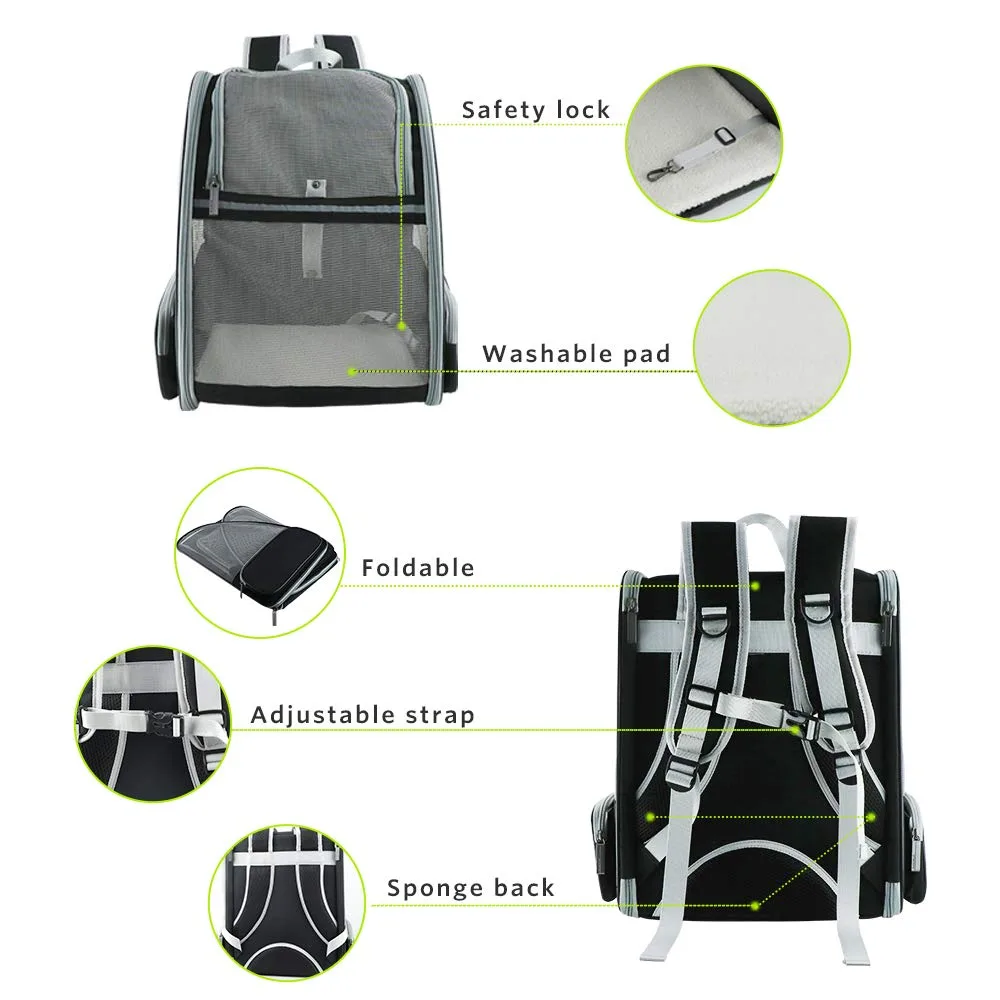
A collar range is a size range, and the grading architecture is decided long before artwork. Getting it right affects cost, inventory and customer satisfaction more than any aesthetic decision in the programme.
The standard structure is three to five sizes spanning roughly 20 cm to 65 cm of neck circumference, with webbing width increasing across the run. Three sizes suit a focused range; five sizes suit a brand serving toy breeds through large working dogs. Each additional size adds inventory complexity and a small tooling or pattern cost, but it also materially reduces returns, because a mis-sized collar is the most common reason for a return in this category.
Adjustment range matters as much as the nominal size. A size that covers 30-40 cm will fit more customers than one covering 33-37 cm, and generous adjustment reduces the number of SKUs needed to cover a population. The trade-off is excess strap length, which is why a keeper loop and a clean strap end treatment are worth specifying.
Grading should be consistent with the rest of the set. If the harness and the leash use the same three size bands, a customer who knows their size in one product buys the others confidently. Inconsistent grading across a coordinated set creates hesitation at checkout and it is a surprisingly common cause of abandoned baskets.
Regional sizing expectations differ. European and North American customers expect metric and imperial callouts respectively, and a size chart printed on the packaging or the hang tag should show both. Including a weight guide alongside the neck measurement improves fit accuracy substantially, because most owners know their pet weight more precisely than their pet neck circumference.
Document the grading on the tech pack with a drawing per size, including width, length, hole or slider positions and hardware placement. That drawing is what makes the second production run match the first, and it is what allows a new size to be added later without redeveloping the range.
Colour System Consistency Across Carrier, Collar and Leash
Colour is where coordinated sets are won or lost, and the difficulty is physical: the same Pantone target behaves differently in dyed polyester webbing, in coated fabric, in printed panels and in anodised aluminium. A single reference cannot govern all of them.
The method that works has three steps. First, define the master target using a recognised standard - reference libraries are maintained by Pantone, and a solid coated reference is the usual master. Second, approve a physical standard in each material, accepting deliberate small deviations that make the items look right together. Third, record those approved standards, photograph them together under a defined light source, and hold them as the reference for every reorder.
Light source discipline is essential. Dye-sublimated polyester and solution-dyed webbing can look identical under daylight and visibly different under warm retail lighting. Approve under two standard sources and state which governs. This is not pedantry: metamerism is the most common cause of a set that looks mismatched on shelf despite passing every internal check.
Dye-lot control is the operational half of the problem. Webbing is dyed in lots, and lots vary. For a coordinated set, the webbing for collar, leash and harness should be dyed in the same lot wherever possible, and the lot number should be recorded on each tech pack. Our production team plans dye lots across the set for exactly this reason, and the practice eliminates most of the drift that brands otherwise experience between items.
Finally, plan the colourway architecture as a system, not a list. A core neutral, a seasonal fashion colour and one limited edition per year gives retailers something permanent and something new, and it keeps the range coherent. Adding colourways without that structure produces a shelf that looks busy rather than designed.
Safety, Standards and Documentation for Collars
A collar sits around an animal neck, which makes it the most safety-sensitive item in an accessory range. Two concerns dominate: chemical content and mechanical performance.
On chemical content, dyed webbing, coatings, inks and metal hardware each need declarations appropriate to the destination market. Specifying inputs that already carry recognised certification is far cheaper than testing finished goods after production, and textile inputs certified to OEKO-TEX standards give brands an auditable answer to the standard retailer question about harmful substances. Metal hardware needs heavy metals testing for the US market and nickel release consideration for the EU.
On mechanical performance, the questions are breaking strength, hardware security and, for cats, release behaviour. A breakaway collar is designed to release under a defined load so that a cat caught on a branch or a fence can escape; any brand selling into the cat category should offer one and should specify the release load explicitly. For dogs, the requirement is the opposite - the collar must not release unintentionally - so documented breaking strength and a pull test on the D-ring attachment are the relevant records.
Veterinary guidance is worth reading when writing product copy and warnings. Professional resources from organisations such as the American Veterinary Medical Association inform sensible fit and supervision guidance, and aligning label copy with mainstream professional advice protects both the customer and the brand.
Documentation closes the loop. Each collar SKU should carry a tech pack with material specification, hardware specification and test result, size grading drawing, colour reference and approved sample photographs. Retailers increasingly ask for these documents before listing, and having them ready at launch shortens onboarding considerably.
Finally, write the label copy carefully. Fit guidance, a supervision statement and, where relevant, a breakaway explanation belong on the packaging or the hang tag - not buried in a website footer.
Cost Tiers, Set Bundling and Launch Cadence
Collar economics follow the familiar shape: fixed set-up costs dominate at low volume, material dominates at high volume, and the transition happens earlier than most brand owners expect.
At 500 pieces across a size run, jacquard loom set-up, hardware procurement and dye minimums produce a unit price that looks high. Tripling to 1,500 pieces typically improves unit cost by 25-40 percent, because yarn and hardware are bought in one lot and the loom runs once. Beyond roughly 5,000 pieces the curve flattens. The practical implication is that consolidating to one webbing specification and one hardware finish across the whole set produces a larger saving than negotiating any single line item.
Bundling is where the coordinated set proves its value. A carrier and collar sold as a set at a modest discount increases average order value and gives the customer an immediate reason to choose the brand over a competitor selling the carrier alone. A three-piece set - carrier, collar, leash - works even better online, because it removes the need for the customer to match colours themselves. In physical retail, a set hung together on one fixture outsells the same items merchandised apart.
Timing follows the established pattern: sampling in 6-10 working days, bulk in 35-50 days after approval, with custom-dyed webbing at the longer end. For a set that must launch together, start all three items at once, roughly 110 days before the launch date, and lock hardware finish first because it has the longest procurement tail.
Cadence should mirror the range. Keep two or three core colourways permanently in the catalogue to capture replacement purchases, and add one seasonal colourway per quarter at 500-1,000 pieces. Over a year that produces four merchandising moments without developing a new product, and because the collar shares artwork, hardware and colour references with the leash, harness and bandana, each seasonal drop can cascade across the whole set from a single design decision.
Why brands source here
- Pet carrier programs run since 2014; founding team in sewn goods since 2004
- SGS-verified production floor of 4,950 m² with 137 workers across 7 lines
- Monthly capacity of 200,000 units, audited to BSCI and ISO 9001
People Also Ask
How much does a custom collar cost?
Between $1.60 and $6.80 per unit depending on webbing, hardware and logo method, with the sharpest improvement between 500 and 1,500 pieces.
Why develop a collar alongside the carrier?
The collar is worn and photographed daily, generates repeat purchase as pets grow and items wear, and acts as the entry product for customers not yet ready to buy a carrier.
What is the difference between jacquard and sublimation?
Jacquard weaves the mark into the webbing and is permanent with a limited palette. Sublimation infuses full-colour dye into light polyester with no set-up cost.
Should collar hardware be plastic or metal?
Plastic is light, quiet and inexpensive but signals an entry product. Metal signals quality and adds weight. A coated metal-look plastic offers a middle path.
How do we reduce collar returns?
Offer generous adjustment ranges, publish both metric and imperial measurements plus a weight guide, and keep grading consistent across the whole set.
Should core collar colourways be seasonal?
No. Keep two or three core colourways permanently in the catalogue to capture replacement purchases and add one seasonal colourway per quarter for novelty.
Frequently Asked Questions
What is the minimum order for a custom collar set?
MOQ 500 pieces per colourway across the size run, which covers jacquard loom set-up, hardware procurement and dye-lot minimums.
How long does collar sampling take?
Sampling takes 6-10 working days from approved artwork and includes physical webbing in the intended weave, a fitted hardware sample and a size-run grading check.
What is the bulk production lead time?
Bulk runs 35-50 days after sample sign-off, with custom-dyed webbing and bespoke hardware finishes at the longer end of the range.
Which webbing material should we choose?
Polyester webbing is the default for coordinated sets because it holds colour, dries quickly and accepts both jacquard and sublimation. TPU-coated webbing suits waterproof lines and leather suits premium tiers.
How wide should a collar be?
16 mm suits cats and toy breeds, 20-25 mm suits small and medium dogs and 25-38 mm suits large breeds. Thickness of 1.0-2.2 mm is the working range.
What logo method lasts longest on a collar?
Jacquard weaving is effectively permanent because the mark is part of the webbing structure. Silicone badges are extremely durable and work on dark or coated grounds.
Can we use full-colour artwork on a collar?
Yes, with dye-sublimation on light-coloured polyester webbing. On dark or TPU-coated webbing, use a silicone badge or a woven label instead.
Should we offer a breakaway collar for cats?
Yes. Any brand selling into the cat category should offer a breakaway option with the release load specified explicitly on the tech pack and explained on the packaging.
How do we keep collar and carrier colours matching?
Define one master Pantone target, approve a physical standard in each material, dye set items in the same lot where possible, and evaluate under two standard light sources.
What hardware finish should we specify?
Match the finish used across the range and specify plating thickness rather than only a colour name. Anodised aluminium gives the widest colour range at low weight.
How many sizes should a collar range have?
Three to five sizes covering roughly 20-65 cm of neck circumference. More sizes add inventory complexity but reduce returns, which are usually caused by poor fit.
What inspection standard applies before shipment?
Finished goods are inspected to AQL 2.5 under documented ISO 9001 procedures at our SGS-verified production base, shipped FOB Xiamen on T/T 30/70 terms.
Talk to QUANZHOU JUNYUAN BAGS about a pet carrier program: MOQ 500 pieces per colourway, samples in 6-10 working days, bulk production in 35-50 days under AQL 2.5 inspection.
Get a free quote Request a sample