Custom Printed Pet Carrier: Printing Methods
Six printing methods are practical on a custom pet carrier: screen print, heat transfer, dye-sublimation, digital film, puff and reflective. Most branded programs use two. Choice depends on fabric, colour count, quantity and wash durability, with MOQ 500 pieces per colourway.
Printing is the most specified and least understood element of a custom pet carrier program, and the wrong method choice is expensive to reverse because it is locked into the material set. This guide compares the six practical methods - screen print, heat transfer, dye-sublimation, digital film transfer, puff and reflective - against five decision criteria: substrate compatibility, colour and gradient capability, hand feel, durability and cost behaviour at volume. Screen print remains the workhorse for flat polyester panels with one to three spot colours. Heat transfer is the answer for gradients and photographic artwork. Dye-sublimation delivers full-bleed pattern across an entire panel on light polyester with no per-colour surcharge, which makes it the strongest tool for an all-over brand motif. Commercial floor is MOQ 500 pieces per colourway; sample rounds run 6-10 working days each; bulk production runs 35-50 days after sample approval and deposit; and every shipment releases against an AQL 2.5 inspection report. Colour is matched to physical Pantone references, and print durability is verified with recognised textile test methods before bulk is released.
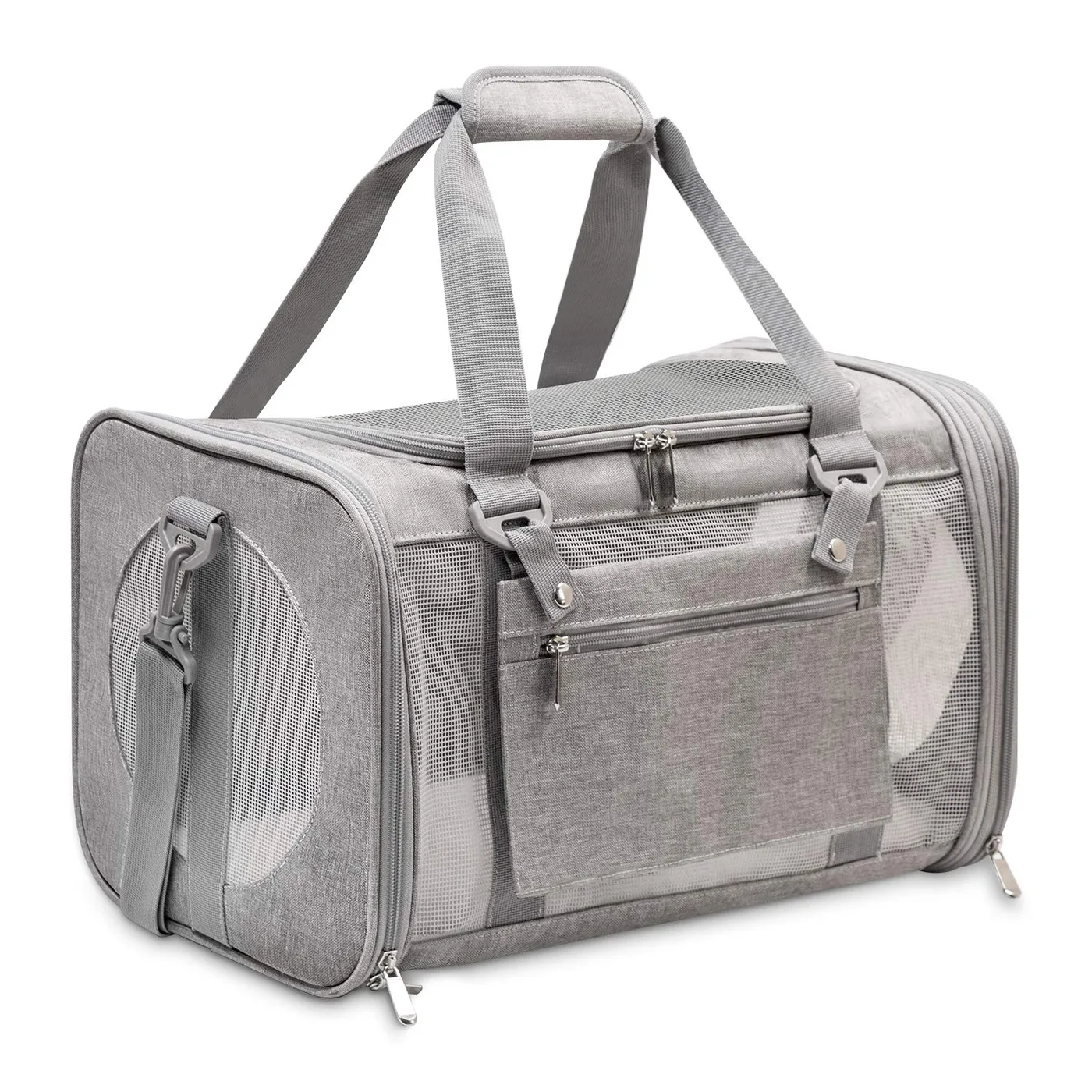
For a custom cat carrier the ventilation question is where the mesh sits, not how much there is: high side panels plus a shaded front zone keeps airflow without visual exposure.
How to Choose a Printing Method: Four Questions Before Anything Else
Method selection is not a matter of preference; it is a matter of constraints. Four questions resolve almost every case, and asking them in this order prevents the most common costly mistake - choosing a method and then discovering the artwork or fabric cannot support it.
Question one: what is the substrate? Coated polyester behaves very differently from uncoated nylon, and a coating that improves water resistance can reduce ink adhesion. Light polyester accepts sublimation; dark or heavy cotton-canvas blends generally do not. Mesh and webbing are a third category entirely and usually require a patch or label rather than a direct print.
Question two: how many colours, and are there gradients? Flat spot colours are the natural territory of screen printing, which charges per colour per placement. Gradients, shading and photographic imagery require heat transfer or digital methods, which charge per area rather than per colour.
Question three: what is the quantity? Screen printing carries a set-up charge that amortises quickly, so it becomes the cheapest option above a few hundred pieces. Digital and transfer methods carry little or no set-up, so they win at low quantity and lose at high volume.
Question four: how will it be washed and abraded? A print on an exterior panel that meets door frames, car seats and pavement needs a different durability specification than a print on an interior lining panel. State the expected use, because a method that survives a gentle hand wash may fail a machine cycle.
Answer those four and the shortlist is usually down to one or two methods. The sections below give the detail needed to make the final call, including where each method fails.
Screen Printing: The Spot-Colour Workhorse
Screen printing pushes ink through a mesh stencil onto the panel, one colour at a time, and cures it into a durable film. It remains the default for branded pet carriers because it is predictable, colour-accurate and economical at volume.
Its strengths are colour fidelity and opacity. A Pantone-matched spot colour laid down by screen is the most accurate way to reproduce a brand mark, including light ink on a dark shell where an opaque white base is printed first. Ink film thickness also gives a slight raised texture that reads as quality, and properly cured plastisol or water-based ink survives repeated washing.
Its limits are equally clear. Each colour is a separate screen and a separate pass, so cost scales with colour count and with the number of placements. Fine gradients and photographic detail are not achievable. Registration - the alignment of successive colours - needs clear space, so tightly nested multi-colour artwork is a production risk. And curved, padded or heavily textured surfaces are difficult to print flat.
Practical specifications our team works to: one to four spot colours per placement is comfortable, above five becomes uneconomic; minimum stroke weight around 0.8 mm so the stencil holds; minimum text cap height around 4 mm for legibility after curing; and at least 15 mm clearance from any seam, zip track or binding, because artwork crossing a seam distorts in production no matter how clean the sample looks.
Screen print is the right default when the mark is flat, the colour count is low, and the quantity clears 500 pieces. It is the wrong choice for a photographic print or a full-panel pattern.
Heat Transfer: Gradients, Photographic Artwork and Small Runs
Heat transfer prints artwork onto a carrier film and presses it onto the panel under heat and pressure. Because the image is created digitally first, gradients, shading, fine detail and photographic imagery all transfer faithfully, and colour count stops being a cost driver.
That makes heat transfer the standard answer for artwork with a blend, a shadow, or a photographic element, and for any program where the brand mark is more illustration than logotype. It is also the most flexible option at low quantity, since there are no screens to make and no per-colour set-up to amortise.
The trade-offs are hand feel, breathability and long-term durability. A transfer sits as a layer on the fabric, so on large coverage areas it can stiffen the panel and reduce the fabric's natural drape - noticeable on a soft-sided carrier. It is also less breathable than bare fabric, which is why large transfers are normally kept away from ventilation fields. Adhesion quality varies with film type and press parameters, so a cheap transfer can crack or peel after repeated washing or after exposure to heat.
Specification points: keep coverage below roughly 40 percent of a panel where drape matters; avoid placing large transfers across a fold or a stress point; specify a stretch-grade film on any panel that flexes in use; and request a wash test on the actual production fabric rather than on a swatch.
Where a brand needs photographic imagery and a soft hand, the modern compromise is a thin, stretch-grade digital film with a matte finish, which reads close to a direct print while retaining gradient capability.
Dye-Sublimation: Full-Bleed Pattern on Polyester
Sublimation is fundamentally different from the other methods: instead of sitting on the fabric, the dye becomes part of it. Heat converts solid dye to gas, which bonds into the polyester fibre, so the image has no hand feel, no layer, and cannot crack or peel.
That property makes sublimation the strongest tool for all-over brand pattern. A full-panel motif, a photographic landscape, a gradient field or an engineered print that flows across panel seams costs the same as a small mark, because the process charges by area and not by colour. For a brand whose identity is built on pattern - which is most fashion-adjacent pet brands - sublimation is usually the method that delivers the intended product.
The constraints are hard. Sublimation requires polyester, and it requires light or white polyester, because the dye is translucent and cannot cover a dark ground. Cotton, canvas and most nylons are out. Colours shift during the process, so Pantone matching is approximate and must be handled with a proof cycle rather than with a formula. And because the dye bonds at high temperature, the fabric's finishing and any coating must be compatible.
Design implications follow. Sublimation rewards engineered artwork: pattern that is designed to meet a seam, a pocket or a panel edge rather than being dropped onto a rectangle. Our designers prepare placement drawings showing exactly where the pattern falls on each panel, because a mis-engineered all-over print looks accidental at the seams.
Cost behaviour is favourable at medium to high volume and unfavourable at low volume, since press time dominates. It is the recommended method for a signature or collaboration drop where the artwork is the product.
Specialty Effects: Puff, Reflective, Metallic and Discharge
Beyond the three core methods, four specialty effects are practical on a pet carrier and each solves a specific design problem. Used sparingly they add perceived value; used together they look unfocused.
Puff, or expanding ink, is a screen-printed additive that rises during curing to produce a raised, soft, three-dimensional mark. It reads tactile and slightly retro, and it is the cheapest way to add dimensionality to a logo. It works best on simple bold artwork, since fine detail is lost in the expansion, and it should be tested for wash durability because a puff print is more exposed to abrasion than a flat one.
Reflective transfer turns the mark into a safety feature, returning light at night. On a pet carrier this is both a design statement and a functional claim that can be printed on the hang tag, and it performs best as a border, a piping-adjacent stripe or a discrete icon rather than as a full logo fill.
Metallic and foil effects deliver a light-catching finish that photographs well, particularly in gold or rose gold on a dark shell. They are less durable under abrasion than standard plastisol, so placement should avoid high-contact areas such as the base panel and the handle underside.
Discharge printing removes dye from a dark fabric rather than adding ink on top, leaving a soft hand with no film. It is the premium answer for printing on dark cotton-canvas blends, where a plastisol print would feel heavy. It requires dyeable fabric and a test cycle to confirm the discharged shade, and it is not available on every colour.
One rule governs all four: one specialty effect per product. A carrier with puff on the logo, reflective on the strap and foil on the tag has no focal point.
Artwork Preparation, Colour Matching and Placement
Most printing problems are artwork problems that surface late. A short preparation checklist removes the majority of them, and it should be completed before the first sample round rather than during it.
Supply vector masters for screen print, puff and foil, and for any method requiring a cut stencil or plate. Supply raster artwork at 300 dpi or higher at final print size for heat transfer and sublimation. Convert all text to outlines, since a missing font substitutes silently and changes the typography of the brand.
Colour matching runs on physical references. Pantone is the reference standard used across the industry and the one our colour approvals are issued against - see Pantone. Critically, specify which Pantone codes apply to ink, which to thread and which to dyed fabric, because one code renders differently across those substrates. Screen printing matches spot colours closely; sublimation requires a proof cycle and an agreed tolerance rather than an exact match.
Placement drawings are where design meets production. A placement drawing states the exact position, size, rotation and clearance of every mark on every panel, referenced to a seam or edge. It prevents the most common dispute in the category - two parties with different assumptions about where the logo goes.
Clearance rules should be written into the drawing: at least 15 mm from any seam, zip track, binding or edge; legibility checked at the smallest size in the range rather than the largest; and the primary mark placed on the panel that faces the camera in the three-quarter hero shot, which is normally the long side panel and not the lid.
Durability Testing and the Defects to Watch For
A print that looks perfect on a sample and fails after a month in a customer's hands is the most damaging failure in a branded program, because it is attributed to the brand rather than to the process. Durability is therefore specified and tested, not assumed.
The relevant properties are colour fastness to washing, to rubbing (both dry and wet), to light, and to perspiration. Recognised test methods for these properties are published by AATCC, and a brand should state the minimum acceptable rating per property in the tech pack. Where a retail buyer requires a documented textile safety standard, fabrics can additionally be supplied to OEKO-TEX Standard 100.
The four defects worth inspecting for during sampling are cracking after stretch, peeling at the edges, colour migration into adjacent light panels, and poor registration between colours in a multi-colour screen print. Cracking indicates an ink film without adequate stretch on a flexing panel. Peeling indicates insufficient press time, temperature or pressure, or a film incompatible with the coating. Migration indicates a dye that is not colour-fast, and it is most visible when a dark accent sits against a light lining. Registration error is a jig or set-up issue and shows as a coloured halo on one side of a mark.
Test on the production material set, not on a swatch, and test the darkest colourway in the range, because it is always the one that fails first. Then keep the tested unit as part of the program file.
Where a program sells into more than one market, test to the strictest requirement among them rather than running separate specifications, since a single material set is cheaper and simpler to control.
Cost Model: Set-Up, Per-Piece Cost and the Quantity Curve
Printing cost has two components that behave in opposite directions, and understanding the split is what lets a brand design to a budget rather than negotiate after the fact. The components are set-up (fixed, per colour per placement) and per-piece cost (variable, driven by area, passes and press time).
Screen printing is set-up-heavy and per-piece-light. Its total cost is high at 50 pieces and low at 5,000, with the crossover typically well below the standard MOQ. Reducing a four-colour mark to two colours, or consolidating two placements into one, is therefore the fastest way to reduce unit cost on a screen-printed program.
Heat transfer and digital film are the reverse: little or no set-up, higher per-piece cost, and a much flatter curve. They are the right choice for small runs, for multi-colour artwork and for programs where each unit carries a variable element.
Sublimation is area-driven. A small mark and a full-panel pattern cost similar amounts, which is why it is uneconomic for a single logo and unbeatable for a pattern. Specifying sublimation for a logo is the most common form of print waste in this category.
| Method | Set-up cost | Per-piece cost | Colour limit | Hand feel | Wash durability | Best quantity |
|---|---|---|---|---|---|---|
| Screen print | Per colour, per placement | Low | 1-4 spot colours | Slight film | Very good | 500+ |
| Heat transfer | Low | Medium | Unlimited, gradients | Film layer | Good, film dependent | 100-1,500 |
| Dye-sublimation | Low | By area | Unlimited on light polyester | None | Excellent | 500+, pattern work |
| Digital film | None | Medium-high | Unlimited | Thin film | Good | Under 500 |
| Puff | Per colour | Low-medium | Simple bold artwork | Raised | Fair to good | 500+ |
| Reflective | Low | Medium | Solid shapes | Film layer | Good | Any |
Every program is then released against an AQL 2.5 inspection with a written report, and the quality management system behind production is maintained to ISO 9001 requirements, so the cost advantage of a chosen method is not paid back in rejects.
Printing on Trims, Tapes and Hardware-Adjacent Surfaces
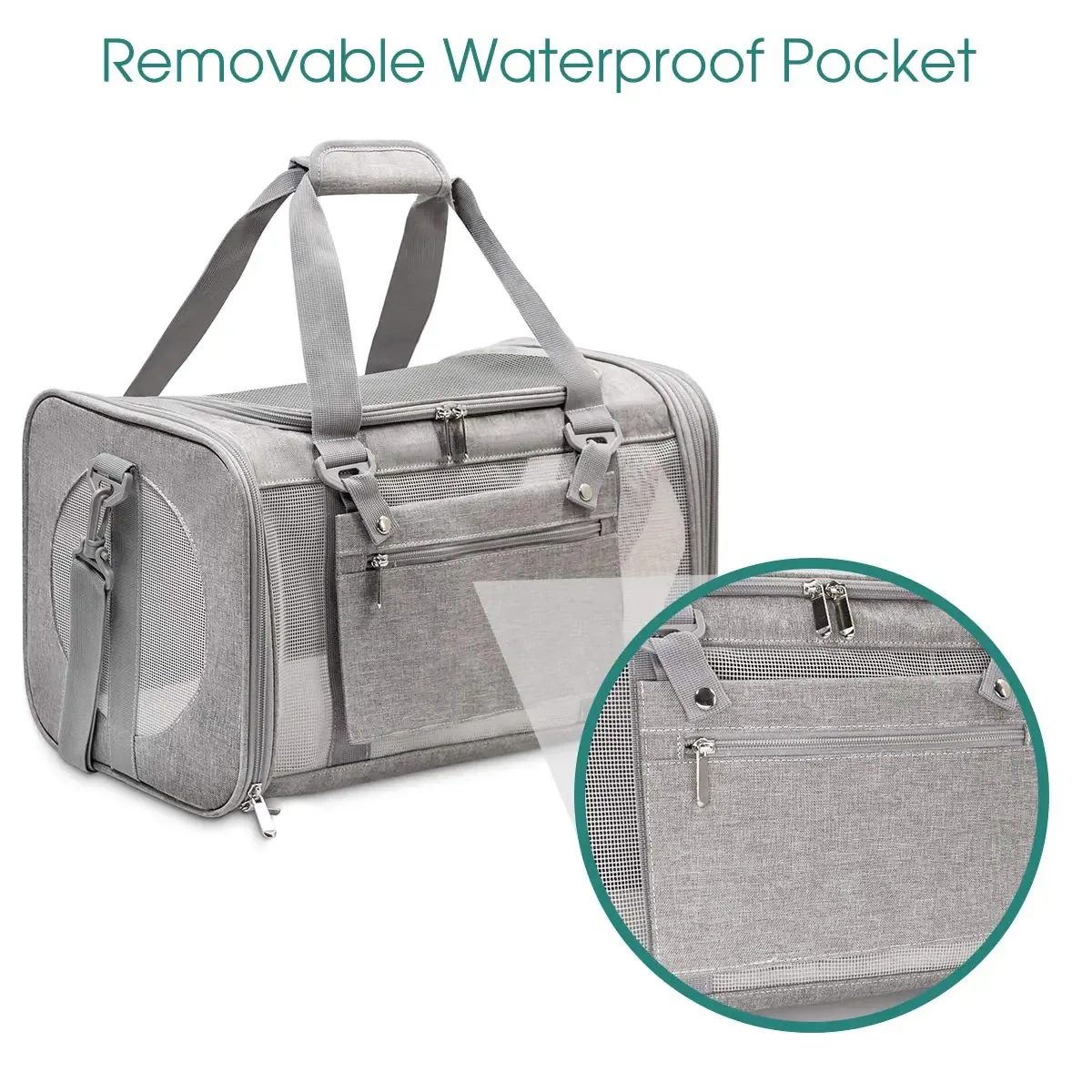
Branding does not stop at the shell. Trims - webbing, binding tape, handle wrap, zipper tape and elastic - are visible in every photograph and are frequently left unbranded, which is a missed opportunity at low cost.
Woven or printed tape is the standard solution for a handle wrap or a strap. A repeated wordmark, a micro-pattern or a two-colour stripe woven into the tape costs by the metre and adds recognition at the point where the customer's hand meets the product. Printed tape is cheaper and works for a simple repeat, but it abrades faster on a high-contact area.
Zipper tape and pull branding is the second opportunity. A printed or debossed pull carries the mark at the most-touched point of the product, and because the tooling is shared with the hardware set, the incremental cost is small. Silicone-dipped pulls with a debossed mark are durable and quiet in use, which customers notice.
Binding and piping are the third. A contrast binding in a brand accent colour, or a printed pattern on a binding tape, costs almost nothing in material terms and is the detail that makes a product look designed rather than assembled from stock components.
Two cautions apply. Adhesion on narrow woven surfaces is weaker than on a flat panel, so any printed trim should be tested for rub and wash fastness before bulk. And reflective or metallic effects on a trim flex constantly in use, so they should be specified as a stretch-grade film.
Trims are also the easiest place to test a bolder idea. Because the area is small and the cost is low, a reflective stripe or a contrast binding can be trialled on one colourway before it is committed across the line.
Multi-method programs: budgeting set-up across methods
Programs using two or three print methods pay multiple set-ups, and the total is often larger than expected because each method carries its own charge and its own minimum. Planning for that is straightforward once it is visible.
The usual structure is one screen-printed primary mark - one set-up per colour, amortised over the full run - plus a sublimated lining print charged by area, plus optionally a woven label whose loom set-up is booked seasonally. Three set-ups, three different curves, and only the first improves sharply with quantity.
The saving strategies are consolidation and reuse. Consolidating placements - one larger mark instead of two small ones - removes a set-up entirely. Reusing the same artwork across colourways avoids re-separations. And booking label and trim runs by season rather than by order spreads set-up over multiple production cycles.
Where a program is genuinely small, the honest answer is to use one method well rather than three thinly. A single well-executed screen print reads more deliberate than three methods each executed at the minimum quantity.
Inks, coatings and the sustainability conversation
Print chemistry is an increasingly common question from retail buyers, and answering it well requires knowing which inks and coatings are in the specification rather than assuming they are standard.
Plastisol is the conventional screen printing ink and performs well, though it contains plasticisers that some buyers now restrict. Water-based and discharge inks are the alternatives: they penetrate the fibre, give a softer hand, and carry a cleaner chemical profile, at the cost of a narrower colour range and more sensitive curing. PVC-free and phthalate-free formulations are available for most applications.
Coatings and finishes on the fabric also matter, because a durable water-repellent finish applied for stain resistance can affect print adhesion. Where a program needs both, the sequence and the cure cycle must be specified together rather than ordered separately.
Where a buyer requires documentation, inks and fabrics can be assessed against recognised textile standards such as OEKO-TEX, and certificate numbers should be collected at sample stage. The practical rule is the same as for any claim: state what is actually in the product, hold the document, and do not overstate the scope.
Approving a print proof: a short checklist
A proof is approved in minutes and governs thousands of units, so it deserves a written checklist rather than a glance. Six items cover the risk.
Check colour against the physical Pantone reference under controlled lighting, not against a screen. Check placement against the placement drawing, measuring from the stated seam or edge. Check scale, confirming that the mark matches the approved millimetre size rather than looking proportionally right. Check clearance from seams, zips and binding at the stated minimum.
Check legibility at the smallest size in the range, because artwork approved on a large carrier routinely fails on a small one. And check the substrate: the proof must be printed on the production fabric in the production colourway, since a swatch on a different ground tells you very little about the real result.
Photograph the approved proof, record the date and the approver, and add both to the program file. It becomes the reference for every reorder.
Order and quality terms
- MOQ 500 pieces per colourway; samples in 6-10 working days
- Bulk production 35-50 days after approval; AQL 2.5 inspection standard
- T/T 30/70 terms, FOB Xiamen, full document set per shipment
People Also Ask
What is the most durable print for a pet carrier?
Dye-sublimation, because the dye bonds into the fibre rather than sitting on it, so it cannot crack or peel. Properly cured screen print is close behind and is the better choice for exact spot-colour matching.
Is screen printing or heat transfer cheaper?
Screen printing is cheaper above roughly 500 pieces per placement because its set-up amortises quickly. Heat transfer is cheaper below that, and it is the only practical option for gradients.
Can I print a photo on a pet carrier?
Yes, with heat transfer or dye-sublimation. Photographic detail requires a digital process; screen printing cannot reproduce continuous tone.
Why does my printed logo crack?
Usually an ink film without enough stretch on a panel that flexes, or a film incompatible with the fabric coating. Specify a stretch-grade ink and test on the production material set.
Can printing be combined with embroidery?
Yes. A common combination is an embroidered primary mark on a padded or curved surface with a printed secondary motif on a flat panel, both sharing one colour system.
Does printing change the fabric hand feel?
Screen print and heat transfer add a film that stiffens the printed area; large coverage noticeably reduces drape. Sublimation adds nothing, which is why it is preferred for full-panel artwork.
How do I proof a print before bulk?
Request a confirmation sample on the production fabric in the production colourway, approve the Pantone reference under controlled lighting, and specify the minimum fastness ratings to be tested before release.
Frequently Asked Questions
Which printing method is best for a pet carrier logo?
Screen print for one to four flat spot colours at 500 pieces or more; heat transfer for gradients or photographic artwork; dye-sublimation for an all-over pattern on light polyester. Most programs use a screen-printed primary mark plus one secondary method.
What is the MOQ for a custom printed pet carrier?
MOQ 500 pieces per colourway is the standard floor. Digital and transfer methods can run below that, but per-piece cost is higher and the set-up saving rarely compensates beyond the first small run.
Can you match our Pantone brand colour in print?
Yes for screen print, which matches spot colours closely. Sublimation requires a proof cycle with an agreed tolerance because the dye bonds into the fibre. Always specify which Pantone codes apply to ink, thread and fabric separately.
Will the print survive machine washing?
A properly cured screen print or a sublimated pattern will. Wash durability should be specified as a minimum fastness rating and tested on the production material set, on the darkest colourway, before bulk is released.
Can you print on mesh or webbing?
Direct printing on mesh and webbing is unreliable because the surface is open and textured. A woven label, a printed tape or a small patch applied to the panel is the usual solution for branding those areas.
How many colours can we print?
Screen print is comfortable up to four spot colours per placement and uneconomic above five. Heat transfer, digital film and sublimation have no practical colour limit because they are printed digitally.
What artwork files do you need?
Vector files for screen print, puff and foil; raster artwork at 300 dpi or higher at final print size for heat transfer and sublimation. Convert all text to outlines and supply a placement drawing with clearances.
How close to a seam can a logo be printed?
Keep at least 15 mm clear of any seam, zip track, binding or edge. Artwork crossing a seam will distort in production regardless of how clean the sample looks.
What is puff printing?
A screen-printed additive that expands during curing to create a raised, soft, three-dimensional mark. It suits simple bold artwork, loses fine detail, and should be wash tested because the raised surface abrades more than a flat print.
Can we have a different print on each colourway?
Yes, though each colourway may carry its own set-up charge for screen print. A common approach is one shared primary mark plus a colourway-specific lining print, which keeps set-up costs contained.
How long does a printed sample take?
Sample rounds run 6-10 working days each, and a printed program typically needs two rounds: one to verify construction and one to confirm colour, placement and durability before bulk.
What inspection applies to printed goods?
An AQL 2.5 final random inspection with print-specific defect checks - registration, adhesion, colour consistency and placement - before the written report is issued and the shipment released.
Talk to QUANZHOU JUNYUAN BAGS about a pet carrier program: MOQ 500 pieces per colourway, samples in 6-10 working days, bulk production in 35-50 days under AQL 2.5 inspection.
Get a free quote Request a sample