Custom Patch: Iron-On or Sew-On for Private Label Pet Brands
A custom patch costs $0.18-$1.60 per piece at 500-5,000 units, and sew-on outlasts iron-on by roughly three to five home wash cycles per year of use. Choose iron-on for speed and a clean face with no visible stitch; choose sew-on when the carrier will be washed, checked as baggage or sold as a lifetime product. Our production team samples both versions in 6-10 working days and runs bulk in 35-50 days, inspected to AQL 2.5.
This executive summary covers patch development for private label pet programs. MOQ 500 pieces per design or colourway is the practical entry point, set by embroidery machine set-up, thread procurement and the cost of a heat-seal or laser die. Sampling takes 6-10 working days from approved artwork and includes one embroidered or moulded physical sample plus a placement mock-up on the actual carrier panel. Bulk production runs 35-50 days after sample sign-off, with the range driven by thread dyeing, backing availability and whether the patch is applied in-line or shipped loose for the customer to apply. Every order is inspected to AQL 2.5 under ISO 9001 documented procedures at our SGS-verified production base, with goods shipped FOB Xiamen on T/T 30/70 terms. Decide attachment method before artwork is finalised: iron-on and sew-on need different edge allowances, and changing the decision after sampling adds a full cycle. Storage matters as well, because heat-seal adhesive loses activation strength after roughly twelve months in a warm warehouse, so reorders should be planned against realistic sell-through rather than bought several years ahead in a single run.
Private label pet bags put the buyer name on the label, the barcode and the carton print while our production team holds the pattern and any tooling.
Where a Patch Sits in a Private Label Identity System
A patch is the most tactile brand mark you can put on a pet carrier. It has thickness, sheen and edge definition, and it survives the two things that kill printed marks: abrasion and washing. That is why patches usually appear on the hero SKU of a range rather than across the whole catalogue - they signal a tier.
In collection planning, the patch answers a specific question: which product in this range is worth more? A three-tier carrier programme typically uses a printed logo on the entry tier, a woven label on the mid tier and an embroidered or metal-rimmed patch on the top tier. The customer reads that hierarchy in about two seconds on shelf, without reading a single word of copy. When we plan a range with a brand owner, the patch tier is usually decided before the fabric is, because it sets the price ceiling for everything beneath it.
Placement matters as much as the patch itself. On a soft-sided carrier, the front panel slightly above centre reads best at eye level on a shelf; the top handle wrap reads best in lifestyle photography; the side gusset reads best when the bag is stacked. Avoid placing patches across a seam, across a zip garage, or over a structural webbing anchor, because the stitch line will pucker and the panel will pull. A placement mock-up on the real panel is worth the extra two days of sampling every time.
Scale discipline is the other half of placement. A 45 mm round patch on a small cat carrier is a hero detail; the same patch on a large dog crate looks lost. As a working rule, the patch width should sit between one ninth and one sixth of the panel width, and it should never exceed the width of the smallest panel on which it appears.
Cost per tier is the practical reason brands ask about patches rather than prints. A printed logo mark typically adds a small fraction of a dollar to unit cost, a woven label adds a little more, and a quality embroidered or moulded patch adds the most but also supports the largest price increase on shelf. The relevant metric is not the patch cost but the margin it unlocks: a patch that adds ninety cents and supports a nine dollar retail increase is the best value in the identity system. Brands that skip the patch tier often find their premium product looks identical to their entry product, which makes the price gap impossible to defend in a retailer line review.
The patch also plays a role after purchase. Because patches are removable in the customer imagination even when they are sewn, they carry the resale and gifting narrative. Brands running anniversary or city-exclusive drops use the patch as the collectible element, which is a far cheaper way to create a second purchase than developing a new carrier body. Our notes on custom embroidered logo options cover the same logic when the mark is stitched directly into the panel instead.
Patch Constructions: Embroidered, Woven, PVC, Chenille and Leather
Five constructions cover almost every brief we see, and each delivers a different handfeel at a different price. Understanding what each one does well prevents the common mistake of specifying a look that the process cannot deliver.
Embroidered patches are built from rayon or polyester thread stitched onto a twill ground with a fill base. They have visible texture, take gradients poorly, and excel at bold marks with two to five colours. Coverage above roughly 70 percent of the shape starts to feel stiff and heavy, so embroidery favours lettering, crests and simple icons. Woven patches use thinner threads at higher density, which allows fine detail and small type, but produces a flatter, smoother face with less presence.
PVC patches are moulded from soft vinyl and can hold 3D relief, precise edges and photographic-level detail in a way thread cannot. They wipe clean, which suits travel and outdoor lines, and they read as technical rather than heritage. Chenille uses looped yarn for a soft, varsity-jacket texture that is unmistakably retro and completely wrong for a minimal brand. Leather and PU patches bring a material story - tanning, grain, burnished edges - and work beautifully when the carrier itself uses leather trim, because the two materials age together.
| Construction | Face character | Detail capability | Relative cost index | Best use |
|---|---|---|---|---|
| Embroidered | Raised, textured, classic | Bold shapes, 2-5 colours | 1.0x | Heritage and lifestyle marks |
| Woven | Flat, smooth, precise | Fine type, small detail | 1.2x | Wordmarks and small crests |
| PVC moulded | Gloss or matte relief | 3D relief, photographic detail | 2.4x | Technical, outdoor, wipe-clean lines |
| Chenille | Looped, soft, retro | Largelettering only | 2.1x | Collegiate and nostalgic capsules |
| Leather or PU | Grained, burnished, debossed | Deboss, foil, stitch detail | 2.8x | Premium tiers with leather trim |
Colour count drives cost in thread-based constructions because each colour change adds machine time, while it barely affects moulded PVC or debossed leather. If your mark has six colours and you want embroidery, the honest advice is either to reduce the palette or to move to woven, where multiple colours sit side by side in the same weave without extra passes.
Thread selection is the hidden quality variable. Rayon thread has the best lustre and is the traditional choice, but it shrinks slightly more in washing. Polyester thread holds colour better and resists fading, which matters for a product that may sit in a sunny car window. We default to polyester for travel lines and offer rayon where the brand wants the sheen and the product is not wash-exposed.
Iron-On vs Sew-On: The Attachment Decision
The attachment method is the decision this page exists to settle, and it is not a coin toss. Each method has a clear domain, and the wrong choice shows up as warranty claims rather than as aesthetic complaints.
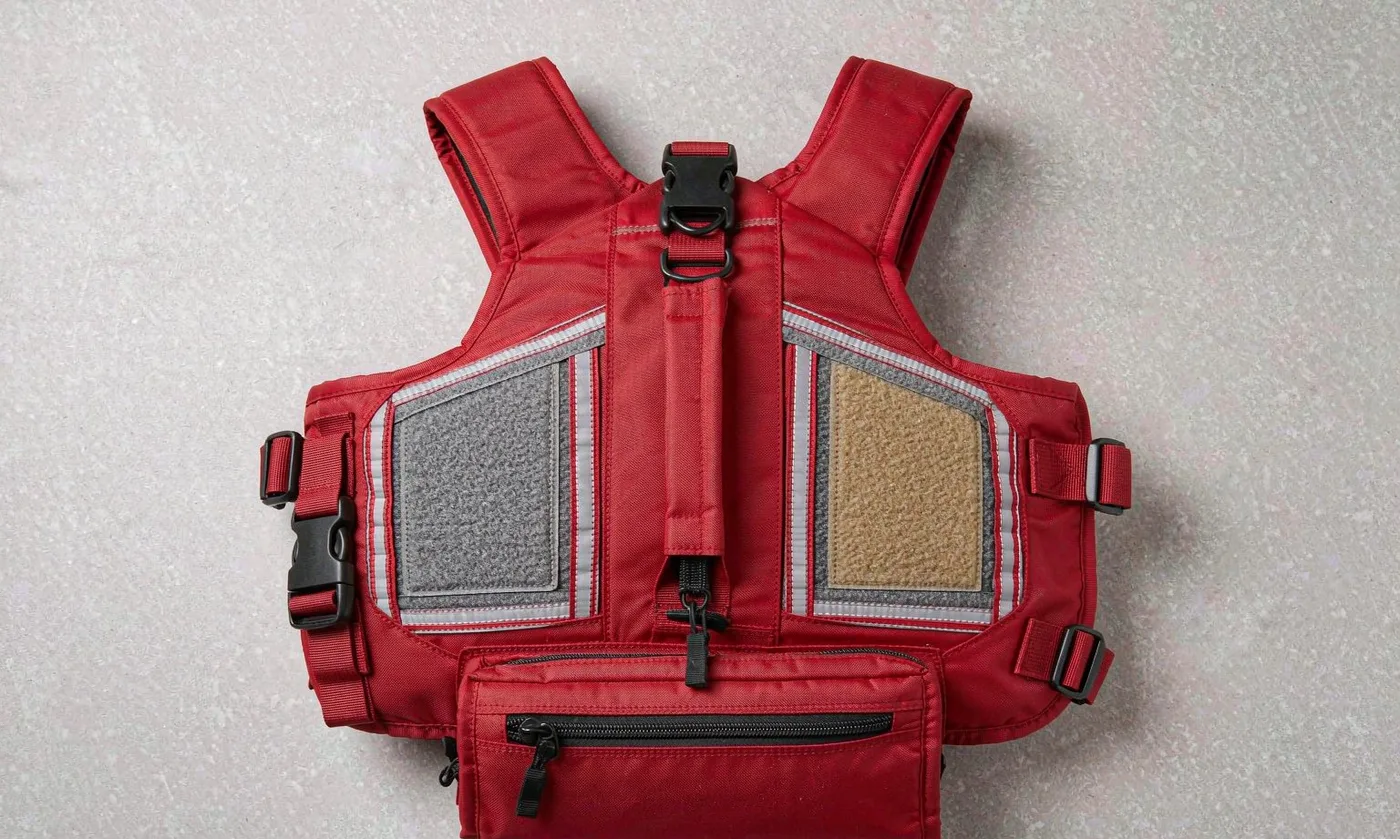
Iron-on patches carry a heat-activated adhesive backing that bonds to the face fabric under controlled temperature, pressure and dwell time - typically 130-160 degrees Celsius for 10-20 seconds depending on the substrate. Applied correctly, the bond is strong, the face is perfectly clean, and there is no stitch line to interrupt the artwork. Applied incorrectly, the patch lifts at the corners after a few weeks, and because the failure is at the adhesive rather than the patch, the customer assumes the product is cheap. Substrate matters enormously: heat-seal bonds beautifully to polyester and nylon, less reliably to coated or water-repellent finishes, and poorly to silicone-treated fabrics.
Sew-on patches are stitched through the patch edge into the panel. The bond is mechanical rather than chemical, so it does not care about coatings, water-repellent treatments or fabric blends. It survives washing, dry cleaning and baggage handling. The cost is labour and a visible stitch line, and on a curved or padded panel an inexperienced operator can pucker the fabric around the perimeter.
The hybrid answer is what we recommend most often for premium programmes: a light heat-seal tack to hold the patch in position, followed by a perimeter stitch. The tack eliminates alignment drift, the stitch guarantees permanence, and the two together cost only marginally more than stitching alone because the operator works faster on a patch that is already held in place. If you plan to offer a replacement or repair service, note that a fully sewn patch is far harder to swap than a heat-sealed one.
Application quality control is where most iron-on failures actually originate. A heat press with even pressure and a calibrated platen outperforms a handheld iron by a wide margin, and it is the only realistic option for consistent bulk application. Every production run should begin with a test panel, followed by a peel check after cooling and a recorded parameter set - temperature, pressure, dwell time and substrate batch - held on file. When a complaint arrives months later, that record is the difference between a process correction and a guess.
There is a third option worth knowing: hook-and-loop backing. It turns the patch into an interchangeable element, which is ideal for name tags, event editions and retailer-exclusive variants, and it lets one carrier body serve several brand expressions without additional sewing.
Edge Finishes and Backing Options
Edge finish is the detail that separates a considered patch from a generic one. Three finishes dominate: merrowed border, laser-cut or heat-cut edge, and a raw or folded edge on leather.
A merrowed border is an overlock stitch that wraps the perimeter in a dense band of thread. It is the traditional embroidered-patch finish, gives a soft rounded edge that resists fraying, and can be specified in a contrasting colour to frame the artwork. It adds roughly 2-3 mm to the overall dimension in each direction, so artwork must be planned with that in mind. Merrowed edges do not follow extremely tight concave curves well, which is a real constraint on star shapes and thin lettering.
Laser-cut edges use heat to seal the synthetic ground fabric, producing a crisp, clean outline that follows intricate shapes precisely. This is the right finish for woven patches and for any design with sharp internal corners. On embroidered patches, a heat-cut edge can be combined with a thin merrow to get definition plus softness. For PVC, the edge is part of the mould and needs no treatment beyond a clean parting line.
Backing options determine how the patch behaves before and during application. Plain backing suits sew-on. Heat-seal backing suits iron-on. Plastic backing adds stiffness for patches that must stay flat in transit. Adhesive sticker backing exists for temporary placement and photography but should never be mistaken for a permanent solution. For hook-and-loop, the loop face is sewn to the patch and the hook face to the garment or bag, and both faces should be ordered together so their colours match.
One practical note: heat-seal adhesive has a shelf life. Patches stored for more than about twelve months in a hot warehouse can lose activation strength, so plan reorder quantities with realistic sell-through rather than ordering several years of patches in one go.
Colour Matching in Thread: Pantone Targets and Realistic Tolerance
Thread behaves differently from ink. A Pantone reference can be approached in thread but rarely hit exactly, because the perceived colour of a stitched surface depends on stitch direction, thread lustre, ground colour showing through and the density of the fill. Brands that insist on an exact match set themselves up for disappointment; brands that define a tolerance get a patch that looks right and ships on time.
The practical process is to convert each brand colour to the nearest thread shade from a standard shade card, then approve a physical stitch-out. Our production team dyes to order when a brand colour is critical and the volume justifies it, which typically means several thousand pieces across a programme rather than a single 500-piece drop. Dyed-to-order thread adds roughly two weeks to the schedule, so it must be decided before sampling begins, not after.
Ground colour is the variable designers forget. A white twill ground under a light-coloured fill will lift the tone; a black ground will darken it. Specifying the ground colour alongside the thread colours removes an entire class of sampling surprises. For PVC patches, colour is compounded rather than dyed, and matching is generally closer, though metallic and fluorescent effects remain approximations.
Durability of colour is a separate specification from accuracy of colour. Colourfastness to washing, rubbing and light is assessed using standardised textile test methods published by AATCC, and a sensible brand asks for crocking and laundering results on the patch before committing to a bulk run. On carriers that will be spot-cleaned frequently, rubbing fastness matters more than washing fastness; on apparel-adjacent items, the reverse is true.
Finally, declare how many colours the artwork uses and which are critical. In most programmes two colours drive brand recognition and the rest are supporting detail. Concentrating dye-to-order budget on those two colours is the highest-return decision available in patch development.
Durability Testing: Wash, Abrasion and Handling
A patch fails in predictable ways: corners lift, thread fades, edges fray, adhesive creeps, and on PVC the print layer scratches. Each failure has a cheap test that can be run at sample stage, and each test costs far less than a season of returns.
Wash testing is the first gate. Five home laundering cycles at 30 degrees with a mild detergent, followed by line drying, will reveal adhesive creep and thread shrinkage. For a product positioned as washable, ask for ten cycles. Crocking - rubbing a white cloth against the patch under standard pressure - reveals whether dye is migrating, which is the failure that stains light-coloured panels and generates the angriest customer photographs.
Abrasion testing matters for carriers that slide across car boots, airport floors and kennel surfaces. A simple Martindale or rotary abrasion run to a defined cycle count gives a comparable number between two patch options. In our experience a dense merrowed edge plus polyester thread outlasts a cut edge plus rayon thread by a wide margin on high-abrasion placements, which is why we steer outdoor and travel lines toward that combination even when the cut edge looks cleaner in a photograph.
Handling and chemicals are the remaining risks. Alcohol-based cleaners, flea treatments and sunscreen all attack certain adhesives and coatings, and a patch that survives water may not survive a disinfectant wipe. If the product will be used in a kennel, veterinary or grooming environment, declare that at specification stage so a chemically resistant construction is selected.
Field feedback closes the loop. Encourage retail staff and customer service teams to log the failure mode, not just the fact of failure: corner lift means an adhesion or application problem, edge fray means a finish problem, fading means a thread selection problem, and a cracked face on PVC means a compound or plasticiser problem. Each mode maps to a different correction, and a brand that records modes rather than incidents can usually fix the cause in a single reorder cycle.
We run these checks during the 6-10 working day sampling window and record the results on the tech pack. When the same patch is reordered a year later, that record tells the production line exactly what was approved and prevents quiet specification drift.
Compliance and Material Documentation for Patches
Patches touch animals and, occasionally, children, so material documentation is not optional. The three documents most retailers and marketplaces ask for are a restricted substance declaration, a colourfastness report and, for metal components, a heavy metals result.
On restricted substances, the practical route is to specify materials that already carry certification rather than to test finished patches after production. Textile inputs certified to OEKO-TEX standards give brands a recognised,auditable answer to the standard question about harmful substances, and they shorten retailer onboarding considerably. Adhesives and PVC compounds need their own declarations, because a certified fabric with an uncertified coating is still a problem.
Metal elements - eyelets, rivets, hook-and-loop hardware, charm attachments - need lead and cadmium results for the US market, with requirements set out under CPSIA and administered through the U.S. Consumer Product Safety Commission. Nickel release matters in the EU. Order metal components from a supplier that can produce a current test report per batch rather than a generic certificate.
Physical safety is the last piece and it is mostly design judgement. Sharp points, protruding edges and small detachable parts on a patch are hazards in a product that sits next to an animal. Keep metal elements flush, avoid hard corners on moulded PVC, and specify a pull test for any attached component so the number is on file.
Documentation discipline pays off at reorder. Store the tech pack, the thread shade references, the backing specification, the application parameters and the test reports as one file per patch SKU. A reorder with that file is a production job; a reorder without it is a development project.
Cost Structure, Order Planning and Launch Cadence
Patch cost is driven by construction, size, colour count, quantity and attachment method. Of these, quantity has the steepest curve and attachment method the most surprising one.
A 500-piece embroidered run carries digitising, set-up and backing costs that make the unit price look high. Tripling the quantity typically reduces unit cost by 30-45 percent, because digitising is paid once and machine time is the only recurring production cost. Beyond about 5,000 pieces the curve flattens and material dominates. This is why consolidating patch designs across a range - one master crest used on three carrier sizes instead of three slightly different crests - is often the single largest saving available.
Attachment cost surprises people because it sits outside the patch price. Heat-seal application in-line adds seconds per unit; sewing adds minutes. On a premium product the labour is justified; on an entry tier it is not. Decide the attachment tier alongside the construction tier rather than after, and the range will price coherently.
Timing follows the same shape as the rest of our programmes: sampling in 6-10 working days, bulk in 35-50 days after approval, with dye-to-order thread adding up to two weeks. For a seasonal capsule, start artwork about 100 days before the drop date.
Cadence is where patches really earn their keep. A permanent base patch ordered once at volume, plus a small seasonal variant at 500-1,000 pieces, gives a brand novelty without a new development cycle. City editions, event patches and anniversary marks all work through this pattern, and they create repeat purchase behaviour that a static logo never will. Pair the variant with a small-run custom hang tag that explains the edition, and the drop reads as intentional rather than incidental.
Why brands source here
- Pet carrier programs run since 2014; founding team in sewn goods since 2004
- SGS-verified production floor of 4,950 m² with 137 workers across 7 lines
- Monthly capacity of 200,000 units, audited to BSCI and ISO 9001
People Also Ask
How much does a custom patch cost?
Between $0.18 and $1.60 per piece depending on construction, size and colour count, with the sharpest improvement between 500 and 1,500 units.
Can you put an iron-on patch on any fabric?
No. Heat-seal bonds well to polyester and nylon, less reliably to coated or water-repellent finishes, and poorly to silicone-treated fabrics. Always test on the actual panel.
What temperature is needed to apply an iron-on patch?
Typically 130-160 degrees Celsius for 10-20 seconds under even pressure, varying with substrate. The parameters are recorded on the tech pack and validated during sampling.
Do embroidered patches fray at the edges?
A merrowed border prevents fraying and adds a soft rounded edge, which is why it is the default finish for embroidered patches on travel products.
Should one patch design be used across a whole range?
Yes where possible. Consolidating to one master crest across several carrier sizes is usually the single largest cost saving available in a patch programme.
How long do custom patches last?
Polyester thread with a merrowed edge typically outlasts the product on a carrier. Adhesive-backed versions depend on storage conditions and application accuracy, with heat-seal adhesive losing strength after about a year in hot storage.
Frequently Asked Questions
Is iron-on or sew-on better for a custom pet carrier patch?
Sew-on is better for products that will be washed, checked as baggage or positioned as lifetime items. Iron-on is better for speed, a clean face and dry-use products. For premium ranges we recommend heat-tack plus perimeter stitch.
What is the minimum order quantity for custom patches?
MOQ 500 pieces per design or colourway, which covers embroidery set-up, thread procurement and the backing die. Lower quantities are occasionally possible on simple woven designs but carry a poor unit price.
How long does patch sampling take?
Sampling takes 6-10 working days from approved artwork and includes a physical stitch-out or moulded sample plus a placement mock-up on the actual carrier panel.
What is the bulk production lead time for patches?
Bulk runs 35-50 days after sample sign-off. Dye-to-order thread can add up to two weeks, and complex PVC tooling adds time on the first run only.
Can you match our Pantone colour exactly in thread?
Thread approaches a Pantone reference rather than matching it exactly, because stitch direction and ground colour affect the read. We convert to the nearest shade, sample a physical stitch-out, and dye to order when a colour is critical.
Which patch construction gives the finest detail?
Woven patches give the finest flat detail and legible small type. PVC gives the best three-dimensional relief. Embroidery is best for bold marks with two to five colours.
What edge finish should we choose?
A merrowed border suits embroidered patches and soft rounded shapes. A laser-cut or heat-cut edge suits woven patches and designs with sharp internal corners. PVC needs no edge treatment.
Will an iron-on patch survive washing?
A correctly applied heat-seal bond survives light washing on polyester and nylon, but coatings and water-repellent finishes reduce reliability. For washable products, specify sew-on or the hybrid tack-and-stitch method.
Do patches need compliance testing?
Yes. Textile inputs should carry recognised harmful-substance certification, adhesives and PVC need their own declarations, and metal components need heavy metals testing for the US market.
Can we order hook-and-loop patches for interchangeable designs?
Yes. The loop face is sewn to the patch and the hook face to the product, and both should be ordered together so colours match. This suits name tags, event editions and retailer exclusives.
How should patch artwork be supplied?
Supply vector artwork with fonts outlined, Pantone references declared and colour count stated. Note that merrowed borders add roughly 2-3 mm to each dimension, so allow for it in placement drawings.
What inspection standard applies before shipment?
Finished patches are inspected to AQL 2.5 under ISO 9001 documented procedures at our SGS-verified production base, covering stitch density, edge quality, colour consistency and backing adhesion.
What payment and shipping terms apply?
Standard terms are T/T 30/70 with goods shipped FOB Xiamen. Other Incoterms can be quoted on request for consolidated programmes.
Talk to QUANZHOU JUNYUAN BAGS about a pet carrier program: MOQ 500 pieces per colourway, samples in 6-10 working days, bulk production in 35-50 days under AQL 2.5 inspection.
Get a free quote Request a sample