Suitcase Strap: Attaching a Custom Pet Carrier to Rolling Luggage
A suitcase attachment strap is an adjustable webbing or elastic system on a pet carrier that wraps around a rolling case and clips back onto itself, holding the carrier on top of the luggage without needing a pass-through sleeve. Ribbon widths run 20-32 mm, elastic sections recover after 3,000 extension cycles, and the assembly typically adds USD 1.20-2.90 per unit at MOQ 500.
Where a trolley sleeve suits purpose-built travel cases, an attachment strap suits everything else: cases with unusually shaped handles, bags already loaded with other items, and the many travellers who prefer the carrier on top rather than behind. The engineering question is recovery rather than strength, because elastic loses tension long before it breaks, and a strap that looks correct but holds loosely is worse than no strap at all. Our design team therefore specifies this assembly around duty cycle, buckle hardware and release speed, treats branding on the buckle as one of the strongest value positions available in the range, and it specifies the replacement strategy alongside the assembly rather than years later.
- Sampling: strap assemblies built into nominated shells in 6-10 working days, cycled before approval.
- Minimums: MOQ 500 units; custom buckle bodies carry mould tooling.
- Schedule: strap anchoring and hardware assembly run within the carrier's 35-50 day bulk window.
- Quality: recovery, buckle engagement and anchoring inspected to AQL 2.5.
- Terms: T/T 30/70, FOB Xiamen, straps folded rather than stretched in packing.
Private label pet carrier reorders depend on dye-lot control: the reference is held for twelve months so a repeat matches the approved sample.
The cases where a strap beats a sleeve
Two solutions exist for the same problem, and recommending both is more useful than defending one. A pass-through sleeve is cleaner and more stable when it fits, because nothing needs adjusting and the carrier cannot creep. A strap adapts to everything else, at the cost of requiring the traveller to do something correctly each time.
The decisive variables are handle shape and case contents. Handles with unusual cross-sections, twin-tube assemblies or very bulky grip housings defeat sleeves, and so do cases whose top handle is also needed for lifting.
There is also a loading-order argument. Travellers frequently need to reach their case during a journey, and unclipping a strap is faster than unthreading a loaded carrier from a handle in a confined space.
Straps additionally suit softer luggage and wheeled duffels, where nothing about the case resembles the rigid shell a sleeve expects. For ranges sold alongside duffle-format products, that compatibility is worth more than it sounds.
The honest weakness is dependence on correct use. A strap applied loosely, routed through the wrong path or clipped without tension delivers far less than its specification suggests, and it is always the products depending on user adjustment that generate the widest gap between design intent and daily reality, which is why the instruction diagram matters almost as much as the hardware.
From a brand perspective the strap has one advantage the sleeve never matches: it can be offered as a retrofit accessory. Existing products in the range gain travel capability through a purchased part, which creates accessory revenue without redeveloping shells.
There is a cost-of-entry argument worth making too. Adding a strap to an existing platform requires a new anchor, a webbing run and hardware, whereas adding a sleeve requires rethinking the entire rear panel. For ranges already in production, that difference frequently decides the question before anyone discusses performance.
Most travel-focused ranges eventually offer both, with the strap as the universal default and the sleeve as the premium upgrade. That structure works because each product has an obvious reason to exist.
Elastic versus fixed webbing: choosing for duty cycle
The first engineering decision is whether the strap contains elastic. It seems minor and governs almost everything about how the feature behaves after six months.
Elastic sections provide tolerance: they accommodate cases of different thickness, they forgive a slightly loose adjustment, and they keep tension as contents shift. They also fatigue. Rubber cores lose recovery gradually and almost invisibly, and what felt tight in month one feels slack by month nine.
Cycle count should be agreed before choosing, and it is worth being realistic about it. A traveller taking four trips a year uses this feature perhaps twenty times a year, whereas a city commuter using it alongside a wheeled bag may use it two hundred times, and those are different products sharing one name.
Fixed webbing with a cam adjuster behaves differently. There is nothing to fatigue, tension is whatever the traveller sets it to, and the failure mode is visible rather than gradual - either it is tight or it is not. Its weakness is that it requires the traveller to adjust it correctly every time.
For consumer programmes we generally recommend a hybrid: a short elastic section providing tolerance, paired with an adjuster that sets the resting length. This gives forgiveness without depending on elasticity to do all the work, and it tolerates a wide range of case sizes.
Recovery should be specified rather than assumed. Stating that the assembly recovers fully after a defined number of extension cycles, then testing it, is far more predictive than any statement about the rubber itself.
| Assembly | Structure | Best case sizes | Notes | Added unit cost |
|---|---|---|---|---|
| Fixed webbing with cam adjuster | 25 mm webbing, side release | Single known case size | No fatigue; depends on user adjustment | USD 1.20-1.70 |
| Hybrid with short elastic section | 20-25 mm webbing plus elastic | Most cases 200-350 mm deep | Forgiving; best all-round behaviour | USD 1.60-2.20 |
| Full elastic bungee with hooks | 22-28 mm elastic | Variable loads | Fastest fitting; shortest service life | USD 1.40-1.90 |
| Dual strap cross configuration | Two 20-25 mm webbing straps | Large or soft cases | Best stability; most complex fitting | USD 2.30-2.90 |
Width should follow load rather than style. A 20 mm strap is adequate for light carriers; heavier combinations need 25-32 mm to avoid the strap digging into the case or the carrier during transport.
Finally, note where the strap sits relative to the animal's chamber. Load arriving through a strap passes through the structure, and keeping it clear of the interior wall is a specification detail nobody notices until something presses inward during transport.
Two further specification lines help here. State the resting length and the extension range separately, so nobody confuses how long the strap is with how far it stretches; and state whether the elastic is replaceable, because if it is not, the whole assembly has a finite life determined entirely by that one component.
Finally, specify the elastic supplier rather than a generic description. Recovery figures vary enormously between grades that look identical on a card.
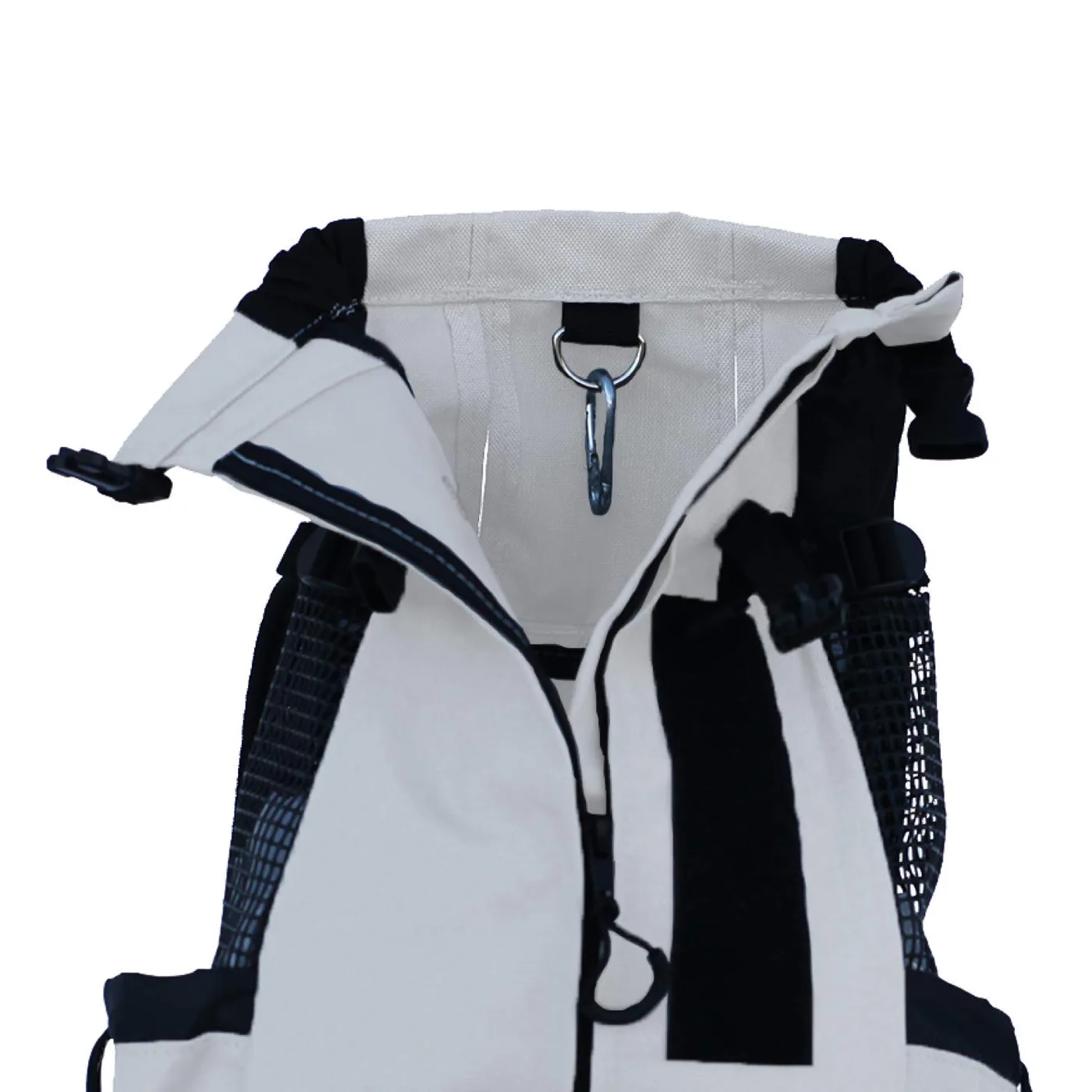
Buckle hardware: the most valuable brand position in this assembly
Buckles are expensive relative to their size, which is exactly why they matter. Nothing else on this feature is touched as often, seen as closely or remembered as clearly.
Side-release buckles are standard for good reason: they operate one-handed, release predictably, and are available in large volumes at reasonable prices. For most programmes they are the correct choice, and specifying a branded version costs far less than designing one.
Audible feedback deserves more attention than it gets. A buckle that clicks clearly tells the traveller the connection is made without requiring a visual check, which is precisely what someone juggling documents and a lead actually needs in the moment.
Custom buckle bodies with moulded logos are the strongest upgrade available. The tooling cost is real but modest, the unit premium is small, and the result appears in every travel photograph taken of the product. For programmes competing on perceived quality, this returns more than almost any equivalent spend elsewhere.
Hook-based systems are the fastest to fit, which matters for travellers juggling documents, but they can release unintentionally when snagged. Where hooks are specified, a secondary retaining loop is worth adding rather than regretting.
Finishes deserve the same discipline applied elsewhere in the range. Dark, textured finishes resist the scuffing that inevitably occurs against luggage handles and conveyor surfaces, whereas bright finishes show every mark within a single trip.
Nickel content and coating compliance apply to this hardware like any other metal component, and should be screened at development rather than during a retailer's audit.
Compatibility with luggage-mounted accessories is worth noting. Many travellers already use add-on straps around their cases, and a new system that cooperates with those rather than competing for the same path is considerably more likely to survive the first real journey.
One small but genuinely appreciated detail: the buckle should be operable with gloves on. Winter travel is when this feature gets used most, and winter conditions are when small hardware is hardest to operate.
Anchoring for a strap that pulls sideways
Strap loads are unusual because they arrive laterally from several directions at once, and often through vibration rather than through a single event.
Anchors should therefore be distributed rather than point-loaded. Continuing each strap anchor into a webbing spine that runs around the panel, rather than terminating it in face fabric, prevents the incremental tearing that otherwise appears after a few journeys.
Lateral direction matters because a strap wrapped around a case pulls inward and downward simultaneously. An anchor designed only for outward pull will delaminate progressively, and the first visible sign is usually a slight distortion rather than a clean failure.
Stitch patterns should be the standard box-and-cross with bar-tacked corners, and where there is space, doubling the row at the outer edge distributes load further. These instructions cost nothing to write and prevent the most common warranty claim attached to this feature.
Spare strap assemblies are a sensible addition to the after-sales range. Straps are lost, damaged by airline handling and deliberately removed by owners who prefer to carry, and having replacements available keeps the whole system usable rather than permanently degraded.
Vibration-induced wear is frequently overlooked. Hours against a moving case rubs both the strap and the panel it crosses, so adding a smooth wear patch at contact points is a small specification that extends appearance considerably.
Consider also whether the strap should be detachable. Detachable versions launder better and replace cheaply, but they get lost, and a lost strap is functionally a lost feature. Fixed versions are simpler and usually the better consumer choice.
Water and dirt resistance deserve a line for this assembly, since anything wrapped around a case eventually meets wet pavement and airport flooring. Solution-dyed polyester handles both considerably better than printed alternatives, and it costs very little more at typical programme volumes.
Finally, decide where the strap lives when unused. Loose webbing hanging from a bag looks untidy and gets caught in doors, so a stow position - whether a small pocket or a keeper loop - should be designed rather than left to the traveller.

Routing paths the traveller can follow without thinking
This feature succeeds or fails on whether someone can route it correctly on the first attempt, in a hurry, without reading anything. That is a design target rather than a documentation problem.
The best test of routing is also the fastest: ask someone to fit it while carrying the animal. Failure modes cluster around exactly those conditions, and any design that survives them will survive everything quieter.
The simplest effective path runs around the back of the case's vertical handle and back to the carrier's own hardware, forming a loop that pulls the carrier toward the case. Anything more elaborate increases fitting time and mistakes proportionally.
X-configurations, where two straps cross over the top of the case, provide noticeably better stability for large or soft luggage and are appropriate where the range targets those cases. They double fitting complexity, which is the honest trade.
Marking helps more than instructions. Colour-contrasting one strap end, or printing a small directional arrow, removes ambiguity in a way no paragraph achieves, and costs almost nothing on the webbing run.
Length should be set so the traveller needs at most one adjustment. Requiring several attempts before the strap is usable guarantees that most users will leave it slightly wrong, which is worse than a simpler system set correctly.
One more consideration for larger cases: whether the strap can reach at all. Very large check-in luggage has a circumference beyond what carrier-mounted straps reasonably span, so stating compatible case dimensions is honest and prevents predictable disappointment.
Check routing with the case upright and loaded rather than empty on its back. Orientation changes how gravity acts on the assembly, and several apparently reasonable paths stop working the moment the case stands up.
Colour differentiation is worth using deliberately. Making one strap end a contrasting shade tells the user instantly which part moves and which stays put, and it removes a category of instruction without adding a printed word to anything.
Finally, test with a person who has never seen the product. Their first attempt is the instruction manual nobody will read, and it tells you more than any internal review.
Fatigue testing, ageing and honest service-life language
Elastic-containing assemblies age, and programmes that pretend otherwise eventually receive photographs of a slack strap beside a slightly damaged carrier. Being honest about service life is cheaper than replacing product.
The core measurement is recovery: after a defined number of extension cycles, does the assembly return to within a stated percentage of its original length? Anything losing more than a few percent at the sample stage will not survive genuinely frequent travel.
Heat ageing deserves inclusion for programmes sold in warm climates. Rubber cores degrade faster above ambient temperatures commonly reached in vehicles and holds, and a strap specified in a temperate sampling room behaves differently in summer distribution.
Cold weather deserves the same attention given to heat, because elastic stiffens noticeably at low temperatures and loses the forgiveness that justified specifying it in the first place.
UV matters less indoors and considerably more for anyone leaving luggage near a window or poolside, which describes a surprising share of pet travel. Specifying UV-stabilised webbing costs little and eliminates one visible ageing pathway.
Documentation should then state replacement intervals plainly. Telling an owner to inspect every season, and showing what degradation looks like, converts a future complaint into routine maintenance - and it is a genuinely responsible thing to put in print.
Independent verification of these figures is worthwhile at this level. We arrange cycle and ageing testing through third-party laboratory services, and because the resulting report belongs to the client, it travels with the brand rather than with any supplier relationship.
Vibration is the last variable worth specifying rather than assuming. Hours against a moving case abrade the strap and the panel it crosses, so a wear patch at contact points and a stated abrasion expectation prevent the fuzzy edge appearance that otherwise arrives well before any functional problem does.
Where standardised reference methods are preferred for comparison across a range, published ASTM standard test methods give every supplier the same yardstick.
Merchandising a strap system in a travel range
Because a strap is the more adaptable of the two travel solutions available to most ranges, it carries several merchandising roles that a sleeve cannot, and planning them early avoids expensive later changes.
Accessory programmes also produce useful product intelligence. Sales patterns show which sizes of case customers actually pair with the carrier, and that information is worth having before developing the next travel hardware iteration.
The retrofit accessory is the most valuable. Owners of existing products in the range gain travel capability through a purchased part, which is incremental revenue with almost no development cost and a strong reason to keep customers inside the brand.
Tiering is the second. A base carrier without travel hardware, a mid version with a strap, and a premium version with both a strap and the trolley sleeve specified elsewhere in the range creates three clearly differentiated price points from one platform.
Bundles are third. Straps plus a travel document wallet, ID holder or collapsible bowl create a genuine travel kit rather than a discount mechanism, and kits photograph considerably better than individual items in e-commerce listings.
Fourth is co-branding with luggage labels, which is easier to negotiate than most partnerships because both products appear in the same frame and neither competes for attention.
Packaging should answer two questions immediately: which cases this works with, and how to route it. A single diagram on the belly band does more than four paragraphs in a manual nobody opens before boarding.
After-sales teams should be briefed alongside marketing. Questions about routing and compatibility arrive constantly in the first months, and the answer should be the same diagram that shipped on the belly band rather than an improvised explanation.
Finally, give e-commerce teams one photograph of the product attached to a neutral case. That single image does most of the explanatory work the whole system requires, and it is usually reused for several seasons.
Costing, sampling evidence and inspection
Unit cost divides into webbing and elastic, buckle hardware, anchoring labour and testing amortisation. Fixed webbing versions begin around USD 1.20-1.70, hybrid assemblies USD 1.60-2.20, full elastic systems USD 1.40-1.90, and dual cross configurations USD 2.30-2.90, with custom buckle bodies adding tooling rather than much unit cost.
Planning volume across the whole range rather than per model tends to change the answer here, because hardware decisions made once apply everywhere, and that universality is itself a saving.
Two behaviours keep this affordable. Using one buckle family across the range concentrates purchasing and removes assembly error, and supplying elastic from a named grade avoids substituting a cheaper core that fails later.
Sampling should be evidentiary. Our production team builds strap assemblies into nominated shells within 6-10 working days and cycles them before shipment, so approval is based on recovery behaviour rather than on how the strap looked when first fitted.
Two quoting behaviours keep costs honest across a range. Sharing one buckle family everywhere concentrates purchasing, and naming the elastic grade rather than accepting any equivalent prevents the silent substitution that turns a sound specification into a warranty line within one season.
Inspection criteria accepted to AQL 2.5 should include strap length within plus or minus 5 mm, buckle engagement firmness verified by hand rather than visually, absence of skipped stitches at each anchor, correct bar-tack placement, and a visual check that elastic is not pre-stretched in packing. Where branded buckles are specified, logo registration should be part of the same check.
Bulk follows the standard programme: MOQ 500 units, 35-50 days from sample approval, T/T 30/70 terms and FOB Xiamen shipment, with straps folded rather than stretched so nothing loses tension before the customer ever uses it.
Production capability
- SGS-verified production space of 4,950 m², 149 machines, 7 assembly lines
- Pet carrier and pet bag output since 2014 from a 137-person team
- 200,000 units shipped monthly under BSCI and ISO 9001 systems
People Also Ask
Can I add travel capability to an existing carrier?
Yes, through a strap accessory. That is one of its strongest commercial advantages over a sleeve, which has to be built into the shell during manufacture.
Do I need both a strap and a sleeve?
Many travel ranges eventually offer both, with the strap as the universal default and the sleeve as the premium upgrade, giving two clear price points from one platform.
Why does my strap loosen during a journey?
Usually because the traveller set it loosely rather than because it stretched. Vibration then does the rest, which is why hybrid designs with an adjuster tend to behave better.
Does a strap work on soft luggage?
Often better than a sleeve does, since a wrapped strap does not depend on the case having a rigid shell or a conventional handle.
Should the strap be detachable?
Usually not for consumer ranges. Detachable straps launder better but get lost, and a lost strap amounts to a lost feature.
How often should it be replaced?
Inspect seasonally and replace when recovery is visibly reduced. Stating that plainly in the documentation converts a future complaint into routine maintenance.
Frequently Asked Questions
What is a suitcase attachment strap?
It is an adjustable webbing or elastic assembly that wraps around rolling luggage and clips back to the carrier, holding it in place without a pass-through sleeve. It suits irregular handles, soft cases and bags already loaded with other items.
Is it better than a trolley sleeve?
Neither is universally better. A sleeve is more stable when it fits and requires no adjustment; a strap adapts to cases a sleeve cannot accommodate, at the cost of depending on correct use each time.
Will the elastic go slack over time?
All elastic loses recovery eventually, which is why we specify recovery after a defined number of cycles and test it. A hybrid design with an adjuster depends less on elasticity than a full bungee does.
What width should the strap be?
20-25 mm suits light carriers; more loaded combinations need 25-32 mm so the strap does not dig into the case or the carrier during transport.
Can we put our logo on the buckle?
Yes, and it is one of the highest-return brand positions in the range. Custom buckle bodies carry modest tooling and appear in nearly every travel photograph of the product.
Why use elastic rather than fixed webbing?
Elastic tolerates different case depths and forgives imperfect adjustment. Fixed webbing never fatigues but must be set correctly every time, which many travellers do not do.
How should the strap be routed?
The simplest reliable path runs around the back of the case's vertical handle and back to the carrier's own hardware. More elaborate routes increase mistakes more than stability.
Where should the strap go when unused?
Anywhere it cannot hang loose. A keeper loop or small pocket keeps it tidy and out of doors, both of which matter more than owners expect on their first trip.
How much does it add to unit cost?
USD 1.20-2.90 depending on construction, plus tooling if a custom buckle body is specified. Branded buckles add relatively little per unit once the tool exists.
What is the MOQ?
MOQ 500 units. Using one buckle family across several models concentrates purchasing and removes a whole category of assembly error.
How long does sampling take?
Assemblies built into nominated shells arrive in 6-10 working days, cycled before shipment so approval reflects recovery rather than first impressions.
How is it inspected in bulk?
Strap length within plus or minus 5 mm, buckle engagement checked by hand, no skipped stitches at anchors, correct bar-tack placement, elastic not pre-stretched, and logo registration on branded buckles, all accepted to AQL 2.5.
Talk to QUANZHOU JUNYUAN BAGS about a pet carrier program: MOQ 500 pieces per colourway, samples in 6-10 working days, bulk production in 35-50 days under AQL 2.5 inspection.
Get a free quote Request a sample