Purse Shape Pet Carrier: Fashion Bag Design
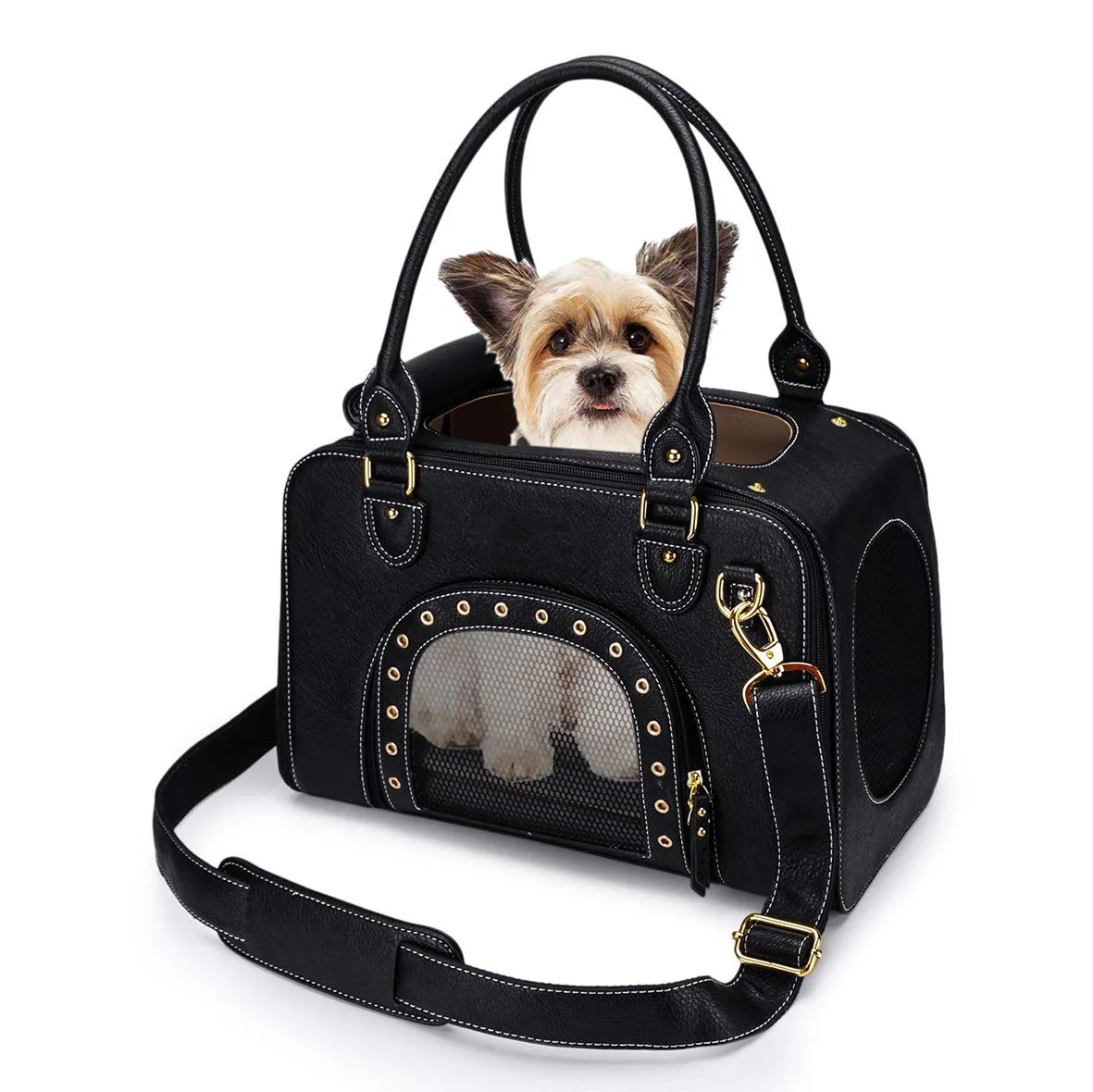
A purse shape pet carrier is a structured carrier built with handbag construction - shaped panels, set-in handles, metal hardware and a lined interior - typically 36-44 cm wide and rated for 5-7 kg. It uses a moulded or bonded body rather than a soft shell, and at MOQ 500 it costs roughly USD 16.80-26.40 per unit, the highest unit cost of any carry form in this series.
The purse silhouette is the only carry form where the customer is buying a fashion object first and a pet product second, and that changes every decision in the specification. Price sensitivity drops, tolerance for compromise drops further, and the details that would be irrelevant on a tote - zip teeth, edge paint, hardware weight, the sound a clasp makes - become the product. It is also the format where a brand can charge the most and lose the most: a purse carrier that looks almost right is worse than a plain carrier that looks honest, because the customer compares it against real handbags rather than against other pet products.
- Sampling: structured prototype with hardware fitted and a loaded shape test in 6-10 working days.
- Minimums: MOQ 500 pieces per colourway; metal hardware usually carries its own minimum and tooling.
- Schedule: bulk runs 35-50 days from approved sample, with custom hardware the longest-lead component by some margin.
- Quality: hardware finish, edge finish, panel symmetry, seam burst and lining inspected to AQL 2.5.
- Terms: T/T 30/70, FOB Xiamen, individually bagged in a dust bag and boxed to protect the structure.
Custom pet travel bag programmes are usually quoted with the airline dimension printed into the technical pack, so there is no argument at inspection.
The cues that make a carrier read as a handbag
Customers identify a handbag in about a second, and they do it from a small set of signals that have nothing to do with pets. Replicating those signals is the whole design task, and each of them has a cost.
The first cue is a defined top edge. Handbags have a structured opening - a frame, a rolled edge, a set-in zip panel - rather than a soft hem. On a pet carrier that top edge also carries the closure, so the two requirements coincide; the investment is justified twice.
The second is set-in handles. A purse handle rises from the body at a defined angle and returns to it, rather than continuing down the side as a webbing run. It looks less strong than it is, because a set-in handle with a proper internal anchor and a reinforcement plate easily carries 7 kg - the engineering is hidden, which is exactly the point.
The third is a base with feet. Four small metal or moulded feet at the base corners are a handbag convention, they keep the unit off surfaces, and they immediately separate the product from every soft carrier on the shelf. They cost very little and they read as quality more strongly than any other single component.
The fourth is material behaviour. Handbag materials hold a crease and a curve; they do not slump. That is a substrate property rather than a design one, and it is why material choice is the largest single decision in a purse programme.
The fifth is restraint in branding. Fashion products carry small marks. A large logo on a purse carrier identifies it as pet equipment within half a second, which is the opposite of the intention.
Get those five right and the product is read as a bag with an unusual function, which is what the buyer wants. Miss one and it is read as a pet carrier styled as a bag, which is worth substantially less.
Hardware is the fastest quality signal available
Nothing communicates price faster than metal. A customer who knows nothing about construction will pick up a bag, feel the weight of the zip puller, look at the plating and decide within seconds what it is worth. On a purse carrier that judgement happens before they notice the pet function at all.
Zips come first. A metal-toothed zip with a substantial puller reads as quality; a coil zip with a light puller reads as luggage. The difference in unit cost is modest and the difference in perceived value is large. Specify a branded or unbranded metal chain of a known gauge, and check that the slider action is smooth - a stiff slider on an expensive-looking bag is a worse impression than a cheap zip on a cheap one, because it suggests nobody tried it.
Then feet and clasps. Metal feet are the cheapest luxury signal in the specification and should be specified as a solid fitting rather than a plated plastic, because plating wears off a plastic foot within weeks and the wear is directly visible on the base. Turn locks, magnetic clasps and twist closures each read differently - a turn lock reads classic, a magnetic clasp reads contemporary - and the choice should follow the brand's fashion position rather than cost.
Plating should be specified with a wear expectation. A light gold or gunmetal plating on a frequently touched fitting will wear through at the contact points within a season, and the fix is either a thicker plating specification or a darker finish that hides wear. This is a specification line, not a finishing detail.
Weight is a genuine consideration. Metal hardware adds grams, and on a carried - rather than worn - product that matters less than on a backpack, but it still matters. Spend the weight budget on the two fittings the customer touches: the zip puller and the clasp. Use moulded components for everything structural and invisible.
Finally, hardware is the longest-lead item in the entire programme. Custom tooling runs on its own schedule and it is the single most common reason a purse programme misses a season, so it should be specified and ordered first, before the pattern is finalised.
Materials: vegan leather, PU and the touch test
The material decision dominates a purse carrier because the product is judged by hand-feel before it is judged by eye. Three families are commercially viable, and they sit at distinct price points.
Polyurethane-coated fabrics are the workhorse. Modern PU coatings can be made soft, grained and matte, they take embossing well, and they cost a fraction of leather. Their weakness is longevity: lower-grade PU hydrolyses and peels after two or three years, which for a premium product is a reputational problem. Specify a hydrolysis-resistant grade and ask for the test data rather than accepting a generic description.
Microfibre and microfibre-suede materials are the premium synthetic choice. They feel closer to suede than any PU, they wear well, and they accept quilting and edge finishing beautifully. They cost more and they show water marking, which is a care-instruction issue rather than a defect.
Textured woven fabrics with a coating - jacquards, embossed canvases, quilted nylon - give a fashion-forward reading at mid cost and are the most forgiving in use. They are the right answer for brands whose positioning is contemporary rather than classic.
| Material | Cost at 500 (USD) | Hand-feel | Durability | Positioning |
|---|---|---|---|---|
| Standard PU coated woven | 2.40 - 3.60 | Firm, plastic | 2-3 years | Entry premium |
| Hydrolysis-resistant PU | 3.80 - 5.20 | Soft, grained | 4-5 years | Mid premium |
| Microfibre suede | 5.60 - 7.80 | Soft, suede-like | 4-6 years | High premium |
| Quilted technical woven | 4.20 - 6.10 | Textured, soft | 5 + years | Contemporary |
One test resolves most material debates: fold a corner sharply, hold it for ten seconds, and look at the crease. Materials that whiten or crack at the fold will do the same on a product within a season. It takes a minute and it eliminates more bad options than any specification sheet.
Substance documentation should be prepared as routine. Fashion-adjacent products attract chemical-content questionnaires at retail, and certification through OEKO-TEX standards, kept on file, answers them before they are asked.
Construction details that carry the price
Handbag construction differs from bag construction in a handful of specific operations, and those operations are where a purse programme either earns its price or wastes it.
Edge finishing is the most visible. A raw cut edge on a synthetic material reads as cheap; a bound edge reads as luggage; a painted edge reads as handbag. Edge paint is applied in two or three coats with sanding between, it requires skilled labour, and it is the single operation most responsible for the difference between a USD 18 product and a USD 40 one. It is also the operation most likely to fail in production, so it needs a defined acceptance standard - no cracking, no tackiness, even coverage.
Quilting is the second. A quilted panel transforms a flat material into something that reads as crafted, and it works with synthetic wadding under a face fabric. Stitch pattern matters: diamond reads classic, horizontal channels reads contemporary, and random patterns read as mistakes. Quilting also adds structure, which is useful on a pet carrier where the walls need to hold.
Piping is the third, and it is the cheapest of the three. A narrow cord in the panel seams defines the silhouette and, on a structured product, helps the walls hold their shape. Contrast piping gives a second colour placement that belongs to the construction rather than to a logo.
Panel symmetry is the fourth and it is not an operation but an inspection standard. On a structured product every panel is visible and compared against its opposite; asymmetry of more than 2-3 mm at the top edge is noticeable and cannot be corrected after assembly.
Finally, the interior is not exempt. A customer opening a purse looks inside, and a lining that is stapled rather than sewn, or an exposed foam edge, undoes everything the exterior achieved. Finish the inside as if it were the outside.
Structure: holding shape with an animal inside
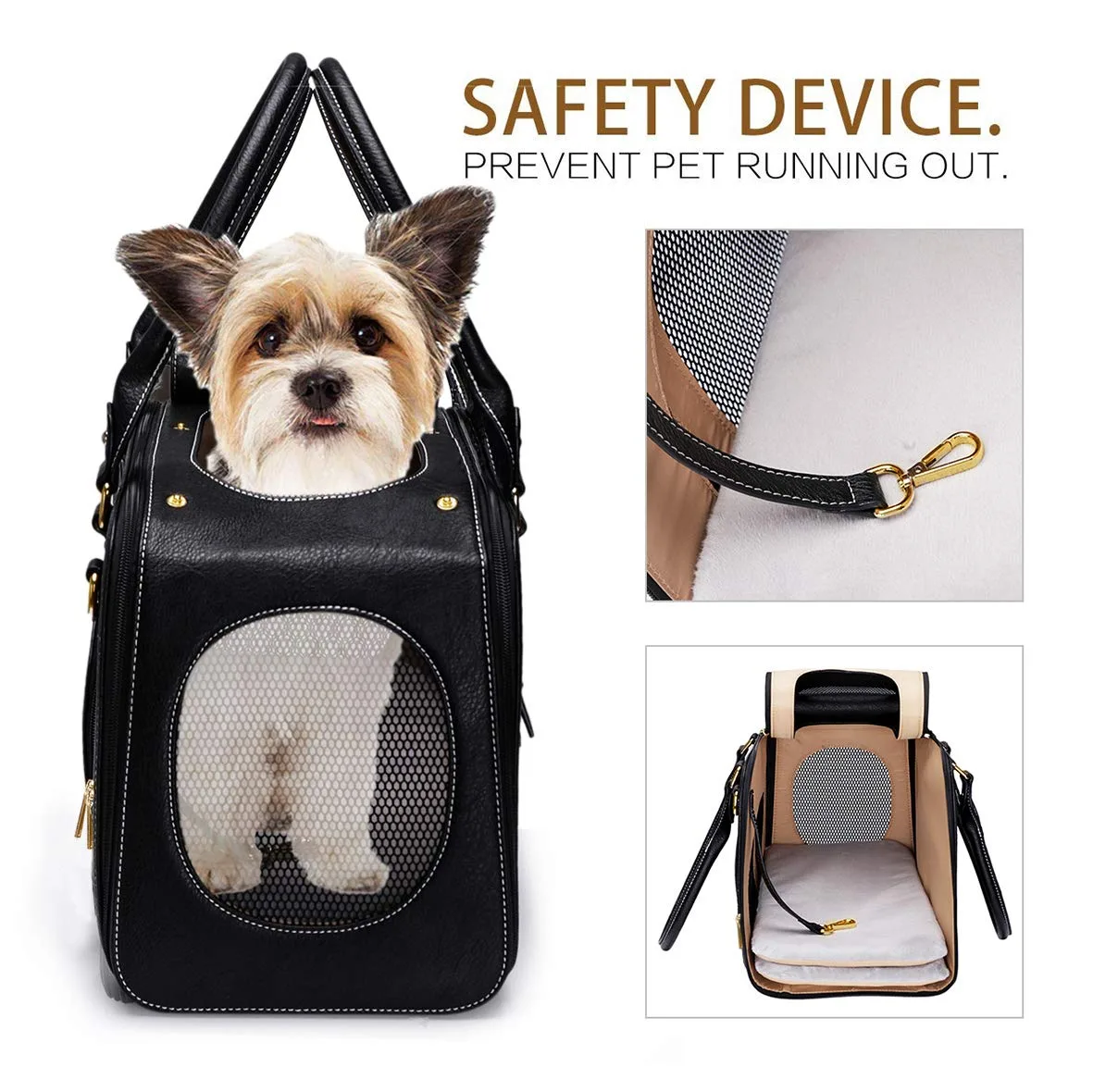
A handbag holds its shape because it is built on a substrate - bonded interlining, moulded panels, or a frame. A pet carrier has to do the same while containing seven kilograms of moving weight, which is a materially harder brief.
The base is the foundation. A rigid board of 6-10 mm, fully bonded into the base panel rather than slipped into a sleeve, gives a flat floor and a stable footprint. On a purse the base should not be removable, because removability implies softness and because the product is not intended to pack flat.
Wall structure follows, and there are two approaches. Bonded interlining gives a semi-structured wall that holds a curve and recovers from compression; a moulded panel gives a rigid wall that holds a precise shape and does not recover from a hard knock. For pet products, bonded is usually the better answer, because the animal's movement is better absorbed by a wall that yields slightly than by one that does not.
The top edge is the structural element most often underdone. A structured opening - a frame or a stiffened band - resists the outward pull of a loaded body, and without it the top edge bows outward under load, which is visible from the front and reads as poor quality even though nothing has failed.
Handle anchorage on a set-in handle requires an internal plate. The handle pull is concentrated at two points and a reinforcement plate spread across 60-80 mm distributes it into the wall structure. This is invisible in the finished product and it is the difference between a handle that lasts and one that tears out in month four.
Finally, test the loaded silhouette. Fill to rating, set the unit on a table and photograph it from the front and side. Any bowing, leaning or sagging is what the customer will see every time they use it, and it is far cheaper to correct at sampling than after tooling.
Interior: hiding the pet function and showing the craft
The interior of a purse carrier has to satisfy two contradictory briefs: it must function as a pet space and it must look like the inside of a handbag. The resolution is to make the pet function removable and the craft permanent.
A removable liner is the key component. It takes the soiling, it can be washed or replaced, and when it is removed the interior reads as a clean lined bag. It should be fixed at a minimum of four points so it does not shift, and it should be dark, since this is the surface the customer sees most.
The floor should be a wipe-clean panel under the liner, framed and bonded, with no exposed edges. On a purse the floor is also the base of the bag, so it has to be flat and rigid - which it is, for the structural reasons described above.
Pockets should be limited and well finished. One zipped pocket and two slip pockets is the handbag convention, and it happens to be exactly what a pet owner needs for a lead, treats and waste bags. Adding more pockets makes the product read as equipment.
Ventilation is the awkward requirement, because mesh reads as sporty and handbags do not have visible air vents. The workable solution is discreet ventilation: mesh panels at the sides placed low and set behind a decorative perforation or a bound aperture. It satisfies the airflow requirement without announcing it, and it should be specified for open area like any other carrier - roughly 20-30 percent across the side and end surfaces.
Tether anchorage should be on a webbing loop finished as if it were a bag detail, not as a pet fitting. It is a small thing and it is the difference between a product that reads as designed and one that reads as a bag with a pet clip in it.
Colour and finish: one coordinated system
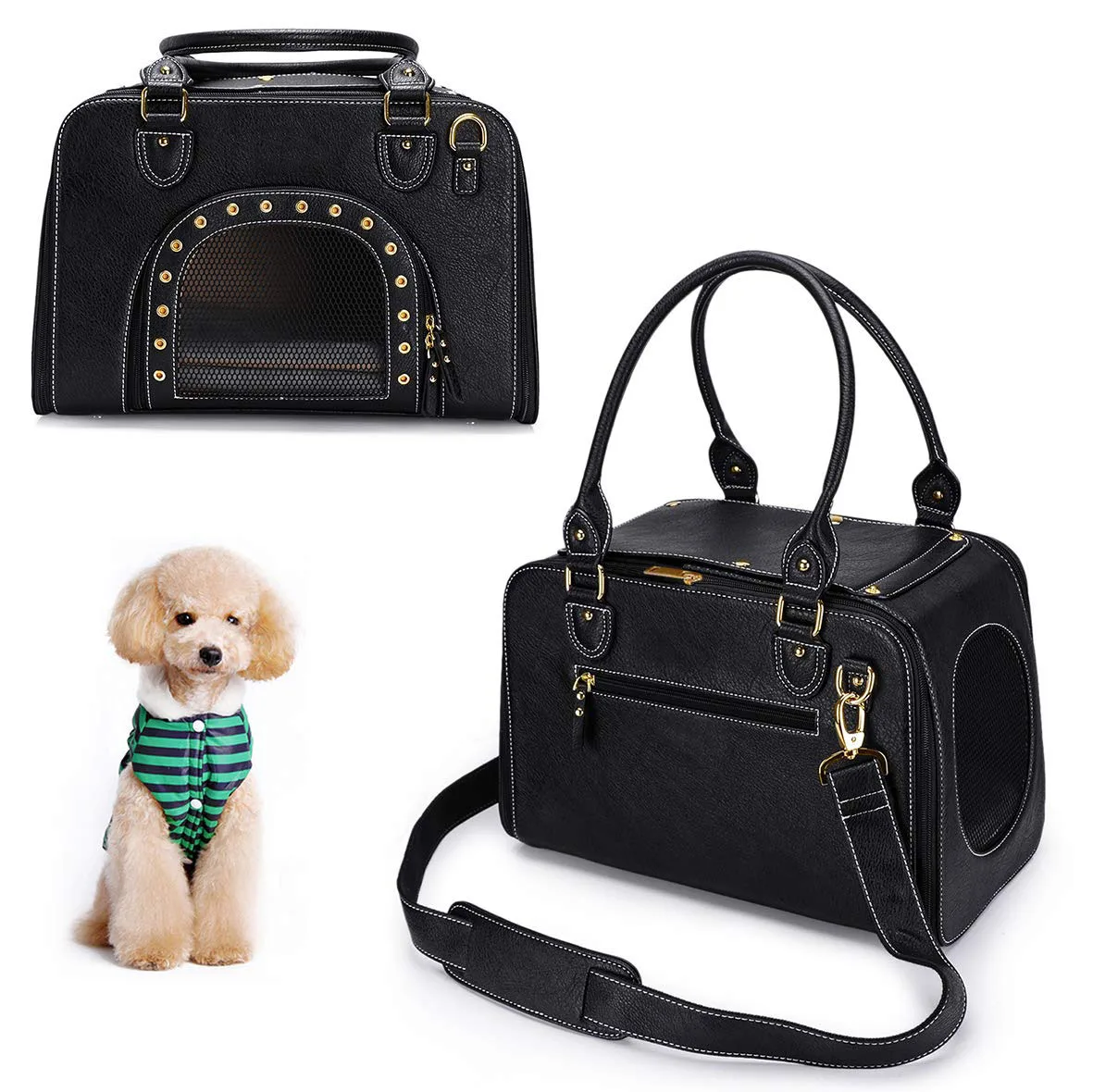
Premium products fail on colour coordination more often than on colour quality. A body, a lining, a thread, a plating and a print that are each acceptable alone can look cheap together, and the coordination is a design decision rather than a manufacturing one.
The practical method is to build a small palette and hold it across the range: a body colour, a trim colour, a metal finish and a lining colour. Four decisions, applied consistently across three colourways, produce a range that looks intentional.
Metal finish should be chosen with the body colour rather than separately. Warm-toned bodies want gold or light brass; cool-toned bodies want nickel or gunmetal; black works with both but reads most expensive with a dark gunmetal. Mixed finishes on one product look unresolved unless they are deliberate.
Thread and edge paint should match the body rather than contrast, except where contrast is the design idea. A visible contrast stitch on a quilted panel is a deliberate device; the same contrast on a top edge looks like a mistake.
Lining colour is the most underrated decision. A tonal lining reads expensive and hides wear; a contrast lining reads playful and shows everything. For a purse positioning, tonal is almost always right, in a mid-tone rather than a light one.
Specification should follow the discipline used across the range: colours referenced to Pantone standards with approved lab dips, and fastness tested to recognised AATCC procedures, because a coated material that crocks onto light clothing generates the kind of return that costs more than the whole unit.
Packaging: the unboxing is part of the product
No other carry form in this series has packaging as a requirement. A purse carrier arrives at a price point where the customer expects a box, a dust bag and a considered opening sequence, and delivering anything less costs more in perceived value than it saves in packaging cost.
The minimum set is three elements: a dust bag, a rigid or semi-rigid box, and a printed card. The dust bag does double duty - it protects the product in transit and it becomes a storage item the customer keeps, which puts the brand in a wardrobe for years. A branded drawstring bag in a soft non-woven costs very little and delivers that permanence.
The box should protect the structure rather than just contain it. A structured product crushed in transit arrives with a crease that no photograph will hide, so internal support - a paper fill or a simple card insert - is worth specifying. This is the same argument that applies across the shaped families in this series, where structure is the thing the packaging is protecting.
The card carries the functional information, which keeps it off the product. Size, weight rating, ventilation, care and the tether instruction all belong on a card in the box, not on a hangtag on a bag. A hangtag on a purse reads as retail markdown; a card reads as documentation.
One more element is worth considering for premium placements: a spare liner. It costs little at MOQ 500, it solves the washing problem completely, and it is the kind of inclusion customers mention in reviews.
Finally, keep the packaging restrained. Over-printed boxes on a fashion product read as mass market. One colour, one mark, good board - the same restraint that applies to the product itself.
Price architecture and building a premium range
A purse carrier is the most expensive product in a carry-form range and it should be priced as a deliberate top tier rather than as an outlier. That means the range below it has to be visibly simpler, so the step up reads as value rather than as an anomaly.
A workable architecture is three tiers: a tote at the entry, a structured shoulder or backpack shape in the middle, and a purse at the top. Each tier is separated by a visible material and hardware step rather than by a feature list, because customers judge tiers by what they can see and touch.
Within the purse tier, range building should be shallow and wide - few sizes, more colourways. Two sizes is usually sufficient, because the buyer at this level is less size-sensitive and more colour-sensitive, and because each additional size multiplies a high unit cost across inventory.
Colourway cadence should be slower than for a tote. A premium product is expected tolast more than one season, so two colourways a year with one carry-over classic is the right rhythm, at MOQ 500 per colourway.
Hardware is the constraint on all of this, because custom metal tooling has its own minimum and its own lead time. The efficient approach is one hardware suite - zip puller, feet, clasp - used across every colourway and every size, so the tooling is amortised across the whole programme.
Programmes run under ISO 9001 frameworks keep the material, hardware and finish specifications documented, and third-party verification through SGS is available where a department-store account requires an independent laboratory. Incoming production is inspected to AQL 2.5 with hardware finish and edge finish as defined defects, because those two are what the customer sees first and forgives least.
Production capability
- SGS-verified production space of 4,950 m², 149 machines, 7 assembly lines
- Pet carrier and pet bag output since 2014 from a 137-person team
- 200,000 units shipped monthly under BSCI and ISO 9001 systems
People Also Ask
Why does my premium carrier still look cheap?
Usually hardware and edge finish. Light plating, a coil zip and unpainted cut edges identify a product as mid-market regardless of the material used.
Is vegan leather acceptable at a premium price?
Yes, if the grade is right. Hydrolysis-resistant PU and microfibre suede perform and feel premium; low-grade PU peels and damages the brand more than a cheaper honest material would.
Should the lining contrast or match?
Match tonally, in a mid-tone. Contrast linings read playful and show wear, which works against a fashion positioning.
Do I need feet on the base?
Yes. Four small feet are the cheapest luxury signal available, they keep the unit off surfaces, and they separate the product from soft carriers immediately.
Is a dust bag worth the cost?
Yes. It protects in transit and becomes a storage item the customer keeps, which keeps the brand visible for years.
How much ventilation can I hide?
Around 20-30 percent open area across sides and ends using low-set mesh behind decorative apertures. Below that, expect retailer questions.
Should I include a spare liner?
For premium placements yes. It solves the washing problem completely, costs little at MOQ 500, and is frequently mentioned in reviews.
Frequently Asked Questions
How much does a purse shape pet carrier cost?
Roughly USD 16.80-26.40 per unit at MOQ 500 depending on material and hardware, moving toward USD 11.90-18.20 at 5,000. It is the highest unit cost of any carry form.
What makes a pet carrier look like a handbag?
Five cues: a defined structured top edge, set-in handles, base feet, a material that holds a crease, and restrained branding.
Which material is best?
Hydrolysis-resistant PU for mid premium, microfibre suede for high premium, quilted technical woven for a contemporary positioning. Standard PU peels in two to three years.
Is metal hardware worth the cost?
Yes. Plating, zip weight and feet are the fastest quality signals a customer reads, and they are judged before the pet function is noticed.
How is ventilation handled discreetly?
Mesh panels set low and behind a bound or perforated aperture on the sides and ends, giving roughly 20-30 percent open area without reading as sports equipment.
Should the base be removable?
No. Bond the board into the base panel. Removability implies a soft product and the purse is not intended to pack flat.
What packaging is expected at this price?
A dust bag, a structured box with internal support, and a printed card carrying the functional information so it stays off the product.
Why does edge paint matter so much?
It is the operation most responsible for the difference between a mid and a high price impression. Specify coats, sanding and an acceptance standard.
How many sizes should a purse range have?
Two. Buyers at this level are more colour-sensitive than size-sensitive, and each additional size multiplies a high unit cost across inventory.
Should hardware be shared across colourways?
Yes. One hardware suite across every colourway and size amortises custom tooling across the whole programme.
What is the longest-lead component?
Custom metal hardware. It has its own minimum and its own schedule, and it is the most common reason a purse programme misses a season.
How do I check a material quickly?
Fold a corner sharply for ten seconds and look at the crease. Materials that whiten or crack will do the same on the product within a season.
How long does development take?
Structured prototype with hardware fitted in 6-10 working days, then 35-50 days bulk from approved sample, with custom hardware the longest lead.
Talk to QUANZHOU JUNYUAN BAGS about a pet carrier program: MOQ 500 pieces per colourway, samples in 6-10 working days, bulk production in 35-50 days under AQL 2.5 inspection.
Get a free quote Request a sample