Paracord Survival Rope in Custom Pet Carrier Design
Type III 550 paracord is the survival-rope spec worth designing into a custom pet carrier. It measures about 4 mm across, carries seven two-ply inner strands under a 32-strand nylon sheath, and is rated to a 550 lb (249 kg) minimum break. On a carrier it serves as handle wrap, zipper pull, lash point and ID loop at a unit cost adder of roughly USD 0.35 to 1.80, and it holds a Pantone-matched brand shade better than most flat webbing.
Executive summary
Paracord detailing turns a functional rope into a brand signature: a cobra-woven handle, a colour-cored zipper pull and a lash tab on the side panel all read as deliberate design rather than assembled hardware. The engineering is simple but not trivial. Cord length per handle wrap has to be calculated from grip diameter and weave pitch, ends need heat sealing, and every load-bearing application has to pass a pull test before the design leaves sampling. We specify Type III 550 cord as the default and step up to 750 or 950 grade only where a grab handle is expected to take real load.
Commercial terms are fixed and predictable. MOQ 500 pieces per colourway, with sampling completed in 6-10 working days and bulk production 35-50 days after written sample approval. Every shipment is inspected to AQL 2.5, and cord colour, weave type and end finish are all recorded on the approved sample card so reorders match the original drop. Our production team runs these programs through an SGS-verified production base audited to BSCI and ISO 9001, and any third-party pull or abrasion test you require is booked through SGS testing services or an equivalent accredited laboratory before bulk starts.
For a custom pet tote or backpack carrier, strap geometry is the first thing to fix - width, padding and load-lifter position decide how the bag carries.
What Paracord Actually Means in a Pet Carrier Spec
Paracord began as parachute suspension line and became a general-purpose survival cord because the specification is unusually honest about what the material does. Type III, the grade used for nearly every consumer pet-product application, is defined by a nominal 4 mm diameter, a braided nylon sheath of 32 interwoven strands and a core of seven two-ply nylon yarns. The military specification MIL-C-5040H sets a minimum break strength of 550 pounds, which is where the familiar 550-cord name comes from, plus a minimum elongation near 30 percent before failure. That mix of soft hand, high strength-to-diameter ratio and abrasion-resistant sheath explains how the material migrated from survival kits into pet carriers, collars and leashes without any change to the underlying construction.
For a private-label carrier program the practical point is that paracord reads as intentional design. A flat 25 mm webbing handle is a component that buyers scroll past; a cobra-woven handle in a brand colour is a detail that survives a product-page zoom, photographs well on a lifestyle shot and gives a merchandiser a visible reason for a price step. The sheath also takes dye with a tighter shade tolerance than most woven webbing accepts, because the yarn is extruded and dyed in long runs that hold consistency across reorders. Core yarns can be left natural or dyed to a second shade, which gives a subtle two-tone effect that appears only where the cord is cut or where a knot opens the weave.
There is a durability argument too. Nylon 6.6 melts around 260 degrees Celsius, absorbs less water than polyester cord of the same diameter, and recovers well after repeated flexing. In a carrier that gets folded into a car boot, shoved under an airline seat and machine-washed twice a year, that recovery matters more than raw break strength. We treat 550 cord as the baseline, quote 750 and 950 grades for heavy grab handles, and decline to use decorative no-name cord on any part that carries load.
One caution worth stating early: cord is not webbing, and it should not be substituted where a flat load path is required. A shoulder strap needs width to spread pressure across the body; a 4 mm cord concentrates it. The design rule we apply is that paracord handles grip, pull and lash functions, while webbing handles suspension and weight bearing. Mixing the two correctly is what separates a considered product from a costume.
Where Cord Detailing Belongs on a Carrier
The strongest applications are the ones the hand touches. A wrapped top handle is the classic: 1.8 to 2.4 metres of cord per handle depending on grip diameter and weave pitch, finished with a heat-sealed end tucked under the wrap so no raw cut is visible. The wrap adds bulk that makes a narrow grab handle comfortable, hides the seam of the underlying webbing, and gives the eye a texture contrast against an otherwise smooth shell. On a structured carrier with a molded EVA base, a woven handle is often the only soft, obviously crafted element on the whole silhouette.
Zipper pulls are the second high-value placement. A 120 to 160 mm length folded into a lanyard knot, threaded through the puller eye and heat sealed gives a pull that is easy to find with a gloved hand and impossible to confuse with a generic slider. Because pulls are small, they are also the cheapest place to introduce a second accent colour: the main shell can stay in a conservative navy while every pull carries the seasonal accent. That is a merchandising trick that costs a few cents per unit and makes a whole collection look coordinated.
Lash points and side loops are the third placement. A short cord loop bar-tacked into a side seam gives owners somewhere to clip a bowl, a waste-bag dispenser or an ID tag, and it creates an obvious story for the product page: the carrier is part of a system, not a single object. We usually specify these loops at 90 to 110 mm of cord, folded and bar-tacked with a 25 mm stitch box, which is enough to take the pull of a clipped accessory without distorting the panel.
- Handle wrap: 1.8-2.4 m per handle, cobra or king cobra weave, sealed end tucked under
- Zipper pull: 120-160 mm folded lanyard, heat-sealed, often in the accent colour
- Side lash loop: 90-110 mm folded, bar-tacked into a seam with a 25 mm stitch box
- ID or tag loop: 70-90 mm near the top opening, sized for a split ring to pass
- Base lash grid: optional on adventure styles, 4-6 loops, decorative plus functional
Placements to avoid are equally clear. Cord should not run across a mesh ventilation panel where it blocks airflow, should not sit where a pet can reach it with teeth, and should not be used as the sole attachment for a shoulder strap. Those three rules eliminate most of the failure modes we see in competitor samples.
Weave Structures and the Shelf Read They Create
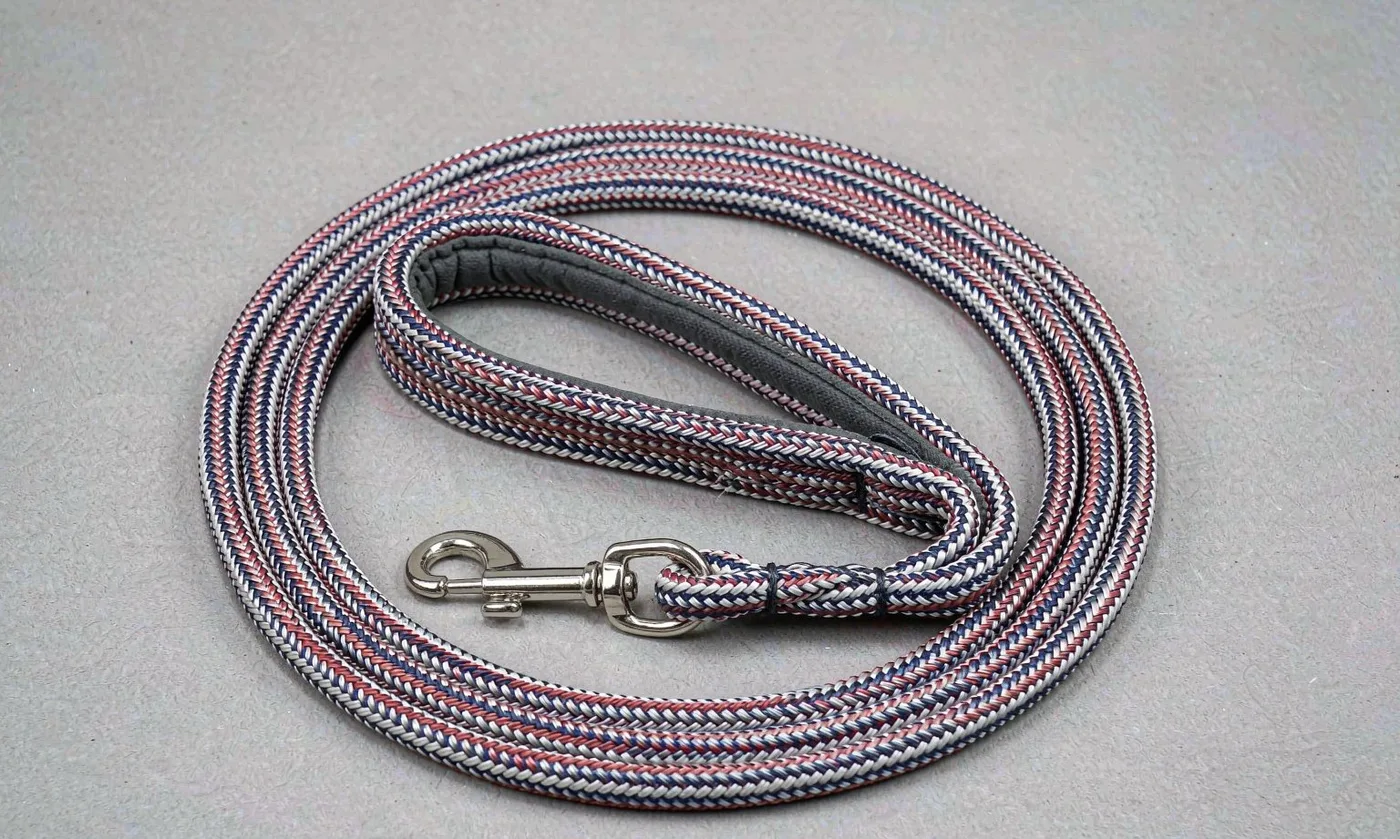
Weave choice is the single most visible decision in a paracord program, and it changes both cost and perceived value. A cobra weave is the default: two working ends alternate over and under a core, producing a flat, ribbed braid about 12 to 14 mm wide over a 20 mm webbing core. It uses roughly 1.3 metres of cord per 100 mm of finished wrap and takes an experienced operator eight to twelve minutes per handle. A king cobra weave doubles the structure by weaving a second cobra layer over the first, which reads heavier and more premium, adds about 60 percent to cord consumption and roughly doubles labour time.
Fishtail and flat braid weaves are the leaner options. They consume less cord, sit flatter against the handle and look more technical and less outdoorsy. For a brand positioned around urban commuting rather than hiking, a flat braid in a tonal shade often reads better than a chunky cobra in high-contrast colours. The trade-off is that flat braids show inconsistency more easily: an uneven pitch is obvious on a smooth braid where a cobra weave hides it in the ribs.
There is also a production reality behind weave choice. Hand weaving is labour, labour is the largest component of the cost adder, and labour is where quality variation enters. We cap weave work at partner facilities that run cord as a dedicated station with a fixed pitch gauge, and we require a retained reference wrap per colourway so an operator in week six can match an operator in week one. Where volume justifies it, a semi-automated braiding jig reduces variance further, but the set-up cost only makes sense above roughly 3,000 units per weave.
Colour interaction with weave deserves its own note. In a two-colour cobra weave the two shades alternate along the length, so the perceived colour of the handle at a distance is a blend of the two. That blend is not the same as either Pantone reference, and it is not something a buyer can approve from a colour chip. We photograph the woven sample under neutral lighting and approve from the photograph plus the physical sample, never from the chip card alone.
Colour Engineering: Building a Signature Palette
Paracord is one of the few components in a carrier where a brand can hold an exact corporate shade across every unit, every reorder and every product in a family. The yarn supplier dyes to a Pantone reference with a tolerance we verify by spectrophotometer, and because the sheath is a single continuous yarn the shade does not shift with weave tension the way a printed panel might. That reliability is why cord is often the element a brand uses to carry identity across a range that otherwise changes fabric, size and structure.
The practical constraint is inventory. Dyed cord is a stock item for common shades and a made-to-order item for anything custom, and custom dyeing carries its own minimum, typically 3,000 to 5,000 metres per shade. On a 500-piece carrier order using 2.2 metres per handle across two handles, consumption is roughly 2,400 metres, which means a custom shade is viable but leaves little margin for waste. The economical answer is usually to place the brand shade on the sheath and use a stock core, or to run the custom shade across two or three products so one dye lot serves the whole family.
Colour planning should also account for soiling. Light cords on a handle that is grabbed hundreds of times will show grime within weeks, and no wash test will change that. For light brand shades we recommend placing them on zipper pulls and side loops, which are touched less and sit away from the primary grip, and using a mid-tone or dark cord on the handle itself. This is a design decision that protects reviews, and it is cheaper than a fabric upgrade.
Finally, consider the colour story across a capsule. A four-colour drop with a shared neutral shell and four different cord colours is a far stronger shelf presentation than four different shell fabrics, and it costs dramatically less because only one fabric has to be sourced, tested and inventoried. The cord becomes the variable, which is exactly the role a small component should play in a well-planned line.
Load Paths, Knots and Pull Testing
Anything that carries load needs to be tested as a finished assembly, not as a raw cord. A 550 lb cord knotted into a loop loses meaningful strength at the knot, and the number depends on knot type: a figure-eight retains more than an overhand, and a poorly seated knot can drop the retained strength below half the rated figure. For that reason we test the finished loop or handle assembly, not the spool, and we set the acceptance threshold from the test result rather than from the cord rating.
The standard pull test for a wrapped handle is straightforward: anchor the handle, apply load through a 25 mm strap simulating the hand, ramp to the specified force and hold for ten seconds, then inspect for slip, sheath damage or stitch failure. We run 150 N for accessory loops and 400 N for grab handles as internal minimums, and we document results with photographs for the sample file. Where a client sells into a market with a specific requirement, we build to that number instead and reference the applicable standard in the test report.
Sealed ends are the other recurring failure point. A heat-sealed end that is cut too short pulls out of the weave under load; one cut too long leaves a hard, sharp nub that owners complain about. The correct finish is a seal about 4 to 5 mm long, trimmed flush while warm and then tucked under the last two weave crossings. It is a small detail that shows up constantly in returned-sample reviews, which is why it is a named line item on our sample approval checklist rather than an assumed skill.
Testing references worth citing on a spec sheet include the general test-method library at ASTM International for pull and abrasion methods, and the consumer-product requirements administered by the U.S. Consumer Product Safety Commission when the finished carrier is sold into the United States. Citing the method, not just the result, is what makes a test report defensible if a retailer asks for it twelve months later.
Cost, Minimums and Production Timing
Cost for paracord detailing splits into material, labour and finishing. Material is modest; labour dominates. The table below reflects typical adders on a 500-piece colourway with a standard cobra weave, and it is the fastest way to show a buyer where the money goes before a sample is cut.
| Application | Cord length | Weave | Labour | Unit cost adder (USD) |
|---|---|---|---|---|
| Zipper pull (2 per bag) | 280 mm total | Lanyard knot | 2-3 min | 0.35 - 0.55 |
| Side lash loop (2 per bag) | 200 mm total | None, folded | 3-4 min | 0.30 - 0.45 |
| Top handle wrap | 2.0 m | Cobra | 8-12 min | 1.10 - 1.55 |
| Top handle wrap | 3.2 m | King cobra | 16-22 min | 1.90 - 2.60 |
| Full handle plus 6 pulls | 4.0 m | Cobra | 20-26 min | 2.40 - 3.20 |
| Decorative base grid | 1.2 m | None, bar-tacked | 10-14 min | 0.95 - 1.35 |
Timing follows the standard program: MOQ 500 pieces per colourway, samples in 6-10 working days, and bulk 35-50 days after approval with AQL 2.5 inspection. The one variable that can stretch the sampling window is a custom dyed shade, since the dye lot has to be made before sampling can start; budget an extra eight to twelve working days for a non-stock colour. Everything else in a cord program runs on the normal critical path because cord, hardware and shell fabric are sourced in parallel rather than in sequence.
Where a program needs to hold a price point, the lever is almost always labour rather than material. Dropping from a king cobra to a standard cobra weave removes around 45 percent of the cord cost adder with almost no change to the visual identity if the colour stays the same. That is usually a better trade than switching to a cheaper shell fabric, which changes the entire look and feel of the product.
Freight and packing deserve a mention as well, even though they rarely appear in a costing conversation. A wrapped handle adds 10 to 16 mm to the packed height of a folded carrier, which on a 500-piece order can add a carton layer and therefore a measurable freight cost on an ecommerce program. Flattening the handle against the body during packing, or specifying a fold-flat handle structure, removes that cost entirely and is worth resolving during sampling rather than after the first shipment is booked.
Finally, build a small contingency into the unit cost for waste. Hand-woven cord work generates offcuts, and on a custom shade with a fixed dye lot the waste rate matters: at eight percent waste, a 2,400 metre consumption becomes 2,600 metres, which can cross a dye-lot threshold and change the shade approval path. We quote with waste included so the number a buyer approves is the number they pay.
Paracord as a Limited-Drop Device
Because cord is cheap, fast and visible, it is the ideal variable for a limited edition. A brand can run the same shell, same tooling and same pattern across four drops, changing only the cord colour and the woven label, and each drop reads as distinct on shelf. From a production standpoint this is close to a free product launch: there is no new pattern, no new mould, no new fabric testing, and the colourway minimum of 500 pieces applies per cord colour rather than per construction.
The collectible angle is stronger still. Numbered runs with a specific cord colour, released seasonally and never repeated, create the kind of scarcity that drives pre-orders and social posts. We have seen brands coordinate cord colour with a hang tag number, a woven label shade and a printed liner motif so that the whole package tells one story. The cost of that coordination is a few cents per unit; the perceived value is a limited product. The same logic applies at wholesale sell-in, because a buyer reading a line sheet sees four distinct products rather than one product in four colours, and that difference is visible in how many doors a collection gets placed into.
There is a practical warning about consistency, though. If a brand commits to "never repeated" colours, it must keep the dye formula on file, because a customer will eventually ask for a replacement part or a matching accessory. Keeping the formula costs nothing and prevents an awkward conversation later.
Pairing cord drops with retail moments works well too. A dark olive cord and a reflective-accent pull for an autumn hiking capsule, a bright coral cord for a spring city collection, a black-on-black with a single neon core for a collaboration: these are one-line changes to the bill of materials that marketing can build an entire campaign around.
Sampling and Approval Checklist
A cord sample should be approved against a fixed checklist, because the failure modes are all small and all visible after delivery rather than before. The items below are what we ask a buyer to confirm in writing before a bulk order is released, and they take about fifteen minutes to work through on a physical sample.
- Shade: cord sheath matches the approved Pantone reference under neutral lighting, photographed alongside the shell fabric for a blend check
- Weave pitch: consistent across the full length, with no skipped crossings at the ends
- End finish: 4-5 mm heat seal, trimmed flush, tucked under at least two weave crossings
- Grip comfort: wrapped diameter between 26 and 32 mm at the narrowest point
- Pull test: 150 N on accessory loops and 400 N on grab handles, held ten seconds, no slip
- Abrasion: 500 cycles against the shell fabric with no sheath fuzzing
- Wash: one domestic cycle at 30 degrees, no colour transfer onto the shell, no shrinkage of wrap
- Bar-tack: 25 mm stitch box on every folded loop, no skipped stitches
Once the checklist is signed, the physical sample is retained as the golden sample and the cord reference, weave type and end finish are written onto the specification card. That card travels with the order, and it is what an inspector compares bulk against at AQL 2.5. Without it, "matches sample" is an opinion rather than a measurable requirement.
Two items on that list deserve extra attention because they cause most of the disputes we see. Shade approval under neutral lighting is the first: retail lighting, showroom lighting and phone screens all distort a dyed nylon shade, and an approval made under warm showroom light is routinely rejected when the bulk arrives at a warehouse. Photograph the sample next to a grey card and approve from that image. Grip comfort is the second, because a wrapped handle that measures well can still feel wrong; have two people hold the sample for thirty seconds each before signing it off.
One last piece of practical advice: order two extra sample sets. One gets destroyed in testing, one goes to the photographer, and one stays in the file. Sample cost is trivial compared with the cost of a bulk run that has to be renegotiated because nobody can remember which shade was approved.
Order and quality terms
- MOQ 500 pieces per colourway; samples in 6-10 working days
- Bulk production 35-50 days after approval; AQL 2.5 inspection standard
- T/T 30/70 terms, FOB Xiamen, full document set per shipment
People Also Ask
What type of paracord is best for pet carriers?
Type III 550 cord is the right default. It is about 4 mm in diameter, has a 32-strand nylon sheath over seven two-ply core yarns, and is rated to a 550 lb minimum break, which is far more than any carrier handle needs while still handling softly enough to wrap comfortably.
Is paracord strong enough for a pet carrier handle?
Yes for grip and grab functions, provided the finished assembly is tested rather than the raw cord. Knots reduce retained strength substantially, so we test the wrapped handle or loop to 400 N for grab handles and 150 N for accessory loops and set acceptance from the result.
How much does paracord detailing add to unit cost?
Typically USD 0.30 to 3.20 per carrier depending on application and weave. Two zipper pulls add about USD 0.35 to 0.55, a cobra-wrapped top handle adds USD 1.10 to 1.55, and a king cobra wrap plus six pulls can reach USD 2.40 to 3.20. Labour, not cord, is the dominant cost.
Can paracord be Pantone matched?
The sheath can be dyed to a Pantone reference and verified by spectrophotometer. Custom shades usually carry a dye minimum of 3,000 to 5,000 metres and add eight to twelve working days to sampling, so stock shades are preferable for tight calendars.
Does paracord detailing survive machine washing?
It survives a domestic 30 degree cycle when ends are heat sealed and loops are bar-tacked, but light shades show soiling on high-touch areas. That is why we put brand shades on pulls and loops rather than on the primary grip.
Can cord replace webbing on a shoulder strap?
No. A 4 mm cord concentrates pressure where a 25 mm webbing spreads it, so cord should stay on grip, pull and lash functions while webbing handles suspension and weight bearing.
Frequently Asked Questions
What is the minimum order for a paracord-detailed carrier?
MOQ is 500 pieces per colourway. That minimum covers the shell fabric, the cord in the approved shade and any custom hardware, and it is the level at which unit economics start to make sense for hand-finished detailing.
How long does sampling take with custom cord?
Standard sampling is 6-10 working days. A non-stock dyed cord shade adds eight to twelve working days because the dye lot must be produced before the first sample can be woven.
What is the bulk production window?
Bulk runs 35-50 days after written sample approval, depending on order size, fabric availability and how much hand finishing the design requires. Heavily woven designs sit at the longer end of that range.
Which inspection standard applies?
Every shipment is inspected to AQL 2.5. Cord shade, weave pitch, end finish and bar-tack integrity are checked against the retained golden sample, which is the reference the inspector works from.
Can you mix two colours in one weave?
Yes. A two-colour cobra weave alternates shades along the length, which produces a blended appearance at a distance. Approve it from a photograph of the woven sample plus the physical piece, because a yarn chip will not show the blend.
Are cord colours consistent across reorders?
Stock shades are consistent because the yarn comes from the same supplier runs. Custom shades are consistent when the dye formula is kept on file, which we do at no charge so replacement parts and later accessories can match.
Is the cord safe if a pet chews it?
No cord is chew-proof. We keep cord away from areas a pet can reach inside the carrier and place it on exterior grip and lash points, and we flag any design that puts cord within reach of the opening.
What weave do you recommend for an urban commuter line?
A flat braid or fishtail in a tonal shade usually reads better than a chunky cobra for urban positioning. It sits flatter against the handle and looks technical rather than outdoorsy, though it shows pitch inconsistency more easily.
Can paracord be combined with reflective elements?
Yes, and it is a strong pairing. A reflective tracer strand woven into the sheath, or a reflective cord on the perimeter loops, gives night visibility without changing the daytime colour story.
Do you provide test reports for cord assemblies?
Yes. Pull, abrasion and wash results are documented with photographs and retained in the sample file, and third-party verification can be booked through an accredited laboratory before bulk starts.
Can cord detailing be added to an existing carrier design?
In most cases yes, subject to a sampling round. Adding pulls or side loops is a low-risk change; converting a webbing handle to a wrapped handle changes the pattern allowance and needs a fresh sample.
What file do you need to start a cord program?
A tech pack with placement drawings, cord length per placement, weave reference, Pantone call-outs and any load requirement. If you only have a photograph of a reference product, we can reverse-engineer a specification from it.
How is cord costing quoted?
As a line-item adder on the base carrier price, split into material, labour and finishing. That breakdown lets you see exactly where to cut if a price target has to be met, which is usually the weave labour.
Does a cord drop need its own certification?
The finished carrier keeps its existing certification; the cord itself needs to meet the same chemical requirements as the rest of the bill of materials, documented on the material declaration for the shipment.
Talk to QUANZHOU JUNYUAN BAGS about a pet carrier program: MOQ 500 pieces per colourway, samples in 6-10 working days, bulk production in 35-50 days under AQL 2.5 inspection.
Get a free quote Request a sample