Drawstring Closure Custom Pet Carriers: Cinch Top Engineering
A cinch top closes by drawing a cord through a channel so the mouth gathers to roughly 55 to 70 percent of its open circumference, and a correctly specified drawstring costs USD 0.85 to 2.40 per unit at 500 pieces. It is the cheapest closure in the category and the most dependent on three tolerances: channel width, cord diameter and cord length. Miss any of them and the closure either will not gather or will not stay closed.
Executive summary
A drawstring is a gathering device, not a sealing device. It reduces an opening; it does not close it. That single distinction decides whether the closure belongs on a program, and it is the reason a cinch top works beautifully as a secondary closure over a mesh panel or as a soft top on a fashion silhouette, and works badly as the only thing keeping an animal inside a carrier.
The engineering is deceptively precise. Channel width has to be cord diameter plus 4 to 6 millimetres, the cord has to be specified by diameter and by construction rather than by appearance, and the free cord length has to be capped so the loop cannot become an entanglement hazard. Those three numbers are where nearly every drawstring problem originates, and all three are cheap to get right at specification stage and expensive to fix at bulk.
Program terms are unchanged: MOQ 500 pieces per colourway, samples in 6-10 working days, bulk production 35-50 days after approval, and AQL 2.5 inspection on every shipment. Our production team validates cord, lock and channel combinations at an SGS-verified production base audited to BSCI and ISO 9001, and we set cord length and loop limits with reference to the entrapment and strangulation guidance published by the US Consumer Product Safety Commission.
Private label pet bags put the buyer name on the label, the barcode and the carton print while our production team holds the pattern and any tooling.
What a Cinch Top Is Good At, and What It Is Not
A drawstring gathers fabric. Pull the cord and the mouth of the carrier contracts from its full circumference to something smaller, and the amount of contraction depends on how much fabric is in the channel. In practice a cinch top closes an opening to about 55 to 70 percent of its open state, and no amount of pulling takes it further.
That makes it excellent for three jobs and poor for one. It is excellent as a privacy closure over a mesh or net panel, where the point is to reduce the view rather than to seal anything. It is excellent as a shaping device on a soft, unstructured silhouette, where gathering the top is what gives the bag its form. And it is excellent as a secondary closure over a primary opening, because it costs almost nothing and adds a layer of visual finish.
The job it is poor at is containment. A gathered mouth is not a closed mouth, and an animal that pushes at a gather will open it. We therefore specify a drawstring as the sole closure only on products where the opening is small relative to the animal, or where a panel behind the gather does the actual containing. On everything else the drawstring is the outer layer and something else is the closure.
This framing matters commercially because it changes how the feature should be described. A hangtag that says "secure drawstring closure" invites a customer to test containment and will disappoint. A hangtag that says "gathered top with mesh panel" describes what the product does and sets the right expectation, and it is the version that survives a retailer's claim review.
There is one more job a cinch top does better than any hardware closure, and it is the one designers notice first: it gives a soft product a finished top edge without adding weight. A gathered mouth is self-finishing, it has no binding to fray and no hardware to break, and on a lightweight travel product where every gram is argued over, that is a genuine advantage rather than a compromise.
The containment test we apply
Before we approve a drawstring as a primary closure, we run a simple test: a weighted bag of the target animal's approximate mass is placed inside, the cord is drawn to a normal hand tension, and the assembly is tilted 45 degrees. If the mouth opens more than 30 millimetres, the closure is reclassified as secondary and a panel or zipper is added behind it.
Channel Geometry: The Tolerance That Decides Everything
The channel is the tunnel of fabric the cord runs through, and its width relative to the cord is the single most important tolerance in the whole assembly. Too narrow and the cord binds, the gather is uneven and the user has to work it by hand. Too wide and the channel bunches into visible folds when drawn, which reads as poor making even on an expensive shell.
Our rule is cord diameter plus 4 to 6 millimetres of free space. A 4 millimetre cord wants an 8 to 10 millimetre finished channel; a 6 millimetre cord wants 10 to 12 millimetres. That allowance accommodates the fabric thickness on the turn, which is the part most specifications forget, because a channel is not a flat measurement and a heavy shell eats into the allowance on both faces.
Channel construction has two options. A turned channel, where the shell fabric is folded and stitched, is cheaper and looks softer, but it depends on operator consistency and it narrows over time as the fabric relaxes. A separate binding channel, made from a tape or a self-fabric strip applied over the cord path, holds its dimension far better and gives a cleaner line; we specify it on any program above a mid price point.
The opening in the channel, where the cord exits, needs engineering as well. A raw slit frays. A bound eyelet is cheap and serviceable; a metal eyelet is stronger and looks more considered; a reinforced bar-tack box is the most durable of the three and the one we use where the cord sees real tension. Whichever is chosen, the exit should be positioned away from the handle root so that carrying the product does not drag the cord across the opening.
Silhouettes that take a cinch top well
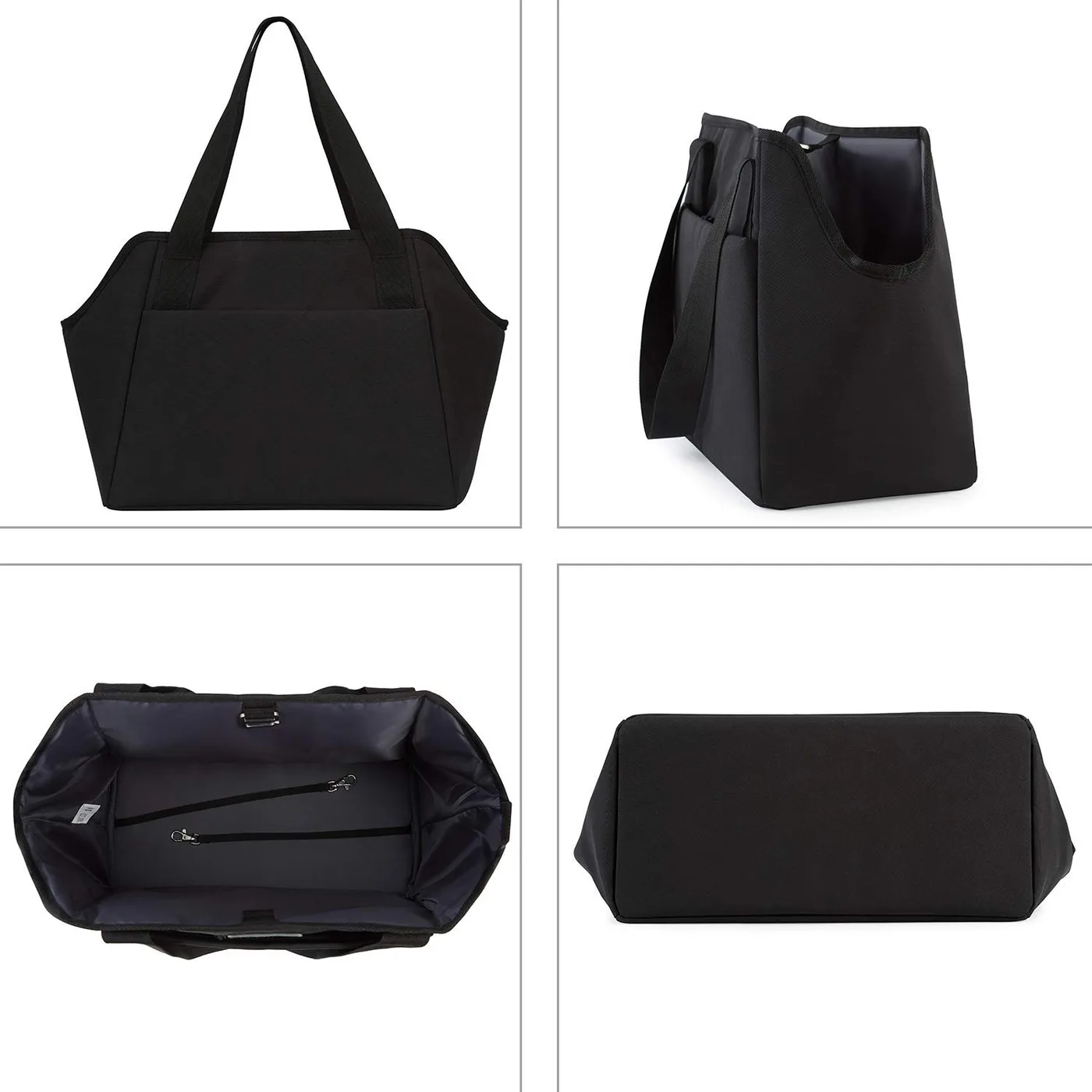
A gather needs slack fabric to work with, so a cinch top suits a soft or semi-structured shell and fights a stiff one. Bucket, duffle and tote silhouettes gather beautifully; a framed or moulded shell does not, because the channel is trying to pull a rigid edge into a curve and the result is a series of flat facets rather than a gather.
Where a brand wants both a structured body and a gathered top, the answer is a hybrid: a structured lower shell with a soft fabric collar above it, and the channel running through the collar. It costs one more seam and it reliably gives the designer the shape they wanted, whereas a channel cut directly into a stiffened panel never does.
Cord Specification: Diameter, Construction and Hand
Cord is specified too casually in most tech packs, usually as "matching cord". Three properties actually matter and each one can be written as a number.
Diameter comes first, because it drives channel width, lock size and the visual weight of the gather. Three to four millimetres reads as delicate and suits a fashion silhouette; five to six millimetres reads as technical and suits an outdoor or utility product; anything above six millimetres looks like luggage hardware and should usually be replaced by webbing. We hold diameter to a tolerance of plus or minus 0.3 millimetres, because a cord at the top of its tolerance in a channel at the bottom of its tolerance is exactly how a binding drawstring happens.
Construction is the second property and it is the one that determines how the cord behaves. A braided cord with a core has a round, firm cross section, holds its diameter under load and draws smoothly; it is the default. A twisted cord is cheaper and softer but it flattens under tension and it tends to untwist at the cut end. A hollow braid without a core looks round in the sample and collapses flat in use, which is the most common source of a drawstring that feels wrong after a month.
Hand is the third property and it is what the customer touches. A polyester braid is smooth and slightly slick, a cotton braid is warmer and grips better but absorbs water and stains, and a textured reflective braid adds a safety element at low cost. On a pet product we generally avoid cotton in the closure path, because it will be chewed, and chewed cotton holds moisture and odour in a way polyester does not.
| Cord type | Diameter | Channel width | Behaviour in use | Best for |
|---|---|---|---|---|
| Cored braided polyester | 4 mm | 8-10 mm | Round, firm, draws smoothly | Fashion silhouettes |
| Cored braided polyester | 5 mm | 9-11 mm | Firm, visible, technical | Outdoor and utility |
| Twisted polyester | 4 mm | 8-10 mm | Soft, flattens under load | Low cost programs |
| Hollow braid, no core | 5 mm | 9-11 mm | Collapses flat in use | Not recommended |
| Reflective braided | 4 mm | 8-10 mm | Adds low-light visibility | Evening walking ranges |
Cord Locks, Toggles and the Safety Ceiling
The lock is the part the customer operates and the part most likely to be under-specified. A spring toggle is the cheapest and the most familiar: it grips by spring pressure on a barrel and it releases with a thumb. It is adequate for light duty and it fails in two predictable ways, by losing spring tension and by cracking at the barrel seam after prolonged outdoor exposure.
A cord lock with a positive cam or a toothed grip holds better under load and is the right choice where the cord is doing any containment work at all. A sliding knot or a simple cinch bead is the minimalist option, it has no hardware to fail, and it suits a design-led product where the brand wants the mechanism to be visible and honest rather than hidden.
Safety is the hard constraint and it is not negotiable. A free cord on any consumer product creates an entanglement hazard, and on a pet product the hazard has two victims, the animal and any child in the household. We cap free cord length, we specify a maximum loop circumference when the closure is fully open, and we avoid a cord path that runs inside the interior where an animal can reach it. Where a program needs a longer draw, the answer is a shorter cord with a webbing extension rather than a longer cord.
We also treat the cord ends as a specification item. A heat-cut end on polyester is clean and permanent; a knotted end is bulkier and can work loose; a metal end cap looks premium and adds a hard element that can scratch. Our default is a heat-cut and back-tacked end, with the knot hidden inside the channel exit, which gives a clean appearance with nothing hard or loose anywhere on the product.
Where the cord should exit
Place the exit on the side of the product away from the carrying handle and away from the animal's reach when the carrier is open. On a shoulder-carried product that is normally the rear panel; on a hand-carried product it is normally the left side. An exit near the handle gets pulled every time the product is lifted, and a drawstring that releases itself in transit is a containment failure.
Cord colour matching across a colourway program
A cord is dyed in a separate process from the shell, and it is the component most likely to arrive off shade. On a multi-colourway program we standardise the cord supplier for the whole order and approve the cord against the shell under the same light source the retailer will use, which is normally a neutral 4000 kelvin booth rather than a showroom.
Where an exact match is impossible, the better decision is a deliberate contrast rather than a near match. A cord that is two shades off reads as a mistake; a cord in a clearly chosen accent colour reads as a design decision, and it is the choice we make in most programs where the dye lot will not cooperate.
Branding a Cinch Top
A drawstring gives a brand three surfaces that a zipper does not: the cord itself, the lock and the channel. Used well, those three are the cheapest brand real estate on the product; used clumsily, they are the fastest way to make an expensive shell look cheap.
The lock is the best of the three. A moulded toggle with a debossed or embossed mark is touched on every use, it sits at the most visible point of the closure, and at 500 pieces it costs a fraction of any other branded hardware. Tooling for a custom toggle is modest and it is shared across a program, so the same lock can serve three colourways and two sizes.
The cord is the second surface and it rewards restraint. A printed or woven cord with a repeating brand name is a recognisable premium detail, but it is legible only at close range and it can look busy on a fashion silhouette. A contrast cord in a single brand colour is usually the stronger choice, because it reads at three metres in a photograph, which is where the purchase decision is made.
The channel is the third surface and the most overlooked. A contrast binding on the channel draws an eye-line around the top of the product, and on a plain shell that line is doing more brand work than a logo would. We often specify a contrast channel and a tonal logo, which reads as design confidence rather than as under-branding.
What to avoid is a mark placed on the gathered fabric itself. Anything printed or embroidered on the panel that gathers will distort when the cord is drawn, and a distorted logo is worse than no logo, because it looks like a fault rather than a decision.
Pattern, Assembly and Cost
A cinch top is the least expensive closure to assemble and one of the most expensive to assemble badly, because the channel is a long, narrow, highly visible seam that runs right around the product. Any inconsistency in that seam is at eye level on the finished bag, and it cannot be hidden by a flap or a trim.
The assembly sequence matters. The channel should be formed and the cord threaded before the shell is closed, because threading a finished bag takes longer and risks snagging the lining. We also specify a cord retainer inside the channel during transit and display, which prevents the cord from being pulled fully out by a customer in a store, an event that turns a display unit into a returns case and happens more often than most brands expect.
Cost at 500 pieces breaks down roughly as follows: channel binding 0.35 to 0.60 dollars, cord 0.25 to 0.70 dollars depending on diameter and construction, lock 0.15 to 0.90 dollars depending on whether it is a stock or a custom moulding, and assembly labour about 0.10 to 0.20 dollars. That puts a complete cinch closure between 0.85 and 2.40 dollars, against 2.20 to 4.80 dollars for a comparable zippered opening with a garage and puller.
The saving is real but it should be spent somewhere. In most programs we advise putting part of it into a better cord and a custom lock, because those are the two components the customer touches, and a closure that feels good in the hand does more for perceived quality than the same money spent on a heavier shell fabric.
One cost line deserves its own warning. A custom moulded lock needs tooling, and tooling has a lead time that sits outside the sampling cycle. Releasing it with the order rather than after approval keeps bulk at 35-50 days; releasing it late adds roughly two weeks, which is the most common and most avoidable schedule slip in this closure type.
Validation and What to Check at Inspection
Drawstring problems are almost all tolerance problems, so the validation protocol is built around measurement rather than around stress. We check finished channel width against the specified dimension at six points around the mouth, cord diameter against its tolerance at three points, and the gather circumference at a defined pull force. Those three measurements predict essentially every field complaint.
The second group of checks is mechanical. The lock is cycled 300 times and its retention is measured before and after; a drop of more than 20 percent in holding force sends the specification back. The cord exit is pull tested to 50 newtons, and the end treatment is inspected after a 5 cycle wash to confirm a heat-cut end has not unravelled.
The third group is safety and it is non-negotiable: free cord length measured against the cap, loop circumference measured at full open, and confirmation that no cord runs inside the animal's reach. We record these on every shipment because they are the items a retailer's own audit will ask for, and a file that already contains them turns a two week question into a one hour answer. Testing protocols in this category are commonly aligned with the standard methods maintained by ASTM International, and we reference the relevant method numbers in the tech pack so a buyer's laboratory can repeat our figures.
Commercial terms close the loop: samples in 6-10 working days, bulk 35-50 days after approval, MOQ 500 pieces per colourway, and AQL 2.5 inspection with the three dimensional checks written into the inspection sheet rather than left to general workmanship judgement.
Display and packaging behaviour
A drawstring product is usually displayed half gathered, because that is the state in which the silhouette reads best. That means the retail unit has to arrive with the gather already set, which in turn means the packing instruction needs to specify both the cord tension and the position of the lock. Without that instruction, ten units on a shelf will show ten different gathers and the range will look inconsistent.
The same applies to the cord retainer mentioned earlier. It should be designed to be removed by the customer without tools and without cutting, because a retainer that needs scissors turns the first minute of ownership into a small annoyance, and first-minute annoyances are disproportionately represented in negative reviews.
Why brands source here
- Pet carrier programs run since 2014; founding team in sewn goods since 2004
- SGS-verified production floor of 4,950 m² with 137 workers across 7 lines
- Monthly capacity of 200,000 units, audited to BSCI and ISO 9001
People Also Ask
What is a cinch top on a pet carrier?
A closure where a cord runs through a channel around the mouth and is drawn to gather the fabric, reducing the opening rather than sealing it.
Are drawstring pet carriers safe?
They are safe when free cord length is capped, the loop circumference is limited and no cord runs where the animal can reach it. Those limits should be specified, not assumed.
How tight can a drawstring close?
To roughly 55 to 70 percent of the open circumference. It is a gathering device, so it needs a panel behind it for containment.
What size cord lock do I need?
Match the lock bore to the cord diameter plus about 1 millimetre, and specify a positive cam grip rather than a spring toggle where the cord carries load.
Can a drawstring be branded?
Yes, on the lock, the cord and the channel binding. The lock is the strongest surface because the customer touches it on every use.
Does a cinch top work on a structured carrier?
Poorly. Gathering needs soft fabric to work with; on a structured shell the channel fights the frame and the gather looks uneven.
Frequently Asked Questions
Is a drawstring closure secure enough for a pet carrier?
As a primary closure, only when the opening is small relative to the animal. In most programs we specify it as a secondary layer over a panel or a zipper.
How much does a mouth actually gather?
Roughly 55 to 70 percent of its open circumference. A gather is a reduction, not a seal, and that distinction should be reflected on the hangtag.
What channel width should I specify?
Cord diameter plus 4 to 6 millimetres. A 4 millimetre cord wants an 8 to 10 millimetre finished channel.
Which cord construction is best?
A cored braided polyester. It holds diameter under load and draws smoothly; hollow braid collapses flat in use and twisted cord flattens.
How long can the free cord be?
It must be capped. We set a maximum free length and a maximum loop circumference at full open and record both on every shipment.
Can the cord run inside the carrier?
No. Any cord path the animal can reach is an entanglement risk, so the channel stays on the exterior of the shell.
Is a custom cord lock expensive?
No. Tooling for a moulded toggle is modest and is shared across colourways and sizes, which makes it one of the cheapest branded hardware items available.
Where should the cord exit be placed?
Away from the handle root and away from the animal's reach, normally the rear panel on a shoulder product and the left side on a hand-carried one.
Can I print a logo on the gathered panel?
We advise against it. The mark distorts when the cord is drawn, and a distorted logo reads as a fault.
Does a drawstring work on a waterproof shell?
It reduces the opening but does not seal it. On a coated shell pair it with a roll band or accept a lower weather rating.
What is the cost saving against a zipper?
About 1.35 to 2.40 dollars per unit at 500 pieces, depending on cord and lock selection.
How is drawstring quality checked in bulk?
By measuring channel width, cord diameter and gather circumference, plus a 300 cycle lock retention test and a pull test on the cord exit.
Talk to QUANZHOU JUNYUAN BAGS about a pet carrier program: MOQ 500 pieces per colourway, samples in 6-10 working days, bulk production in 35-50 days under AQL 2.5 inspection.
Get a free quote Request a sample