Custom Food Container: Storage
A custom food container program runs at MOQ 500 units per colourway and size, with decorated samples in 6-10 working days. The build that holds a place in a kitchen is a square-section body in a ladder of 2, 5, and 10 litre capacities, a gasket-sealed lid with a documented freshness result, and a mark applied in mould rather than stuck on afterwards. Bulk production takes 35-50 days after sample approval.
Executive summary. A food container is a storage problem, a kitchen-design problem, and a freshness promise at the same time, and the brands that succeed treat all three seriously. Our production team specifies the body geometry against real bag sizes, the seal against a measurable freshness target, and the mark as part of the mould rather than as a sticker applied afterwards. Terms are MOQ 500 per colourway and size, samples 6-10 working days, bulk 35-50 days, release at AQL 2.5.
Two decisions dominate the program. The first is section shape: square sections store roughly 25 percent more per shelf than round ones and they line up, which is the whole argument for a container that lives in a cupboard. The second is decoration: an in-mould label or a moulded emboss survives the wiping, stacking, and dropping that a lid gets every week, while a pressure-sensitive label on a lid does not.
A custom cat carrier is restrained by behaviour rather than by weight, so locking sliders and bound internal seams matter more than load ratings.
Pantry aesthetics: a container as kitchen architecture
Food storage is one of the few pet categories that is bought twice: once for function and once for how it looks in a cupboard or on an open shelf. The second purchase is the one that carries margin, and it is won by brands that treat the container as a piece of kitchen architecture rather than as a bucket with a lid.
Kitchen architecture has rules. Objects line up, they share a section, they share a colour, and they stack. A container range that respects those rules becomes part of the room; one that does not gets moved into a garage, where the brand is no longer seen by anyone.
The practical design brief is therefore about the row rather than the unit. Design three sizes that share a footprint width, a lid language, and a colour, then check them standing side by side on a shelf at eye level. If the row looks deliberate, the range will sell as a set; if it looks like three separate products, it will sell as one at a time.
The other half of the aesthetic argument is restraint in branding. A container is a large object seen at close range in a domestic room, and a big logo on the front of a 10 litre bin reads as commercial rather than as designed. Put the mark at 60-80 mm, place it low and centred, and let the form and the colour carry the identity.
Capacity ladder and the bag-size arithmetic
Capacity should be derived from how food is actually bought. A 2 kg bag of kibble occupies roughly 3.5 litres, a 6 kg bag around 10 litres, and a 12 kg bag around 20 litres. Sizing containers to those numbers means a customer can decant a whole bag with room to spare, which is the single most common reason a container gets bought.
The ladder that follows is roughly 2 litres for treats and small-bag households, 5 litres for a standard bag, and 10 litres for a large-bag household or a two-animal home. Three sizes cover the market, share a tooling family if planned together, and give a retailer a range without giving a customer a confusing choice.
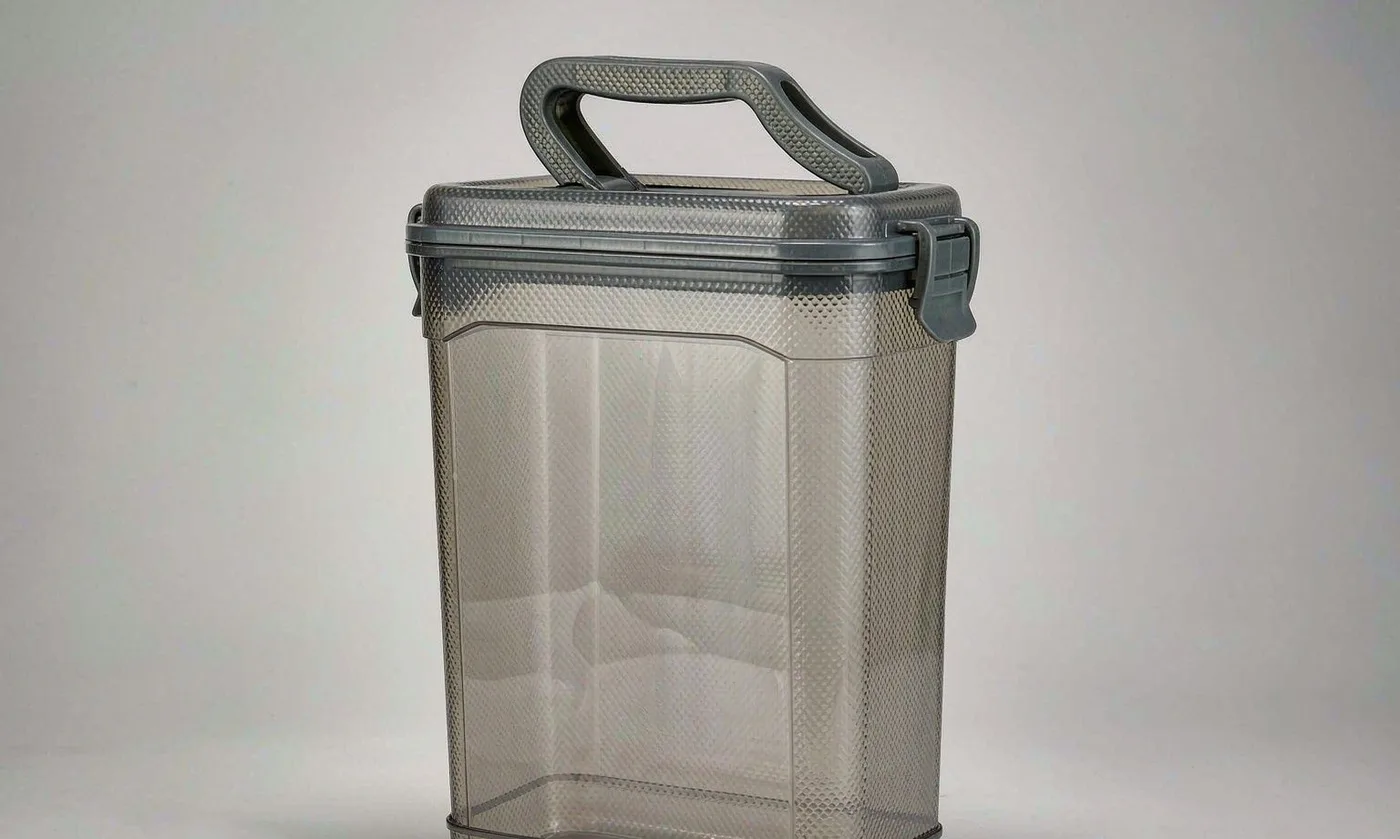
Section shape is where capacity meets the cupboard. A square or rounded-square section uses shelf depth efficiently and lets containers sit flush against each other; a round section wastes the corners and rolls. Square wins on storage by a wide margin, and the only argument for round is a lower tooling cost, which is rarely decisive at these volumes.
Size the footprint as carefully as the volume. A container that is deep rather than wide looks larger on a specification sheet and fails in a standard 300 mm cupboard, and one that is tall fails on an open shelf under a wall unit. Decide the maximum height and depth from the furniture the customer actually owns, then derive the footprint from the required volume rather than the other way round.
Plan for the scoop
A scoop is the accessory that turns a container into a system. Design a clip or a recess in the lid that holds it, because a scoop that lives loose inside the food is a scoop that gets buried, and the customer will blame the container rather than the scoop.
Decanting and the refill ritual
Decanting is the moment the product is judged. A customer opens a bag, pours it into the container, and either feels competent or feels clumsy, and that impression forms in under thirty seconds. Design the opening for that moment rather than for the daily scoop: a lid that removes completely and a mouth wide enough to take a pour without a funnel.
A wide mouth has a second benefit, which is that it makes the container easy to clean. A container that cannot be reached into will be wiped rather than washed, and over a year the residue builds up in exactly the place food touches. A mouth wide enough for a hand is a mouth wide enough to keep clean, and that is worth more than the tidier proportions of a narrow one.
The ritual then repeats in reverse: scoop, serve, close. Because the closing action happens daily and the pouring action happens weekly, the lid must serve both well, which is why a full-lid seal is right for a container even though a hatch is right for daily access. Where both are wanted, a hatch inside a sealed lid gives the best of both and costs one extra component.
Seal engineering: freshness is a measurable claim
Freshness is the promise a container makes and the claim most often made without evidence. It is also genuinely measurable: a sealed container should be tested for moisture ingress and for odour containment over a defined period, and the result should be stated in the specification rather than implied by the word airtight.
The seal itself has three parts. A gasket — silicone rather than foam, because foam takes a compression set and stops sealing within a year. A lid geometry that compresses the gasket evenly, which means at least four clip points on a container above 5 litres rather than two. And a body flange flat enough to meet the gasket across its whole perimeter, which is a tooling tolerance rather than a design choice and should be written into the mould specification.
Openings should be planned for the daily action. A full-lid removal is fine for decanting once a week and annoying for daily scooping; a hinged access hatch in the lid is the better answer above 5 litres. Whatever the opening, it must reseal with one hand, because the other hand is holding a scoop or an animal.
Material: polypropylene, stainless, and glass
Polypropylene is the default and for good reason: it is light, it is food-contact safe, it takes colour beautifully, it is cheap to mould, and it survives being dropped. Its weaknesses are that it scratches, it retains odour over a long life, and it is permeable enough that a very long-term freshness claim is harder to defend. Stainless is heavier, more expensive, impermeable, and odour-free, and it reads as premium kitchen equipment. Glass is impermeable and inert but heavy, fragile, and a freight liability above 2 litres.
For most private-label programs the answer is polypropylene for the body with a considered finish, and stainless for a premium tier if the brand has a kitchen-positioning story to tell. The finish matters more than the base resin: a textured or soft-touch surface hides the scratching that makes a plastic container look old within a year.
Opacity is a deliberate choice. A translucent body lets a customer see how much food is left, which is genuinely useful and reduces the "is it nearly empty" uncertainty. An opaque body hides the contents, looks tidier on an open shelf, and protects a light-sensitive formula. Offer the choice as a range position rather than deciding it per SKU.
Odour retention and long-life care
Every food container eventually smells of the food it held, and the material determines how quickly that becomes a problem. Polypropylene is slightly permeable and holds odour in its surface; stainless is impermeable and holds almost none; glass is inert. For a brand selling a container that will be used for years, the honest answer is to specify a wash cycle and to say so on the pack rather than to imply the container is maintenance-free.
A removable gasket helps more than any material choice, because the gasket is the part that actually retains odour. A gasket that lifts out of its groove can be washed, dried, and replaced; one bonded into the lid cannot. Specify a spare gasket with the large size, and the container has a service life measured in years rather than in bags of food.
Design the care instruction as part of the pack rather than as an afterthought. One line — wash with warm water and mild detergent, dry fully before refilling, replace the gasket annually — sets expectations correctly and prevents the most common negative review in the category, which is a customer discovering an odour she believes is a defect.
Decoration: in-mould, embossed, or applied
Three decoration routes are realistic and they differ enormously in lifetime. An in-mould label places a printed film into the tool before injection, so the graphic becomes part of the wall: it cannot peel, it cannot scratch off, and it costs nothing extra per unit once the tool exists. A moulded emboss or deboss puts the mark into the steel and gives a permanent, tactile, monochrome identity. An applied pressure-sensitive label is the cheapest and the shortest-lived, and on a lid that is wiped weekly it fails first.
For a container that is meant to sit on a shelf for years, in-mould or embossed is the right answer. The tooling cost is real and it is amortised over the run; at 500 units per size a brand should weigh it against the lifetime of the object, which is measured in years rather than months.
Placement should respect the stacking reality. A mark on the front face is covered when containers are stacked; a mark on the lid is covered when something sits on top. Put the primary mark on the front face low and centred, and add a small secondary mark on the lid so the identity survives both stacking and shelving.
Tooling economics for in-mould labels
An in-mould label adds a tooling step and a film cost but almost nothing to unit price once running, which makes it a volume decision rather than a design one. At 500 units per size the amortisation is meaningful; across three sizes sharing one artwork and one tool family it becomes modest; across repeated reorders it becomes the cheapest decoration available.
The economics improve further if the artwork is planned to be shared. A single in-mould label design used across the small, medium, and large bodies, with only the capacity callout changing, requires one film set and one registration setup rather than three. That is a planning decision made at the brief stage and it cannot be recovered later.
The risk to manage is lead time. The film has to be printed and tested before the tool runs, and a misregistration discovered at that point is expensive to fix. Commission the film with the tooling rather than after it, approve a printed proof on the actual resin, and the method will deliver a mark that outlives the container's contents by many years.
Food container specification matrix
| Spec line | Small | Medium | Large |
|---|---|---|---|
| Capacity | 2 litres | 5 litres | 10 litres |
| Suits bag size | Treats and 1-2 kg | Standard 6 kg bag | Large 12 kg bag or two animals |
| Section | Rounded square | Rounded square, shared width | Rounded square, shared width |
| Body | PP, translucent | PP, opaque textured | PP, opaque textured with view window |
| Lid | Two-clip, silicone gasket | Four-clip, silicone gasket | Four-clip plus hinged hatch |
| Decoration | Moulded emboss | In-mould label | In-mould label plus lid emboss |
| Scoop | Loose, 100 ml | Clipped in lid recess | Clipped in lid recess, 250 ml |
| Freshness test | Odour containment, 7 days | Moisture ingress, 14 days | Moisture ingress, 30 days |
The row is the point of the matrix. Shared section width, shared lid language, and shared decoration method across three capacities are what make the set look designed, and they are also what let a customer buy the second and third size later without the shelf looking mismatched.
Label position against the shelf row
Placement of the brand mark on a container should be decided by the shelf row rather than by the single unit. Containers stand side by side, often touching, and occasionally stacked; a mark placed centrally on the front face is visible in a row but hidden in a stack, while a mark placed high on the face is visible in both.
Set the mark in the upper third of the front face, clear of the lid line, and add a small secondary mark on the lid for the stacked condition. Two placements cost nothing extra with an in-mould label, because the film carries both, and they keep the brand visible in every storage configuration a customer might use.
Keep the mark away from the clip and hinge zones. Those areas flex, they are handled most, and any decoration crossing them will show wear first. A mark that sits on a flat, unbroken field will still look new after five years of daily opening, which is the lifespan a container should be designed for.
Colour, finish, and holding a palette across mouldings
A container range is large objects in a small room, which makes colour the highest-stakes decision in the program. Two or three colours is the right number: one neutral that disappears into any kitchen, one brand colour that carries the identity, and optionally a seasonal third. More than three and the shelf row stops looking deliberate.
Think about the second purchase as well as the first. A customer buys one container for the food she has today and a second when she changes it, which means the second purchase happens months later with no marketing behind it. A range that looks the same in both moments is the only mechanism that converts that later purchase into a brand one rather than a category one.
Hold every moulding to one reference. Body, lid, clips, and gasket should all be specified against a single anchor published by Pantone, with a delta-E tolerance of 2.0 for the hero colour, and verified by measured drawdown per resin lot rather than by eye. Polypropylene shifts slightly between lots and noticeably between natural and masterbatch bases, so a retained physical standard is essential.
Gasket colour is the detail most programs get wrong. A white or translucent gasket looks clean on day one and shows every stain; a mid-grey or brand-toned gasket hides a decade of use. It is a one-line specification change with a disproportionate effect on how the object ages.
Stacking and nesting as a range rule
A container range is judged in a cupboard rather than on a bench, and the cupboard is a stacking problem. Decide early whether the containers should nest empty, stack full, or both, because the geometry is different and it cannot be changed after tooling.
Nesting empty matters for freight and for the customer who buys a set and stores the spares. A slight draft angle on the walls and a recess in the lid allow empty containers to stack inside one another, which can cut the shipped volume of a three-size set by more than half.
Stacking full matters for the cupboard. A flat lid with a recessed rim that accepts the base of the container above it makes a stable two-high stack; a domed lid does not. If the brand's customer has a small kitchen, the flat lid is the more valuable feature, and it should be chosen deliberately rather than for its looks.
Compliance, testing, and the AQL 2.5 release gate
A food container is a food-contact article, and the documentation is straightforward but not optional: a food-contact declaration for the body resin, for the gasket, and for any in-mould label film, plus a migration test appropriate to the destination market. Because the container is in contact with dry food for months rather than minutes, the test should reflect that duration rather than a short-contact standard.
Market rules should be checked before tooling rather than before shipment. In the European Union, substance obligations fall under REACH; in the United States, consumer product obligations are administered by the U.S. Consumer Product Safety Commission. Independent verification through a body such as SGS gives a retailer's technical reviewer a third-party document and shortens the review.
Release is at AQL 2.5, general inspection level II, with defect classes agreed before the run. Critical defects are a lid that does not seal, a missing or non-compliant gasket, a food-contact failure, and a sharp edge on a hand-contact surface. Major defects include a warp that breaks the seal plane, an in-mould label misregistration beyond 1 mm, colour outside tolerance, and a clip that does not latch. Minor defects are flow lines invisible at arm's length.
Launch cadence and the pantry capsule
A container should be launched as a pantry set rather than as a single size. The set is what justifies the price, what occupies the shelf, and what generates the second purchase — a customer who buys one size for a small bag will buy the larger one when she changes food.
Sequence it after the feeding products, not before. Bowl and mat establish the brand in the kitchen; the container extends it into the cupboard. That order means the container launches into a room where the mark is already familiar, which shortens the decision considerably.
Plan the tooling decision as the critical path. In-mould labels and embossed tools are the long poles in this program, and they should be committed while the artwork is being finalised rather than after sample approval. Sampling takes 6-10 working days and bulk runs 35-50 days, and a tool committed late adds weeks to both.
Why brands source here
- Pet carrier programs run since 2014; founding team in sewn goods since 2004
- SGS-verified production floor of 4,950 m² with 137 workers across 7 lines
- Monthly capacity of 200,000 units, audited to BSCI and ISO 9001
People Also Ask
How big should a pet food container be?
Derive it from the bag: roughly 2 litres for treats, 5 litres for a standard 6 kg bag, and 10 litres for a 12 kg bag or two animals. The container should hold a whole bag with room to spare.
Why do containers stop sealing after a year?
Almost always the gasket. Foam takes a compression set and stops recovering; silicone does not. Lid geometry and flange flatness matter too, but the gasket material is the usual culprit.
What makes a storage container look designed rather than commercial?
A shared section width across sizes, one restrained colour, a small mark placed low and centred, and a finish that hides wear. Design the row on a shelf, not the single unit on a bench.
Is an airtight claim testable?
Yes, and it should be. Test moisture ingress and odour containment over a defined period and state the result in the specification rather than relying on the word airtight.
Should a container come with a scoop?
Yes, and it should clip into a lid recess. A scoop that lives loose inside the food gets buried, and the customer will blame the container rather than the scoop.
What is in-mould labelling?
A printed film placed into the tool before injection, so the graphic becomes part of the container wall. It cannot peel or scratch off, and once the tool exists it adds nothing to unit cost.
Frequently Asked Questions
What is the MOQ for a custom food container?
MOQ 500 units per colourway and size, covering the body, lid, gasket, decoration, and retail pack. Decorated samples take 6-10 working days and bulk runs 35-50 days.
What sizes should a pet food container range include?
Around 2 litres for treats, 5 litres for a standard 6 kg bag, and 10 litres for a large bag or a two-animal household. Derive the sizes from real bag volumes so a whole bag can be decanted with room to spare.
Square or round section?
Square. A square or rounded-square section stores meaningfully more per shelf, lines up flush, and does not roll. The only argument for round is lower tooling cost, which is rarely decisive.
How do you make a container genuinely airtight?
Three things together: a silicone rather than foam gasket, at least four clip points above 5 litres so compression is even, and a body flange held flat enough by tooling tolerance to meet the gasket across its whole perimeter.
What is the best decoration method for a container?
An in-mould label or a moulded emboss. Both become part of the wall, so they cannot peel or scratch off, which matters for an object wiped weekly and kept for years.
Should the body be translucent or opaque?
Offer it as a range position. Translucent lets a customer see how much is left; opaque looks tidier on an open shelf and protects light-sensitive food.
Can the container match my brand colour?
Yes. Specify body, lid, clips, and gasket against one Pantone anchor at delta-E 2.0 for the hero colour, verified by measured drawdown per resin lot against a retained physical standard.
What colour should the gasket be?
Mid-grey or a brand tone rather than white. A white gasket looks clean on day one and shows every stain; this is a one-line specification change with a large effect on how the object ages.
Is stainless worth it for a container?
For a premium kitchen-positioned tier, yes — it is impermeable and odour-free. For most programs, polypropylene with a textured or soft-touch finish gives a better balance of cost, weight, and colour range.
What compliance documentation is needed?
A food-contact declaration for the body resin, the gasket, and any in-mould label film, plus a migration test reflecting long-duration dry-food contact rather than short contact.
What inspection standard applies?
AQL 2.5, general inspection level II. Critical defects are a lid that does not seal, a missing or non-compliant gasket, a food-contact failure, and a sharp edge on a hand-contact surface.
Should I launch one size or a set?
A set. Three shared-width sizes look deliberate on a shelf, justify the price, and generate the second purchase when a customer changes food.
What are the commercial terms?
T/T with a 30 percent deposit and a 70 percent balance before shipment, quoted FOB Xiamen.
Talk to QUANZHOU JUNYUAN BAGS about a pet carrier program: MOQ 500 pieces per colourway, samples in 6-10 working days, bulk production in 35-50 days under AQL 2.5 inspection.
Get a free quote Request a sample