Water Bottle Pocket: Hydration Storage in Custom Pet Carriers
A water bottle pocket should accept a 73-88 mm diameter bottle with a 25 mm elastic-bound mouth, leave 40-50 mm of the bottle exposed, and drain through an 8 mm grommet at the base. Elastic mesh pockets cost $0.75-$1.40 per unit; insulated structured pockets reach $1.60-$2.30 at MOQ 500.
This executive summary treats the bottle pocket as a load-bearing external component rather than a trimming detail. MOQ 500 pieces per colourway is the standard entry point, set by fabric procurement, mesh and elastic minimums and any custom binding or label the pocket carries. Sampling takes 6-10 working days from approved artwork and must be tested with a full bottle, because water weighs a kilogram per litre and an empty pocket tells you almost nothing. Bulk production runs 35-50 days after sample sign-off, with insulated linings and custom binding tape at the longer end. Finished goods are inspected to AQL 2.5 under documented ISO 9001 procedures at our SGS-verified production base, and shipments move FOB Xiamen on T/T 30/70 terms. Fix the bottle diameter before the panel is drafted, since the pocket circumference cannot grow later without a new pattern. Approve retention with a full bottle after one wash, because elastic relaxes and a pocket that grips an empty bottle will release a full one. Specify a drainage path, because a pocket that holds water will eventually soak whatever sits beside it.
Personalized pet carrier embroidery is priced by stitch count and placement, so a chest panel and a full back panel are not comparable line items.
The Most Used External Feature on Any Carrier
A bottle pocket is the one external component that is used every single outing, and it is the one most likely to be judged on a hot day by a person who is already carrying an animal. It has to accept the bottle without a struggle, hold it while walking, release it one-handed, and cope with condensation, drips and the occasional leak. Those four requirements are mechanical, and they are all decided at specification stage.
The reason to invest engineering attention here is that the failure is memorable. A bottle that falls out of a pocket on a pavement is a story a customer tells, and a bottle that will not go back in is a daily frustration. Neither is recoverable with better marketing.
Commercially, the pocket also does visible work. A bottle standing in a pocket is the clearest possible signal in a product photograph that this is a product for going out with an animal, and it gives lifestyle imagery something to hold. Brands that shoot their carriers empty lose most of that signal.
There is a design tension worth naming early. A pocket sized for a large one-litre bottle looks oversized and floppy when empty, while one sized for a slim 500 ml bottle will not accept the insulated bottle many customers actually own. Resolving that tension is the central sizing decision in the component.
Weight is the other consideration that separates this pocket from every other one on the product. A full litre bottle adds a kilogram to one side of a carrier, and that is a structural load, not an accessory. The pocket has to be attached to the carrier in a way that takes it.
Where the range is travel-led, the bottle pocket usually pairs with other external carry, and the attachment discipline described in our notes on convertible backpack strap systems applies to the load path.
Sizing: Bottle Diameter, Height and the Empty State
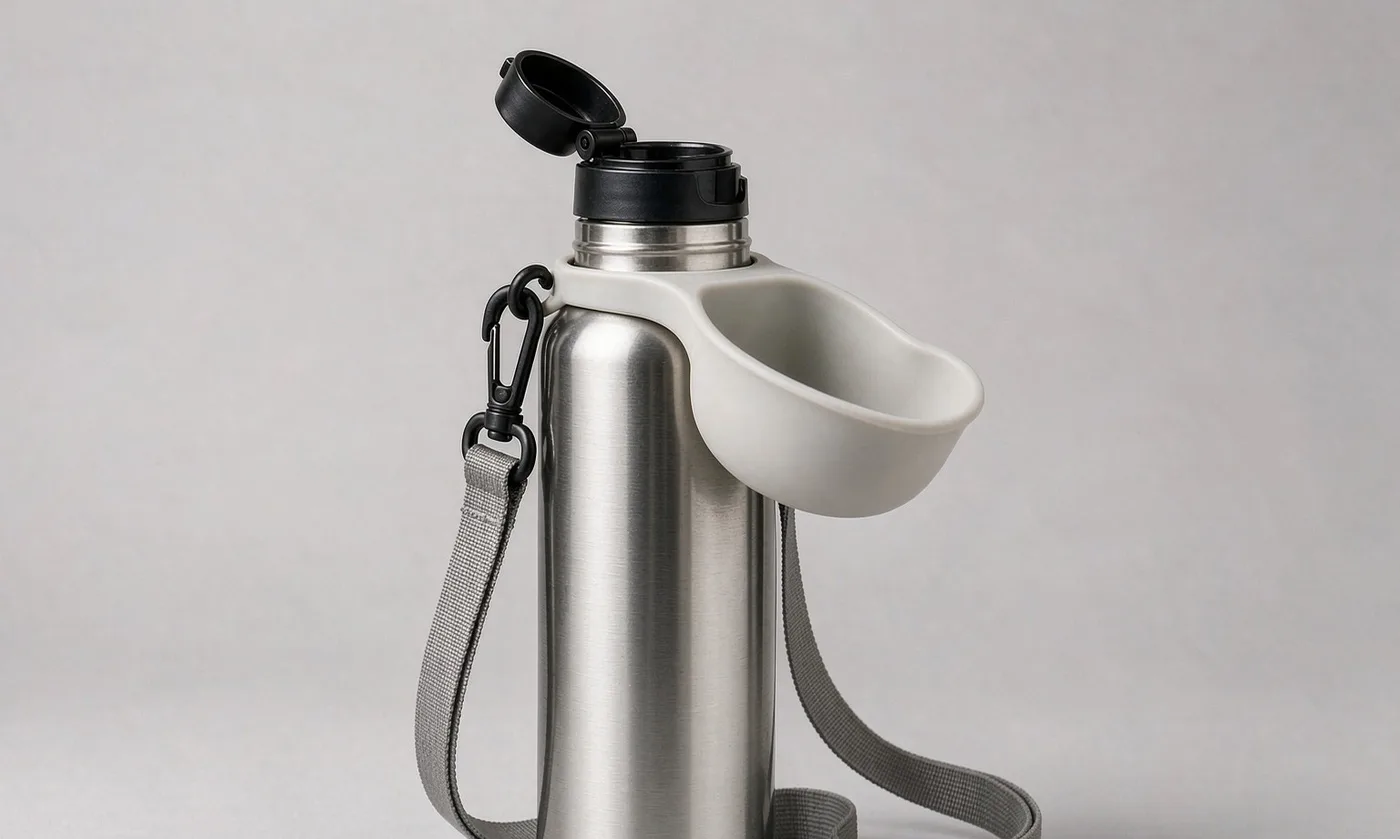
Bottle sizing is a question of diameter range, because height is easy to accommodate and diameter is not.
A standard 500 ml disposable bottle is about 65 mm in diameter. A reusable 500 to 750 ml bottle runs 70 to 75 mm. An insulated steel bottle of 750 ml to one litre runs 73 to 88 mm, and a wide-mouth insulated bottle can reach 92 mm at the cap. Those numbers are why a pocket specified at 70 mm looks fine in development and fails with the customer's actual bottle.
The specification answer is an elastic-bound mouth sized for the largest bottle in the target range with enough stretch to grip the smallest. A 25 mm elastic binding on a pocket cut for 88 mm will grip a 65 mm bottle adequately, which is why elastic is preferred over a fixed woven mouth for this component.
Height should leave 40 to 50 mm of the bottle exposed above the mouth. That is the grip zone: below 30 mm there is nothing to take hold of one-handed, and above 70 mm the bottle levers against the binding with every step and works it loose. Pocket depth of 130 to 160 mm suits most bottles and keeps the centre of gravity low.
Cap clearance is the detail most often missed. An insulated bottle with a wide cap or a loop handle is wider at the top than at the body, and a pocket cut to the body diameter will not accept it. Measuring the bottle at its widest point, usually the cap or the handle, prevents that failure.
The empty state deserves its own decision, because most photographs show it. A pocket that collapses flat when empty looks tidy and tailored; one that stands open looks like a pouch. An elastic mouth with a slightly shorter cut collapses better, and a light interfacing at the mouth helps it hold a shape without standing proud.
Finally, state the capacity on the tech pack and in the copy. "Fits bottles to 88 mm diameter" is a specification customers can check against the bottle they own, and it prevents the most common return reason in this category.
Mesh, Solid or Insulated: Three Constructions
The pocket body has three realistic constructions, and the choice is driven by drainage, drying and whether the range needs insulation.
Open mesh is the classic solution. A polyester or nylon mesh at 200 to 300 gsm drains instantly, dries in minutes, shows the bottle, and weighs almost nothing. It is the right choice for an outdoor or travel range where the pocket will get wet. Its limitations are that it stretches under a heavy bottle over time, it shows everything inside, and it reads as sporty rather than tailored.
A solid pocket in the shell fabric, lined and bound, is the tailored option and suits a fashion-led range. It hides the bottle, it can be colour-blocked, and it holds its shape when empty. It must have a drainage path, because a solid pocket that collects condensation will hold water against the shell and eventually wick into the lining.
An insulated pocket with a laminated thermal lining keeps a bottle cool for a couple of hours and protects the carrier's contents from condensation. It is the premium option, it adds 3 to 5 mm of thickness and real bulk, and it needs a welded or taped liner if the claim is to mean anything. Insulation is a genuine purchase driver in warm climates and a wasted cost in temperate ones.
Lining choice follows the construction. A hydrophobic polyester lining dries fast and suits mesh and solid pockets alike. Where an insulated build is used, the liner should be welded rather than sewn, because needle holes are where condensation escapes into the panel.
Abrasion matters at the mouth more than anywhere else, because a bottle is inserted and withdrawn dozens of times a day against the same binding edge. Textile abrasion methods are published by AATCC, and specifying a tested binding tape is the cheapest way to stop a pocket fraying at six months.
Elastic, Retention and the Load Path
A full bottle is heavy, and the pocket fails at the attachment far more often than at the mouth. Two systems have to be specified together: what grips the bottle and what carries the weight.
Grip comes from the elastic mouth. A 20 to 25 mm flat elastic braid, cut 10 to 15 percent short of the opening, applies continuous inward pressure and accepts a range of diameters. Rubber content and a recovery expectation should be stated, because elastic relaxes, and a pocket approved with an empty bottle is not the pocket that ships.
Depth of engagement is the second grip factor. A bottle engaged only 60 mm will pivot out when the wearer bends; engagement of 120 mm or more holds it through normal movement. Where the panel is short, a taller elastic collar rather than a deeper pocket gives the same engagement without extending the panel.
The load path is where the real engineering sits. A bottle pocket hanging from a single seam will tear out. The specification is a doubled webbing or fabric strap running from the pocket mouth up to a structural point on the shell, bar-tacked at both ends, plus a reinforcement patch behind the lower attachment. That is what turns a pocket into a load-bearing component.
Base support matters as much as suspension. A pocket whose base is a seam will stretch into a V under a full bottle and eventually split. A folded base gusset of 40 to 60 mm, or a base panel of heavier fabric, spreads the load and stops the pocket from deforming.
Testing should reflect reality rather than a laboratory ideal. Load a full one-litre bottle, carry the carrier for an hour, set it down ten times, and lift it by the shoulder strap with the bottle in place. Any drift in the attachment or any stretch at the mouth shows up within that hour.
Finally, check the inverted case. Carriers get turned upside down, and a bottle that slides out onto a pavement is the failure customers remember longest.
Placement, Balance and One-Handed Retrieval
A kilogram on one side of a carrier changes how it carries, and placement is where that is managed.
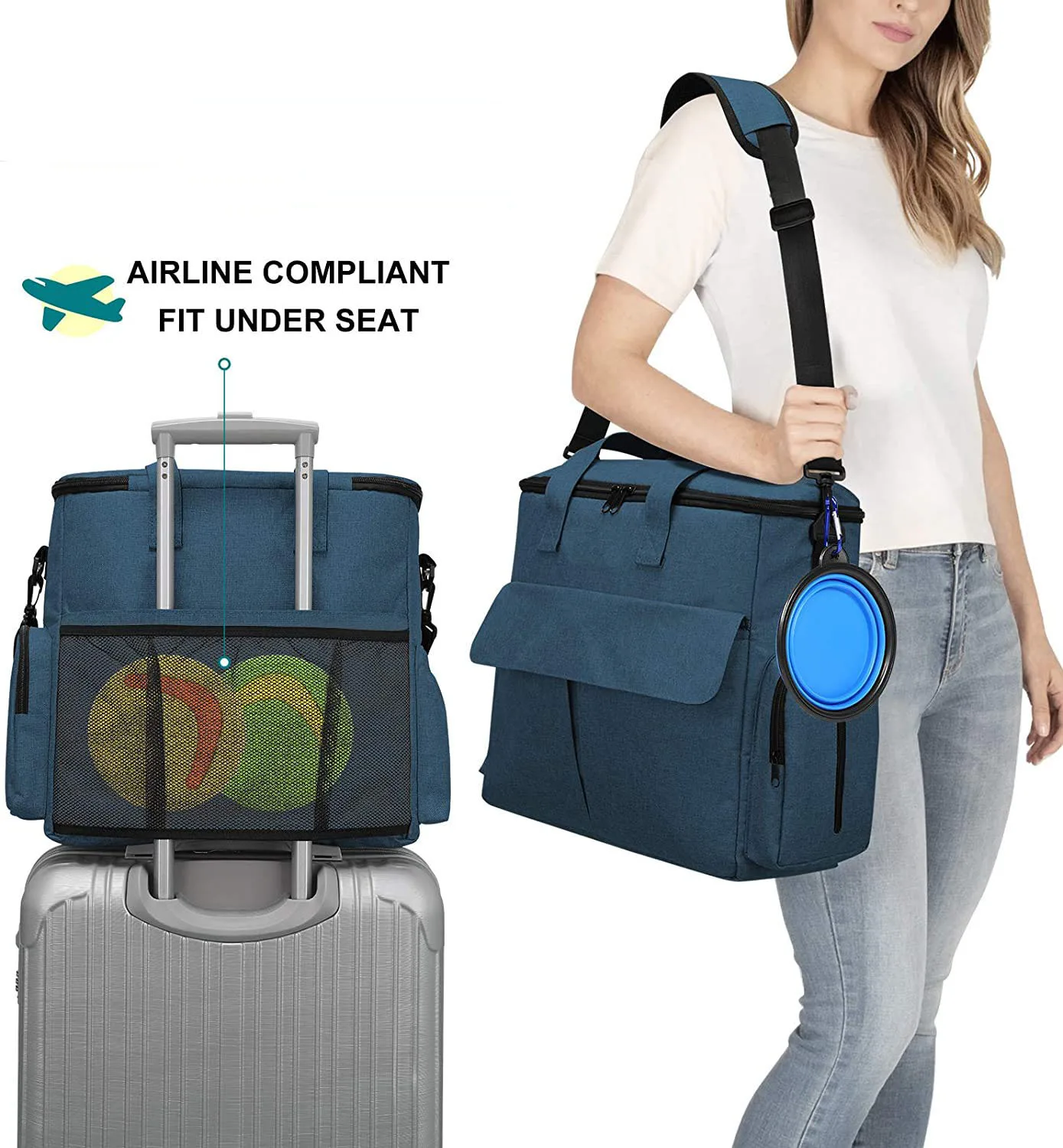
A side panel pocket is the standard and the most balanced position for a shoulder-carried product. The bottle sits at the wearer's hip, the weight is close to the body, and the hand reaches it without crossing the body. The constraint is arm swing: a pocket positioned too far forward will be struck by the hand on every stride.
A front-face pocket suits a structured carrier and reads clearly in photography, but it puts weight on the outermost face, which makes a loaded carrier tip forward when set down. It works where the carrier has a stiff base and is usually set down rather than hung.
Twin pockets, one on each side, solve the balance question outright and are the right answer for a range positioned around long walks. They double the component cost and they invite customers to carry two full bottles, which adds two kilograms the structure then has to take.
Interior bottle storage is the protected alternative: it keeps the bottle away from the weather and from knocks, but it puts a wet, heavy object inside the product next to everything else. Where an interior position is chosen, it should be a dedicated pocket with a waterproof base rather than a shared compartment.
Retrieval geometry decides daily satisfaction. The pocket mouth should be angled 10 to 15 degrees outward at the top, which lets a hand find it without looking and lets the bottle come out on a natural arc. A vertical mouth on a curved panel is noticeably harder to use.
Finally, consider what happens when the carrier is worn on the back. A side pocket reachable at the hip when carried by hand may be behind the arm when worn as a backpack, which is a reason to test the pocket in every carry mode the range offers.
Drainage, Condensation and Protecting the Interior
Water is the reason bottle pockets fail quietly. Condensation on a cold bottle, drips from a cap and the occasional faulty seal all end up at the base of the pocket, and without a planned path they end up in the lining.
A drainage grommet at the pocket base is the simplest answer. An 8 mm metal or plastic grommet set through a reinforced base panel lets water out immediately and costs a few cents. It should be positioned at the lowest point of the pocket when the carrier is carried, not merely at the geometric centre of the base.
A mesh base panel is the alternative and drains better than a grommet, because the whole base is open. It suits an outdoor range and it means the pocket base cannot hold water at all. It does let grit in, so the seam should be bound rather than raw.
Wicking is the failure that survives both. A seam that runs from the pocket into the shell will carry moisture inward by capillary action, so the pocket seam should be bound with hydrophobic thread and the pocket should be attached to the shell at as few points as possible.
Interior protection is the second half of the problem. A wet bottle inside a carrier will soak whatever is next to it, and a waterproof base panel in the main compartment is cheap insurance for any range that offers interior bottle storage. A thermoplastic sheet under the lining, turned up 30 mm at the edges, is enough.
Where insulation is claimed, the liner should be welded rather than sewn, because needle holes leak and a sewn thermal liner gives the appearance of insulation without the performance.
Finally, the carton matters. Carriers packed and shipped with bottles in place will arrive with damp pockets, and a packing specification that keeps bottles separate is the last line of defence against a mould complaint on arrival.
Branding, Colour and the Bottle as a Kit
The bottle pocket is the most visible external component on the product after the shell itself, and it carries brand identity well because it is large, shaped and always in shot.
Contrast binding is the cheapest expression and often the best. A binding tape in the brand accent colour outlines the pocket mouth and is legible from across a room. Because binding tape has a low minimum, it is also the easiest way to run a seasonal colour story without changing the shell fabric.
A woven label or a printed tab set into the pocket seam carries a wordmark at low cost and survives washing. Where the pocket is mesh, a label is better than a print, because prints on open mesh lose definition and stiffen the fabric.
The bottle itself is the bigger opportunity. A branded bottle shipped in the pocket turns a storage feature into a kit, and bottles are available at low minimums with pad print, laser engraving or a full-wrap print. Matching the bottle colour to the binding and the lining requires one reference standard, and the system maintained by Pantone is the practical way to keep three different materials consistent.
Collaboration is realistic here too. Because bottle suppliers work on shorter runs and lower minimums than soft goods, a capsule that pairs a carrier with a bottle in a limited colourway is one of the easiest co-branded launches available to a private label brand.
Two cautions apply. First, a supplied bottle must fit the pocket with the cap in place, so the bottle should be nominated before the pattern is finalised. Second, any bottle intended to hold drinking water should come with material documentation from its supplier, and test methods relevant to consumer product components are published by ASTM International.
Keep the branding to two marks on this component: one at the mouth and one on the bottle. A pocket with a binding, a label, a print and a hangtag reads as uncertain, and certainty is what the branding is for.
Testing, Cost and the Sampling Sequence
Bottle pockets fail under load and over time, so sampling should be built around weight and repetition rather than around fit with an empty bottle. Five checks cover it.
Fit with the largest bottle, capped, inserted and withdrawn twenty times, then repeated after one wash to catch elastic relaxation.
Load testing with a full one-litre bottle: carry for an hour, set down ten times, and inspect the attachment for drift and the base for deformation.
Drainage testing: pour 100 ml into the pocket and confirm it clears within a minute with no residual water at the base seam.
Abrasion on the binding and mesh, where the relevant textile methods are published by AATCC. Independent verification is available through organisations such as SGS, which shortens any retailer technical review.
Inversion testing with a full bottle, because that is the failure customers remember longest and the one most easily prevented at sampling.
Cost is moderate and predictable. An elastic mesh pocket with a bound mouth and a drainage grommet adds $0.75 to $1.40 per unit at 500 pieces. A solid pocket in shell fabric with a drainage path and a contrast binding runs $1.10 to $1.80. An insulated pocket with a welded liner reaches $1.60 to $2.30, and twin pockets roughly double the component cost. Volume improves all of these by 25 to 35 percent when quantity triples.
On the calendar, sampling takes 6-10 working days and bulk runs 35-50 days, with insulated linings and custom binding tape at the longer end. Where a branded bottle is part of the kit, it is a procured item from a separate supplier and should be ordered in the same week as the shell fabric, not at packing.
Quality control reduces to four observable checks: mouth diameter against the stated bottle, binding stretch after extension, drainage path present and clear, and attachment inspected at both bar-tacks. Recording those against AQL 2.5 at our SGS-verified production base makes the most mechanical component in the product also the most inspectable.
Specification Table: Bottle Pocket Builds Compared
The table below compares the four bottle pocket configurations we specify, with the diameter range each accepts, the drainage method and the cost indices that follow. Use it to draft the pocket specification, then confirm against the largest capped bottle the range expects.
| Build | Bottle range accepted (mm) | Depth (mm) | Body | Drainage | Insulation | Cost index |
|---|---|---|---|---|---|---|
| Elastic mesh | 65-88 | 140 | Mesh 240 gsm | Open mesh base | None | 1.0x |
| Solid side | 65-88 | 150 | Shell fabric, lined | 8 mm grommet | None | 1.5x |
| Twin side | 65-88 each | 140 | Mesh, bound mouth | Open mesh base | None | 1.9x |
| Insulated | 73-92 | 160 | Shell fabric, welded liner | Grommet plus liner | 3 mm foam, welded | 2.3x |
Two caveats apply. Diameter range assumes measurement at the bottle body; wide-mouth caps and handle loops can add 4 to 8 mm and should be measured separately. Cost indices are relative to the elastic mesh build at 500 pieces and exclude any supplied bottle.
The choice between these builds should be made before the shell pattern is frozen, because the insulated build needs a flat panel and the twin build needs a reinforced centre. Retrofitting either onto a finished shell means adding a stiffener or a load strap that was never costed, and that is where a pocket upgrade turns into a price increase.
Where a range spans several carrier sizes, keep the pocket mouth diameter constant and let the depth vary with the panel. A constant mouth means one elastic length, one binding specification and one fit test across the run, and it means a customer who owns two sizes finds the pocket behaves identically in both.
For a first season, the elastic mesh pocket is the safest default. It accepts the widest diameter range, it cannot hold water, it costs the least, and it leaves insulation as a clear upgrade for a travel or warm-climate model in the second season.
Order and quality terms
- MOQ 500 pieces per colourway; samples in 6-10 working days
- Bulk production 35-50 days after approval; AQL 2.5 inspection standard
- T/T 30/70 terms, FOB Xiamen, full document set per shipment
People Also Ask
Why does my bottle fall out of the side pocket?
Usually a relaxed elastic mouth or too little engagement. Keep 120 mm or more of engagement, specify rubber recovery, and re-test with a full bottle after washing.
What size bottle fits a standard side pocket?
Most pockets are cut for 70 mm, which misses insulated bottles at 73-92 mm. Measure the capped bottle and specify the pocket to that figure.
Should a bottle pocket have a hole in the bottom?
It needs a drainage path. An 8 mm grommet at the lowest point works, and an open mesh base drains better still.
Does an insulated pocket actually work?
Only if the liner is welded rather than sewn. Needle holes let condensation through and remove most of the thermal benefit.
Can I put a wet bottle inside the carrier?
Only in a dedicated pocket with a waterproof base. Otherwise condensation wicks into the lining and soaks whatever sits beside it.
Is one bottle pocket enough for a travel range?
Twin pockets balance better for long walks. For a shoulder-carried range, one side pocket plus a drainage path is usually the right default.
Frequently Asked Questions
What diameter bottle should the pocket fit?
Specify for the largest bottle customers own: 73-88 mm covers reusable and insulated bottles, and a 25 mm elastic mouth will still grip a 65 mm disposable bottle.
How deep should a bottle pocket be?
130-160 mm, leaving 40-50 mm of the bottle exposed above the mouth as a grip zone. Below 30 mm of exposure there is nothing to take hold of one-handed.
Should the pocket be mesh or solid fabric?
Mesh drains and dries instantly and suits outdoor and travel ranges. Solid fabric is more tailored and hides the bottle but needs a drainage grommet.
How does water get out of the pocket?
Through an 8 mm grommet at the lowest point of the base when carried, or through an open mesh base panel. Both should be paired with hydrophobic thread on the seams.
Will a full bottle tear the pocket off?
Not with the correct load path: a doubled strap from the pocket mouth to a structural point on the shell, bar-tacked at both ends, plus a reinforcement patch behind the lower attachment.
Should there be one pocket or two?
Twin pockets solve balance for long walks and double the component cost. A single side pocket is the right default for a shoulder-carried range.
Can the pocket be insulated?
Yes, with a welded thermal liner and 3 mm of foam. A sewn thermal liner leaks through the needle holes and gives the appearance of insulation without the performance.
Where should the pocket be placed?
On a side panel at the wearer's hip, angled 10-15 degrees outward at the mouth. Avoid the front face on a product that tips forward, and avoid positions that collide with arm swing.
Can we ship a branded bottle in the pocket?
Yes, and it is one of the easiest co-branded kits available. Nominate the bottle before the pattern is finalised so the pocket fits the capped diameter.
How much does a bottle pocket add to unit cost?
From $0.75 for an elastic mesh pocket to about $2.30 for an insulated pocket, measured at 500 pieces and excluding any supplied bottle.
How do we stop the pocket stretching?
Specify rubber content and recovery for the elastic, add a folded base gusset so the pocket cannot deform into a V, and re-test with a full bottle after one wash.
What is the production timeline?
Sampling takes 6-10 working days and bulk runs 35-50 days, with insulated linings and custom binding tape at the longer end.
Talk to QUANZHOU JUNYUAN BAGS about a pet carrier program: MOQ 500 pieces per colourway, samples in 6-10 working days, bulk production in 35-50 days under AQL 2.5 inspection.
Get a free quote Request a sample