Magnetic Closure for Custom Pet Carriers: Silent One-Hand Access
A magnetic closure on a pet carrier should deliver 8-18 N of pull force at the closing face, hold that force across 20,000 cycles with less than 10% loss, and always be paired with a mechanical backup at the primary opening. Use N42-N52 neodymium in a sealed housing, recess it behind the lining, and never let a magnet be the only thing keeping a pet inside.
Magnets are the most emotionally effective closure in the catalogue and the most frequently mis-specified. They deliver the one thing no zipper can: silent, one-hand, find-it-in-the-dark access. They also fail quietly and completely if the grade, the housing or the air gap is wrong, and a closure that releases when a dog leans on it is a safety incident rather than a defect. Our production team specifies magnetic closures on four variables — magnet grade, pull force at the installed air gap, housing sealing, and the mandatory mechanical backup — and validates them on finished panels rather than on bare magnets. Programmes run at MOQ 500 units per colorway, with samples in 6-10 working days and bulk across 35-50 days from approved sample and deposit. Finished goods are inspected to AQL 2.5, and every magnet lot gets a pull-force check at the actual installed gap plus a thermal cycling screen. Quality systems behind the programme are maintained under recognised frameworks such as ISO 9001 quality management, which is what makes those checks repeatable rather than occasional.
A custom cat carrier is restrained by behaviour rather than by weight, so locking sliders and bound internal seams matter more than load ratings.
Why Magnets Read as Premium on a Carrier
Closure sound is an under-rated part of product experience. A zipper announces itself. Hook-and-loop tears. A snap clicks. A magnet does nothing at all except close, and that silence is read by customers as precision engineering whether or not it is. This is why magnetic closures have migrated from luxury handbags into pet carriers, and why they now appear on products at price points where they would have been unthinkable five years ago.
The second reason magnets read as premium is effortlessness. A carrier is typically operated while the owner is holding a leash, a set of keys, and occasionally a moving animal. A closure that finds itself and requires no alignment is genuinely easier, and ease is one of the few product attributes that customers reliably mention in reviews.
The third reason is visual. A magnetic closure can be completely hidden. There is no visible hardware on the outer face, which means the front of the bag belongs entirely to the brand — no zipper tape, no puller, no snap cap competing with the logo. For a line whose identity lives in fabric and print, that is a real design advantage.
The caution is equally real. A magnet provides holding force, not locking force. Anything that provides holding force can be overcome by sustained push from inside a carrier. Every credible magnetic closure design therefore includes a second, mechanical element that carries the actual containment duty.
The retail demonstration is worth designing for as well. A magnetic closure is one of very few product features a customer can evaluate in a single gesture on a shop floor: they push the flap and it closes itself. Brands selling through third-party retail should choose closures partly for that moment, because a buyer who can demonstrate a product in five seconds lists it more readily than one they have to explain at length. It is a merchandising argument, but it belongs in the engineering brief rather than in the marketing brief.
Magnet Grades and Pull Force: Sizing the Magnet to the Opening
Pull force is the only number that matters, and it is meaningless without an air gap. A magnet rated at 30 N in direct metal-to-metal contact might deliver 6 N across a 2 mm gap of fabric and foam. Every specification should therefore state pull force at the installed gap, measured on the actual build-up, because that is the number the customer experiences.
Grade selection follows from that number. N42 is the general-purpose grade and is adequate for pocket flaps and lightweight storm flaps. N45 to N52 covers primary access flaps where the closure has to feel decisive. Higher grades buy force in a smaller volume, which matters when the bag is thin, but they also narrow the temperature tolerance and raise cost roughly in line with grade.
Geometry matters as much as grade. Two small magnets spaced apart resist rotation better than one large magnet, which is important on a flap that can be pushed at one corner. A common build is two 15 mm discs spaced 40-60 mm apart, which resists corner lift far better than a single 25 mm disc of equivalent total force.
Counter-plate selection is the quiet variable. A magnet pulling against a steel counter-plate behaves differently from one pulling against a second magnet. Magnet-to-magnet assemblies self-align and feel better in the hand; magnet-to-plate assemblies are cheaper and more tolerant of misalignment. Choose based on how precisely the flap registers when it closes.
Tolerance stack is the practical enemy of magnetic performance. Nominal pull force assumes a nominal gap, but a production bag accumulates variance from foam thickness, seam allowance, interlining and stitch compression, and a single millimetre of extra effective gap can cost 20-30% of pull force. Specify a maximum accumulated gap on the tech pack and measure it on production samples rather than on the prototype, because prototypes are almost always built tighter than bulk. That one check prevents more magnet complaints than any change to the magnet itself.
The Backup Rule: Every Magnetic Closure Needs a Mechanical Partner
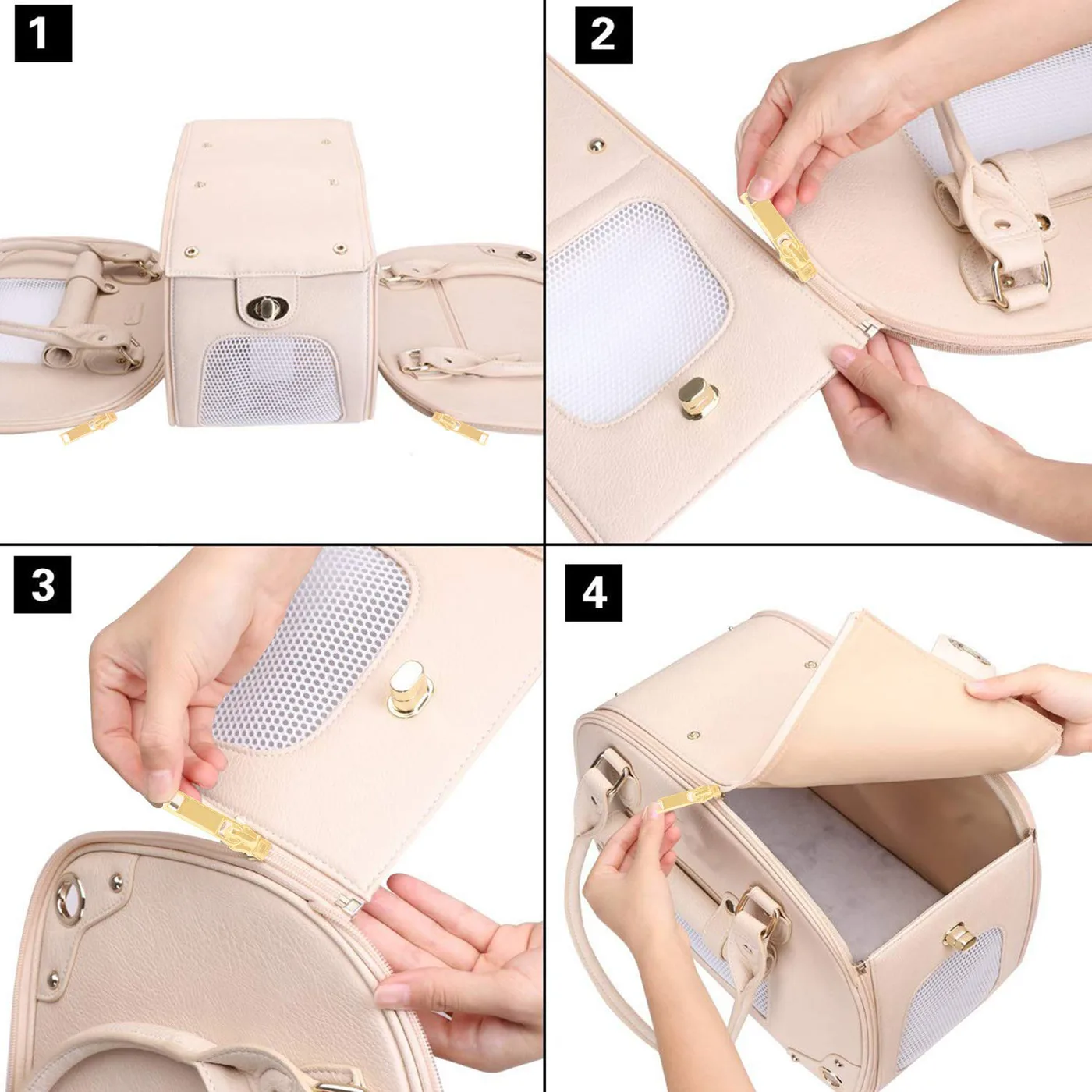
The rule is simple and non-negotiable in our tech packs: a magnet may be the convenience layer, never the containment layer. At a primary opening, the magnet holds the flap in place while a mechanical element — a strap with a side-release buckle, a pair of snaps, a short zipper run, or a tether clip — carries the load if the animal pushes.
This is not over-engineering. A 12 kg dog shifting its weight against a flap generates far more than 18 N of sustained force, and sustained force is exactly the condition magnets handle worst. Momentary pull is what they resist; slow, steady push is what defeats them.
The backup also solves the transport problem. A carrier carried by a handle with a magnet-only closure will open if it is set down hard or knocked in a car boot. A mechanical backup converts an unpredictable failure into a visible one, which is much easier for a customer to accept and to prevent.
From a brand-risk perspective, the backup is cheap insurance. The cost of a strap and buckle is a small fraction of the cost of one incident report, and the backup can be designed to read as a deliberate detail — a contrast webbing strap across a flap is a design feature, not an admission of weakness.
The backup also has to be visible enough to be used. A mechanical backup concealed so thoroughly that owners never fasten it provides no protection at all, and that is a design failure rather than a customer failure. Provide a clear affordance: a contrast strap, a tab that sits proud of the flap, or a clip positioned where the hand naturally lands. The best backup designs are the ones customers fasten without being told to, which can be verified by handing a sample to someone unfamiliar with it and watching what they do.
Instructions are part of the safety system. A one-line hang tag note and a small icon showing the backup fastened tells the owner what the second element is for, and products that explain their backup get it used. This is a copy and packaging decision rather than an engineering one, but it determines whether the safety architecture functions in the field, which is the only place it matters. Design the instruction at the same time as the closure, not after the photography is shot and the packaging is printed.
Shielding, Spacing and the Electronics Question
Magnets and electronics do not mix well, and pet owners carry phones, keys, hotel cards and occasionally microchipped paperwork in the same bag. Three practical rules keep this under control. Keep magnets at least 20 mm from any pocket intended for a phone or cards. Use a mild steel shield behind the magnet to redirect the field away from the interior. And avoid placing magnets directly against a pocket lining that will hold a hotel key card.
Shielding is cheap and effective. A 0.3-0.5 mm mild steel disc behind the magnet housing redirects most of the external field back toward the counter-plate, which simultaneously increases useful pull force and decreases stray field. That is one of the few changes in hardware specification that improves performance and reduces risk at the same time.
Hotels and transit cards are the practical failure case, not phones. Modern phones are largely immune to static fields from small magnets, but magnetic stripe cards are not. If your carrier has a card pocket, place it away from the closure or specify a shielded housing.
There is also an assembly consideration. Loose magnets on a sewing floor are a handling hazard and a quality risk, because a magnet that flips polarity during assembly reverses the closure from holding to repelling. Housing every magnet in a sealed, polarity-marked casing before it reaches assembly removes that failure mode entirely.
Magnets affect logistics as well as design. Strong magnetic assemblies can trigger declarations for air freight, and a pallet of carriers with unshielded magnets occasionally raises questions at cargo screening. Shielded housings and a documented field strength measurement at a stated distance keep shipments routine, so request that measurement from the supplier at specification stage and keep it on file for the freight forwarder. It is a one-page document that prevents a delayed container and costs nothing to obtain during sampling.
One further specification note concerns replacement. A magnet sealed permanently into a panel is difficult to service if it fails, so provide access through a lined pocket with a closure rather than bonding the housing in place. A replaceable magnet turns a product-ending fault into a straightforward repair, and it makes the housing design reviewable at service stage rather than only at launch, which is a useful discipline for any component with a defined service life.
Placement Geometry: Leverage, Recess and Access Angle
Placement decides whether the closure feels decisive or vague. The governing principle is leverage: force at the magnet must resist the moment generated by the flap being pushed at its far edge. A magnet placed 15 mm from the hinge line has to resist several times the force of one placed at the free edge.
The practical guidance is to place the magnet pair at 70-85% of the flap depth, measured from the hinge. That position maximises mechanical advantage while leaving enough material inboard for the housing and reinforcement. Placing magnets at the very edge looks tidy and performs badly.
Recess depth is the second variable. A magnet buried under 4 mm of foam delivers a fraction of the force of the same magnet under 1 mm of fabric. If the design calls for a padded flap, compensate by increasing grade or diameter rather than by accepting a weak close — and record the chosen recess depth on the tech pack so it cannot drift during bulk.
Access angle is the human factor. A flap that closes downward onto a magnet feels natural; one that has to be pushed sideways into engagement feels fussy. Design the approach so gravity assists closure, and the customer will describe the bag as satisfying rather than as merely functional.
One-handed use deserves its own test. The realistic scenario is an owner holding a pet with one arm and closing the bag with the other, often at an awkward angle and without looking at it. A closure that requires the flap to be aligned within a few millimetres fails that test even when it passes comfortably on the bench. Design for a generous capture zone and validate by closing the product one-handed, loaded, and without visual reference, because if the prototype cannot be closed that way, no amount of pull force will make it feel good in use.
Interior surfaces deserve one more check. A magnet housed in a panel that presses against the animal adds a hard point to a surface that should be uniformly soft, and pets will find it. Keep magnet housings in outer panels or in the flap, away from the interior floor and side walls, and add a thin foam layer over any housing that ends up within a few centimetres of the pet's resting position. It is a comfort detail that costs almost nothing and prevents a class of complaint that is otherwise very difficult to diagnose from a returned product.
Finish and Housing: Making the Magnet Invisible or Intentional
A magnetic closure is either hidden or shown, and both are valid. Hidden means the magnet is sealed in a fabric or TPU casing and buried between shell and lining, so nothing is visible on either face. This suits minimal, premium or print-led designs where the surface belongs to the artwork.
Shown means the magnet sits in a visible metal housing — a polished or brushed cap that reads as hardware. This suits lines that use hardware as a signature, and it pairs naturally with a matching snap or badge elsewhere on the bag. A visible housing also makes the closure findable, which helps in low light.
Sealing is not optional in either case. Neodymium is brittle and corrosion-prone; an unsealed magnet in a product that meets water, humidity and washing will degrade. Specify a sealed housing — moulded TPU, welded PVC, or a plated metal cup — and require a corrosion check on the housing after environmental conditioning.
The last finish decision is noise on release. Two hard housings contacting produce a click that undermines the whole point of a magnetic closure. Add a thin silicone or felt buffer at the contact face and the closure goes silent without losing meaningful pull force.
Washing is the condition most magnetic hardware is never tested for. A removable liner going through a machine exposes the housing to water, detergent and agitation, and an inadequately sealed housing admits enough moisture to start corrosion within a season. Specify a sealed housing rated for the wash regime the product claims, and where the product is not washable, say so clearly rather than letting the magnet become the reason it fails. Care language protects both the product and the review score.
Testing Magnetic Closures: Pull Force, Cycles and Temperature
Testing a magnetic closure is straightforward and should be done on finished assemblies. Pull force: measure the force required to separate the closure at the installed air gap, at a controlled separation rate, on three production samples. Target 8-18 N depending on application, and set the acceptance band rather than a single value.
Cycle testing on magnets is mostly about the housing and the stitching, because the magnet itself does not wear. Run 20,000 open-close cycles and re-measure pull force; acceptance at 90% retention is realistic. Losses above that threshold usually indicate the housing is migrating within the panel or the stitch line is stretching.
Temperature matters more than most people expect. Neodymium loses a portion of its flux permanently above roughly 80°C and reversibly in cold. A carrier left in a hot car can reach temperatures where a marginal magnet drops below its required force. A thermal screen — measure pull force at ambient, at 60°C and after return to ambient — catches marginal grades before they ship.
| Application | Magnet build | Target pull at gap | Backup required | Cycle target |
|---|---|---|---|---|
| Treat pocket flap | 1 x N42 disc, 15 mm | 8-10 N | None | 10,000 |
| Mesh storm flap | 2 x N42 disc, 15 mm | 10-12 N | Single snap | 20,000 |
| Top access flap | 2 x N45 disc, 18 mm | 14-18 N | Strap with buckle | 20,000 |
| Rolled opening | 2 x N45 disc, 15 mm | 12-16 N | Side-release buckle | 20,000 |
| Removable mat anchor | 1 x N42 disc, 12 mm | 6-8 N | None | 5,000 |
Where a brand wants independent confirmation of the hardware file, magnet and housing testing can be folded into an accessories programme run through an independent laboratory such as SGS third-party testing alongside fabric and trim testing.
Pull force decay should be documented as a curve rather than as a pass or fail. Measuring at delivery, at 1,000 cycles, at 10,000 cycles and after thermal conditioning produces a decay profile that predicts field performance far better than a single acceptance value, and it gives the brand a defensible number if a customer ever asks how long the closure will last. Suppliers produce this data cheaply when it is requested at sampling stage and reluctantly when it is requested after a complaint.
Cost, MOQ and Lead Time for Magnetic Closure Programmes
Magnetic hardware is more expensive per unit than a snap and cheaper than a moulded buckle, and its cost is dominated by grade and housing rather than by quantity. Moving from N42 to N52 typically raises magnet cost noticeably at small volumes and becomes progressively less significant as volumes grow, which is why grade should be selected against the required force rather than against a round number.
The schedule risk is in housing. A stock moulded housing is available quickly; a custom housing with a branded cap adds tooling and lead time. Our recommendation is to use a stock sealed housing for the first season and move to custom only once the design has proven itself, because the visible benefit of a custom housing is small compared with the schedule cost.
Commercials are standard: MOQ 500 units per colorway, samples in 6-10 working days, bulk across 35-50 days from approved sample and deposit. Finished goods are inspected to AQL 2.5, and magnet lots receive a pull-force check at the installed gap plus pull-force verification after thermal conditioning before components are issued to assembly.
The commercial return on getting this right is a product that feels a tier above its price. Silent, self-finding access is one of the few product experiences customers describe spontaneously in reviews, and it is available for a modest hardware cost if it is specified properly.
In a tiered range, magnets usually belong in the upper two tiers and not in the entry one. Below a certain price point the cost of a shielded housing and a mechanical backup is better spent on fabric and structure, because customers at that level judge a product by material rather than by mechanism. Above it, the closure becomes part of the justification for the price, which is exactly the role a well-specified magnet should play, and placing it correctly is what keeps the three tiers legible to the customer.
Why brands source here
- Pet carrier programs run since 2014; founding team in sewn goods since 2004
- SGS-verified production floor of 4,950 m² with 137 workers across 7 lines
- Monthly capacity of 200,000 units, audited to BSCI and ISO 9001
People Also Ask
Are magnetic closures safe for pet carriers?
Yes as a convenience layer when paired with a mechanical backup. Sustained push from inside defeats a magnet, so containment must be carried by a buckle, snap or zipper.
Why does my magnetic flap feel weak?
Usually air gap or recess depth. Force drops sharply with distance, so compensate for padded flaps with higher grade or larger diameter and record the recess depth on the tech pack.
What is the quietest closure for a pet carrier?
A magnet with a silicone or felt buffer at the contact face. It closes silently and requires no alignment, which is why it is favoured on premium lines.
Can magnets be washed?
Only in a sealed housing. Unsealed neodymium corrodes, so specify moulded TPU or a plated metal cup and require a corrosion check after conditioning.
Do magnets interfere with pet microchips?
No. Microchips are passive RFID devices read at close range by a scanner and are not erased or affected by the small static fields used in closures.
How much does magnetic hardware add to unit cost?
Cost is driven by grade and housing rather than quantity. A stock sealed housing in N42 is modest; custom housings and high grades carry the real premium.
Frequently Asked Questions
How strong should a magnetic closure be on a pet carrier?
Target 8-18 N of pull force measured at the installed air gap on the finished assembly, not the bare magnet rating. Always quote force at the gap, because fabric and foam reduce it dramatically.
Can a magnetic closure be the only closure on a pet carrier door?
No. A magnet holds but does not lock, and sustained push from inside defeats it. Pair it with a strap and buckle, a snap pair or a short zipper run at any primary opening.
Which neodymium grade should I specify?
N42 suits pockets and light flaps; N45 to N52 suits primary access closures. Select against the required pull force at the installed gap rather than defaulting to the highest grade.
Will a magnet damage a phone or credit card in the bag?
Phones are largely unaffected by small static fields, but magnetic stripe cards are not. Keep magnets at least 20 mm from card pockets and add a mild steel shield behind the housing.
How do I stop a magnetic closure from clicking when it closes?
Add a thin silicone or felt buffer at the contact face between the two housings. This removes the click with minimal loss of pull force.
Where should magnets be placed on a flap?
Place them at 70-85% of the flap depth from the hinge line to maximise leverage. Placing them at the very edge looks tidy and performs badly.
Do magnets lose strength over time?
The magnet itself loses very little, but housings migrate and stitch lines stretch. Specify 90% pull-force retention after 20,000 cycles to catch those assembly-level failures.
Does heat affect magnetic closures?
Yes. Neodymium loses flux at elevated temperature, and a carrier in a hot car can reach that range. Screen pull force at 60°C and after return to ambient before approving a grade.
Should the magnet be hidden or visible?
Hidden suits print-led or minimal designs where the surface carries the brand; visible hardware suits lines that use metal trim as a signature. Both work if the housing is sealed.
How is a magnet housed inside a fabric panel?
In a sealed moulded TPU or plated metal cup, polarity-marked before it reaches assembly. Sealing protects against corrosion and prevents polarity reversal during handling.
Does a magnetic closure change the MOQ or lead time?
The standard MOQ 500 units per colorway applies. Custom housings add tooling time, so use a stock sealed housing for a first season and move to custom once the design is proven.
How many magnets should a flap use?
Two spaced 40-60 mm apart resist corner lift far better than one large magnet of equivalent total force, and they make the flap register more precisely.
Talk to QUANZHOU JUNYUAN BAGS about a pet carrier program: MOQ 500 pieces per colourway, samples in 6-10 working days, bulk production in 35-50 days under AQL 2.5 inspection.
Get a free quote Request a sample