Custom Training Lead: Long Line
Private label pet bags put the buyer name on the label, the barcode and the carton print while our production team holds the pattern and any tooling.
Length ladders rather than single lengths
The first decision in a long line programme is not material or colour, it is the ladder — the set of lengths you will offer and how they relate to each other. Most training brands succeed with three, fail with six. Three lengths cover recall practice, distance work and tracking, which are the activities people actually buy for. Six lengths create confusion at the fixture and split your first buy into six 500-unit commitments.
Start from the technique rather than the tape measure. Recall work generally needs 5 to 10 m; distance and stay work needs 15 to 20 m; tracking and scent work benefits from 20 to 30 m. Publishing a short note on the hangtag explaining which length suits which activity measurably increases conversion, because most buyers have never been advised on the subject.
Consider too how lengths are described. Metric-only labelling confuses some markets and imperial-only labelling confuses others, so print both where your distribution crosses regions. Decimal rounding matters as well: a 10 m line is more attractive than a 9.5 m line even though the difference in material cost is modest.
Width should step up with length. A 15 mm tape is comfortable to handle at 5 m but becomes hard to grip wet at 30 m, so most programmes move from 15 mm to 20 mm, and occasionally 25 mm, at the top of the ladder. Wider tape costs more per metre and increases carton weight, so this decision interacts directly with freight.
Finally, keep one width and one material family across the entire ladder. Your hangtags, your photography and your warehouse all benefit from a single visual language, and the shared specification lets you consolidate purchases of tape, thread and hardware into fewer, larger lots.
There is one more consideration that belongs at the very start of the conversation, before any pattern or drawing exists: how your customer will know which length they already own. Long lines are stored coiled for months and then pulled out in poor light, so the length marker has to survive being looked for. Putting the length into the handle loop print rather than only on the hangtag solves it permanently, costs one screen, and quietly reduces the support emails you will otherwise receive.
Think also about whether the ladder needs a deliberately short entry length. A 3 m line used in close-quarters classes is rarely a big seller on its own, but it converts first-time buyers into brand users at a lower price point, and those buyers return for the longer sizes once the habit forms. Entry-price SKUs are a customer acquisition channel in this category, not a margin centre, and should be judged on the longer sizes they sell later rather than on their own contribution.
Flat webbing, round rope or coated webbing
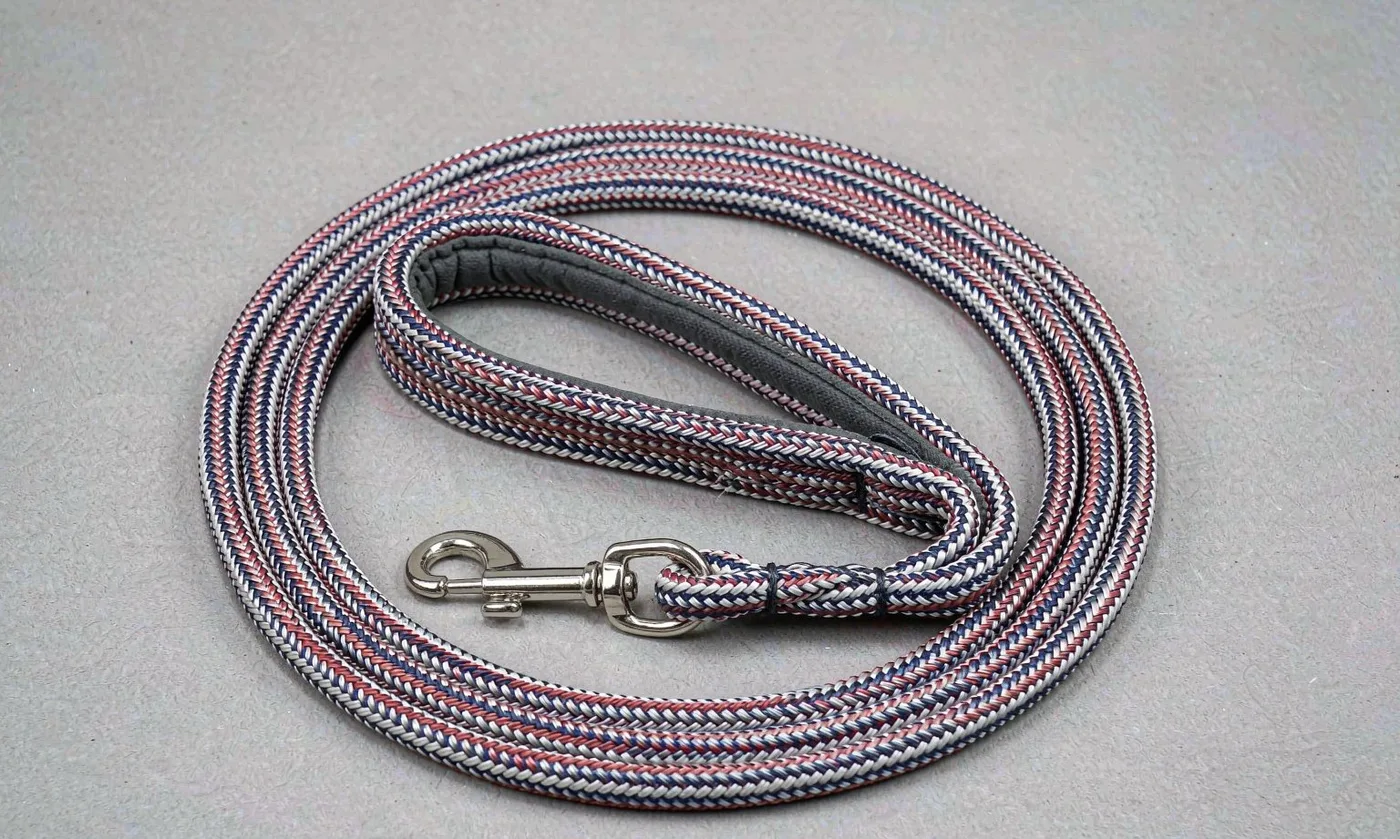
Material choice is where the long line becomes genuinely interesting, because the three main families produce very different handling characteristics in the field. Flat polyester webbing is the default: it is inexpensive, available in wide colour ranges, takes print well, and dries quickly. Its weakness is that it holds grit, stiffens when frozen and can burn a handler's hand if a dog accelerates.
Round rope constructions, whether braided polyester or a soft multifilament core, feel warmer in the hand and coil more naturally. They are the preferred choice for handlers working in cold climates and for brands positioning at higher price points. Rope lines tend to be heavier per metre, which matters for the shipping calculus discussed later.
- Flat polyester webbing: lowest cost, widest colour choice, best print surface, dries fast.
- Braided round rope: premium hand feel, coils cleanly, retains water longer, no flat print area.
- Coated webbing: wipe-clean, waterproof, odour resistant, heavier and slightly stiffer.
- Recycled PET webbing: identical performance to virgin polyester with documented recycled content.
Coated webbing deserves particular mention for training programmes because it solves the two complaints that dominate reviews of ordinary long lines: they stay wet and they smell. A TPU-coated tape wipes clean, does not absorb water, and resists mildew, which makes it the strongest option for wet-climate markets even after accounting for the cost premium.
Whichever family you choose, specify handle construction with care. A 20 mm line used at 20 m generates significant friction when it runs through a hand, and a poorly finished end loop is the first thing to fail. Box-stitched ends with bar-tack reinforcement and a bound or sewn handle loop are standard for anything above 15 m.
It follows that the weakest points in any long line are not the tape but the joins. Every stitch line introduces perforation and every fold concentrates stress, so the engineering effort should go into the terminations rather than into ever stronger webbing. Specify heavier thread and a longer bar-tack than feels necessary; this is the cheapest insurance available in the whole product.
Corrosion behaviour differs between metal families in ways that are easy to specify once and expensive to discover later. Solid brass and stainless behave predictably outdoors, plated zinc alloys look identical new but can pit within a season near salt water, and aluminium keeps the line light without the same corrosion profile. Choose deliberately against your actual markets.
Hardware: swivels, snaps and shock loading
Hardware on a short lead is largely a convenience decision; on a long line it becomes a safety-decision. The reason is simple physics: a dog reaching the end of a 20 m line has travelled twenty times further than it would have on a walking lead, and the energy that must be absorbed at the end of that travel is correspondingly higher.
Two components do most of the work. The swivel prevents torque from twisting the line, which matters enormously at length because accumulated twist propagates all the way back to the handler. The snap or carabiner must be rated well above the working load, not merely above the static load, because deceleration is what generates peak force.
| Component | Standard spec | Premium spec | Break load target |
|---|---|---|---|
| Snap hook | Zinc alloy, nickel finish | Stainless steel, matte | 2.5 kN |
| Swivel | Zinc alloy, polished | Solid brass, matte black | 2.8 kN |
| End ring | Welded steel, plated | Stainless D-ring | 3.0 kN |
| Tape | 20 mm polyester | Coated webbing | 2.4 kN |
Ask for the same fixture philosophy used across the rest of your range. If your collars already run a matte black finish, keeping that finish on long line hardware creates a visible family connection and avoids the mismatch that makes bought-in components obvious. Matte finishes hide scratches better than polished ones, which matters over a long product life filled with abrasion against undergrowth.
Finish durability should be tested rather than assumed. Salt spray testing reveals coating failures long before they appear in the field, and most buyers shipping to coastal markets specify a minimum performance expectation. Documented test methods published by ASTM International provide a common language for those expectations, and organizing them by independent review from bodies such as SGS keeps supplier claims verifiable.
Weight is the last piece of the hardware puzzle, and it quietly shapes how the product feels in use. A large snap at the end of a 5 m line reads as reassurance; the same component on a 30 m line adds unnecessary bulk to a coil that already weighs more than most pet accessories. Many ranges therefore step hardware up in strength but down in mass at the top of the ladder, choosing solid stainless in a slimmer profile to preserve both strength and handling balance.
Printed tape, colour coding and shelf legibility
A long line is one of the few pet products where printing on the load-bearing material is practical, and that opens an unusual branding opportunity. Repeated wordmark along both faces of the tape turns every metre of deployed line into a moving advertisement, while remaining completely invisible when coiled.
Two printing methods dominate. Screen printing on webbing lays ink on the surface and is best for flat colour repeat patterns. Dye-sublimation or heat transfer infuses or bonds the design and handles finer detail, though colour selection depends on the base fibre. Both should be tested for crocking, because pigment transferred onto a handler's glove is a predictable complaint.
Colour coding is the more commercially powerful idea. Assign one Pantone reference per length — 5 m, 10 m, 20 m — and repeat it across tape, binding, hangtag and carton label. Customers standing at a fixture can then select the right length from a metre away without reading small type, and your staff can replenish stock correctly at speed.
The technique works best when one neutral is included. Most ranges need a black or charcoal option for professional handlers who do not want a bright tape on camera, so plan a two-track system: one neutral core plus one coded seasonal colour per length.
Colour fastness deserves its own specification line, particularly for bright seasonal tones used outdoors. Insist on documented rub and light fastness data for the printed tape rather than for the base fabric alone, and reference recognised textile methods such as those maintained by AATCC when writing your tech pack.
Packaging and product colour should be approved together, not sequentially. A bright tape can look superb on the line and unreadable under store lighting, while the same colour printed on litho stock may read several shades differently. Approving both in one session under the same light source avoids the mismatch that only becomes obvious once pallets are unpacked.
Finally, decide how much colour variation your brand can tolerate between production runs. Bright and fluorescent tones are more sensitive to dye-lot drift than neutrals, and tolerances should therefore be tighter for the shades that define the range. Written acceptance limits included in the tech pack turn an argument later into a simple measurement.
Testing protocols that retailers will ask about
Every serious buyer eventually asks the same three questions about long lines: how much load does it take, does it survive wet use, and can you prove it. Answering them with documentation rather than adjectives shortens procurement by weeks, so build the test plan into the development schedule rather than reacting after the request arrives.
A practical protocol covers four areas. Tensile testing on finished assemblies with hardware attached, so the weakest link is measured rather than just the tape. Salt spray or equivalent corrosion testing on metal components. Colour fastness to rubbing, washing and light on printed tape. And dimensional verification of length after loading, since some constructions elongate measurably.
- Finished-assembly tensile: confirms that stitching, not tape, is not the failure point.
- Cyclic loading: simulates repeated shock at the end of the line rather than a single slow pull.
- Corrosion exposure: relevant for coastal, wet and winter-salt markets.
- Abrasion at the handle: the area that shows wear first in daily professional use.
Public pet-safety organisations increasingly publish guidance on how equipment should be evaluated, and referencing their frameworks carries weight with cautious buyers; see, for example, the programmes run by the Center for Pet Safety. Independent laboratory protocols for restraint products are also available from ASTM International.
None of this needs to be expensive if it is planned. Testing scheduled alongside sampling adds days; testing demanded after shipment adds weeks and can hold an entire container at destination. Decide during development which reports your target retailers will require and commission them once, at sample stage, with the report valid for subsequent reorders of the same construction.
Two further tests are worth consideration for programmes sold into professional channels. Repeated shock loading matters more than a single slow pull because lines are rarely loaded in laboratory conditions, and wet-state testing reveals how much strength a material loses once saturated. Neither is expensive, but both require planning into the sample schedule.
Documentation discipline pays back well beyond compliance. Keep the approved construction record, test reports, component certificates and confirmation sheets together in one folder per SKU, so that a retailer questionnaire arriving eighteen months later can be answered the same afternoon rather than reopening development.
Cost model, MOQ strategy and freight arithmetic
Long lines are priced per metre but sold per unit, which produces a counterintuitive costing picture. A 30 m line can cost four times as much to make as a 5 m line while retailing for less than double. Understanding where that pressure comes from helps you build a ladder that stays profitable at every step.
Material dominates at the top of the ladder. Tape cost scales linearly with length, while labour, hardware and packaging are largely fixed. The practical consequence is that short lines subsidise long ones in most ranges, so set prices across the ladder rather than applying a uniform margin to each item.
| Length | Tape width | Material share | Relative unit cost | Typical retail |
|---|---|---|---|---|
| 5 m | 15 mm | 38% | 1.0x | 12-18 USD |
| 10 m | 15-20 mm | 52% | 1.6x | 18-26 USD |
| 15 m | 20 mm | 61% | 2.2x | 24-34 USD |
| 20 m | 20 mm | 68% | 2.9x | 30-42 USD |
| 30 m | 25 mm | 75% | 4.0x | 40-55 USD |
MOQ is 500 pieces per colourway, and most first programmes split that across the ladder rather than repeating it per length. A sensible opening buy might be 300 units at 10 m, 150 at 20 m and 50 at 30 m, all in one shared colourway so tape purchases consolidate. That structure keeps total commitment to one minimum while still giving you a full shelf story.
Freight deserves a specific warning. Long lines are dense and heavy, so volumetric weight can exceed expectations and turn an apparently healthy margin into a thin one. Always model landed cost rather than FOB cost before fixing retail prices, and remember that our terms are quoted FOB Xiamen with T/T 30/70 payment and inspection to AQL 2.5 before loading.
Consolidation is the most reliable lever on landed cost. Shipping long lines with other soft goods from the range spreads both freight and customs handling, and in practice it is the difference between a viable and a marginal top-of-ladder SKU. Plan consignment composition at least a month ahead so packing lists and declarations can be prepared together.
Currency and payment structure deserve a line in your own planning too. A 30% deposit ties up less working capital than full prepayment, and for seasonal programmes it is often sensible to stagger payments across two waves rather than committing to a single large shipment that has to be stored for months.
Winding, packaging and the retail display story
The unglamorous truth about long lines is that a significant share of returns and complaints stem from packaging, not product. A line shipped loosely coiled looks like a returned item the moment a customer opens it, and a correctly presented one communicates quality before the tape is even touched.
Choose one of three presentations. A hank with a reusable cinch strap is cheapest and works well where the product hangs on a hook. A bound hank with a printed belly band communicates more care and gives you a face for instructions. A wound spool is most expensive but displays beautifully in premium channels and solves in-store tangling altogether.
- Belly band: carries length, colour code, load data and the care note in one printed piece.
- Reusable strap: doubles as storage at home, reducing the tangled-line complaints that follow purchase.
- Hangtag: should include both metric and imperial length and the recommended activity.
- Polybag: vented, printed with safety language, sized so tape is not crushed in transit.
Where a range includes other walking and training items, present the whole family identically. Shared card format, shared type hierarchy and shared iconography make three separate products read as one system, which is exactly what a buyer evaluating a new brand wants to see on a fixture.
Finally, use the packaging to teach. A short diagram showing how to coil and store the line reduces the most common negative review in the category, and it costs nothing beyond a line of artwork. consistent attention to those instructions consistently see better repeat purchase than brands that do not.
Online presentation deserves equal thought. Long lines photograph badly because a coiled length of tape is visually anonymous, so plan one image that shows the line deployed at full length and one that shows the coded handle loop close up. Those two frames do more conversion work than the most expensive lifestyle shot.
Finally, treat packaging as repeatable infrastructure rather than a one-off decision. Standardise card size, hole position and barcode placement across every length so a later addition can reuse the existing artwork template, keeping your collateral costs flat as the ladder grows, and it is the simplest way to keep future line extensions affordable.
Positioning the long line inside a training range
A long line is rarely the first product a brand sells and rarely the last one it should add. Its commercial role is as the progression item: customers buy a short lead or a harness first, discover that distance work needs something else, and return for the long line once the habit is established.
That positioning changes how the product should be presented. Marketing it as an entry product is a mistake, because a 20 m line is intimidating to a first-time buyer and requires knowledge they do not yet have. Marketing it as the next step, with a sentence explaining which training stage it serves, converts the customer who already trusts the brand.
| Programme shape | SKUs | Colourways | Units per colourway | Best channel |
|---|---|---|---|---|
| Entry long line | 1 length, 10 m | 1 | 500 | Online, test demand |
| Standard ladder | 3 lengths | 1 | 500 split | Specialist retail |
| Full system | 3 lengths plus pouch | 2 | 500 each | Omnichannel brands |
| Professional tier | 4 lengths, coated | 1 | 500 split | Trainers and clubs |
| Seasonal extension | 1 coded colour | 1 | 500 | Existing customers |
The professional tier deserves particular attention, because trainers buy differently from consumers. They buy in bulk, they care about hardware and coated materials rather than colour, and they recommend products to their clients, which makes them a distribution channel as much as a customer segment.
Bundling is the most effective commercial mechanic available here. A long line, a treat pouch and a short lead presented as a progression set converts at a materially higher value than any of the three sold separately, because the customer is buying a training programme rather than a piece of equipment.
Content should teach the technique rather than describe the product. A short explanation of how distance work is built up, supported by a diagram of the three lengths in use, does more for conversion than any specification list, because the buyer is trying to solve a behaviour problem.
Why brands source here
- Pet carrier programs run since 2014; founding team in sewn goods since 2004
- SGS-verified production floor of 4,950 m² with 137 workers across 7 lines
- Monthly capacity of 200,000 units, audited to BSCI and ISO 9001
People Also Ask
What length of long line should a training range carry?
Three lengths cover the real use cases: 5 to 10 metres for recall work, 15 to 20 metres for distance and stay work, and 20 to 30 metres for tracking or scent work.
Is coated webbing worth the extra cost?
For wet, muddy or odour-sensitive markets, yes. It wipes clean rather than absorbing water, resists mildew and avoids stiffness after freezing, which are the three complaints that dominate ordinary long line reviews.
Should long line widths change with length?
Yes. Use 15 mm up to 10 metres, 20 mm to 20 metres and 25 mm beyond, because wider tape is far easier and safer to grip when a long rope running through the hand generates significant heat.
How do retailers compare long line quality?
Through documentation: finished-assembly tensile results, hardware corrosion performance and colour fastness data. Commissioning those reports at sample stage prevents delays later in procurement.
Can private label long lines match our existing brand colours?
Yes. Nominate a Pantone reference per colourway and approve the printed tape against it under standard lighting, then use the same coded colour across packaging for shelf legibility.
What is the difference between OEM and ODM long lines?
OEM builds to your specification from scratch, including bespoke materials and hardware. ODM starts from an existing construction and adapts tape, colour, width, print and packaging to create your own version.
Frequently Asked Questions
What lengths can a custom long training lead be made in?
Any length from 3 to 50 metres. Most programmes use a ladder of 5, 10, 15, 20 and 30 metres, with custom lengths available at no development charge provided total volume meets the 500-piece colourway minimum.
What is the MOQ across several lengths?
MOQ is 500 pieces per colourway, not per length. A single colourway can be split across three lengths, for example 300 units at 10 m, 150 at 20 m and 50 at 30 m, and still count as one minimum.
Which material suits wet or muddy conditions?
Coated webbing is the strongest choice. It does not absorb water, wipes clean after use, resists odour build-up and avoids the stiffening that untreated polyester suffers when frozen. The trade-off is extra weight and higher material cost.
Can you print our logo along the length of the tape?
Yes. Repeated patterns on flat webbing by screen print or transfer are standard practice. Provide vector artwork and specify repeat spacing; we produce a strike-off so the repeat and colour can be approved before bulk.
How long does sampling take for a long line?
6-10 working days including material sourcing and one printed tape strike-off. Custom hardware finishes add roughly a week because components are made to order rather than pulled from stock.
What break load should we specify for hardware?
Most ranges target 2.5 kN or higher on the snap and a matching or higher figure on the swivel, with the tape specified in the same band. Finished assemblies should be tested as a unit, since stitching often governs performance.
Do you offer recycled webbing options?
Yes. Recycled polyester tape performs identically to virgin polyester and can be supplied with documented recycled content, which supports a defensible marketing claim on your retail packaging.
How is a 30 m line packaged for retail?
Usually as a bound or strapped hank, or wound onto a spool for premium channels. Each presentation is confirmed at sample stage so carton dimensions and print collateral can be finalised together.
What inspection standard applies before shipment?
Inspection runs to AQL 2.5 on finished cartons. Critical failures such as hardware damage or incorrect length are zero-tolerance, and minor visual defects are reported within agreed acceptance numbers.
Can we mix long lines with other training items in one shipment?
Yes, and most buyers do. Consolidating lines, leads and pouches into one container spreads freight cost and simplifies customs entry, particularly when all items share one harmonised classification.
What are the payment and shipping terms?
Standard terms are T/T with a 30% deposit and 70% balance before shipment, quoted FOB Xiamen. We recommend modelling landed cost early because long lines are heavy relative to unit value.
Do you keep archived specs for reorders?
Yes. Approved tape lots, artwork films and hardware references are archived so a repeat run can be scheduled without re-sampling, which shortens the typical reorder cycle considerably.
Talk to QUANZHOU JUNYUAN BAGS about a pet carrier program: MOQ 500 pieces per colourway, samples in 6-10 working days, bulk production in 35-50 days under AQL 2.5 inspection.
Get a free quote Request a sample