Custom Cargo Liner: Trunk Protection Design and Brand Systems
A custom cargo liner is specified around five numbers: a fit matrix covering boot widths from 90 cm to 145 cm, a bumper flap drop of 40-55 cm, an abrasion result above 25,000 Martindale cycles on the load surface, a hydrostatic head above 8,000 mm, and a folded pack volume under 12 litres so the product remains viable for e-commerce freight. Those five figures decide whether a liner sells or sits.
Our production team runs private label cargo liner programs on one commercial frame: MOQ 500 units per colourway, prototypes in 6-10 working days from tech pack sign-off, and bulk production in 35-50 days after sample approval, released at AQL 2.5 with abrasion, hydrostatic and fit records attached to the shipment file. Standard terms are FOB Xiamen with T/T 30/70.
The design opportunity here is scale. A cargo liner presents the largest continuous brand surface in a pet travel range, and unlike a barrier or a harness it is seen from above and from a distance, which means the graphic has to be composed as a field rather than as a logo placement. The engineering risk sits at the bumper flap and the side walls, where almost every low-cost liner fails. Two sampling rounds - geometry first, graphic second - remain the reliable path, and both should be booked before the seasonal bulk slot is requested, because a liner program that starts late compresses every downstream decision at once.
Private label pet carrier reorders depend on dye-lot control: the reference is held for twelve months so a repeat matches the approved sample.
The Fit Matrix: Boot Geometry Is Less Standard Than It Looks
Cargo areas look rectangular and are not. Wheel arch intrusions, spare wheel wells, seat-fold mechanisms, tie-down points and a taper toward the tailgate all vary between platforms, and a liner cut as a true rectangle will bunch at the corners and leave the bumper exposed. The first engineering task is therefore a fit matrix rather than a pattern.
Practical coverage comes from a three-part geometry: a base panel sized to the widest common platform, side walls with a variable height and a two-position fold, and a bumper flap that drops independently. With side wall heights offered at 30 cm and 50 cm and a base adjustable across 90-145 cm, one tooling investment covers the large majority of hatchbacks, estates and SUVs in a market.
The taper matters more than brands expect. Many boots narrow by 8-15 cm toward the tailgate, which means a base panel cut to the widest point will overhang at the back and look poorly fitted in photography. Cutting the rear edge with a slight inward angle and letting the bumper flap mask the remainder is the standard fix and costs nothing.
Seat-fold access is the second repeat complaint. Vehicles with 60/40 split rear seats need a liner that allows one side to fold independently, which argues for a two-panel base joined by a hook-and-loop seam rather than a single piece. It adds a manufacturing step and removes an entire category of review.
Grip on the load surface closes the fit argument. A liner that slides when an animal jumps in is remembered as a failed product regardless of how well it protects. A dot-grid backing plus two anchor tabs clipped to the vehicle's tie-down points keeps the base planted without adhesives.
Finally, build the fit board before the pattern is finalised. Ten platforms, one sample, recorded adjustment positions. If a platform sits outside the designed range, the geometry changes on paper rather than after bulk, and the brand keeps both the timeline and the margin.
Bumper Flap Engineering and the Failure Point Nobody Photographs
The bumper flap is the hardest-working part of a liner and the least considered. It takes claw abrasion on every entry and exit, it is dragged across a painted surface, it folds and unfolds thousands of times, and it is the part that hangs outside the vehicle where everyone sees it. Most cheap liners fail here first.
Dimensionally, a drop of 40-55 cm covers everything from a low hatchback lip to a high SUV tailgate, with a hook-and-loop or snap system to take up the excess. A flap that is too short leaves the bumper unprotected, which is precisely the damage the customer bought the product to prevent.
Material selection on the flap differs from the base. The base wants abrasion and waterproofing; the flap wants abrasion and drape, and it should be backed with a soft non-woven rather than a dot grid so it cannot scratch paintwork. A heavier 900D face here, with a bound edge, is worth the incremental cost.
Attachment method is the recurring engineering decision. Stitched flaps are permanent and clean but make the liner bulky when folded. Detachable flaps on a hook-and-loop seam allow a compact pack and replacement of the worn part, at the cost of a seam that can peel if the hook tape is underspecified. For a premium tier, a stitched flap with a reinforced stress patch is the better answer.
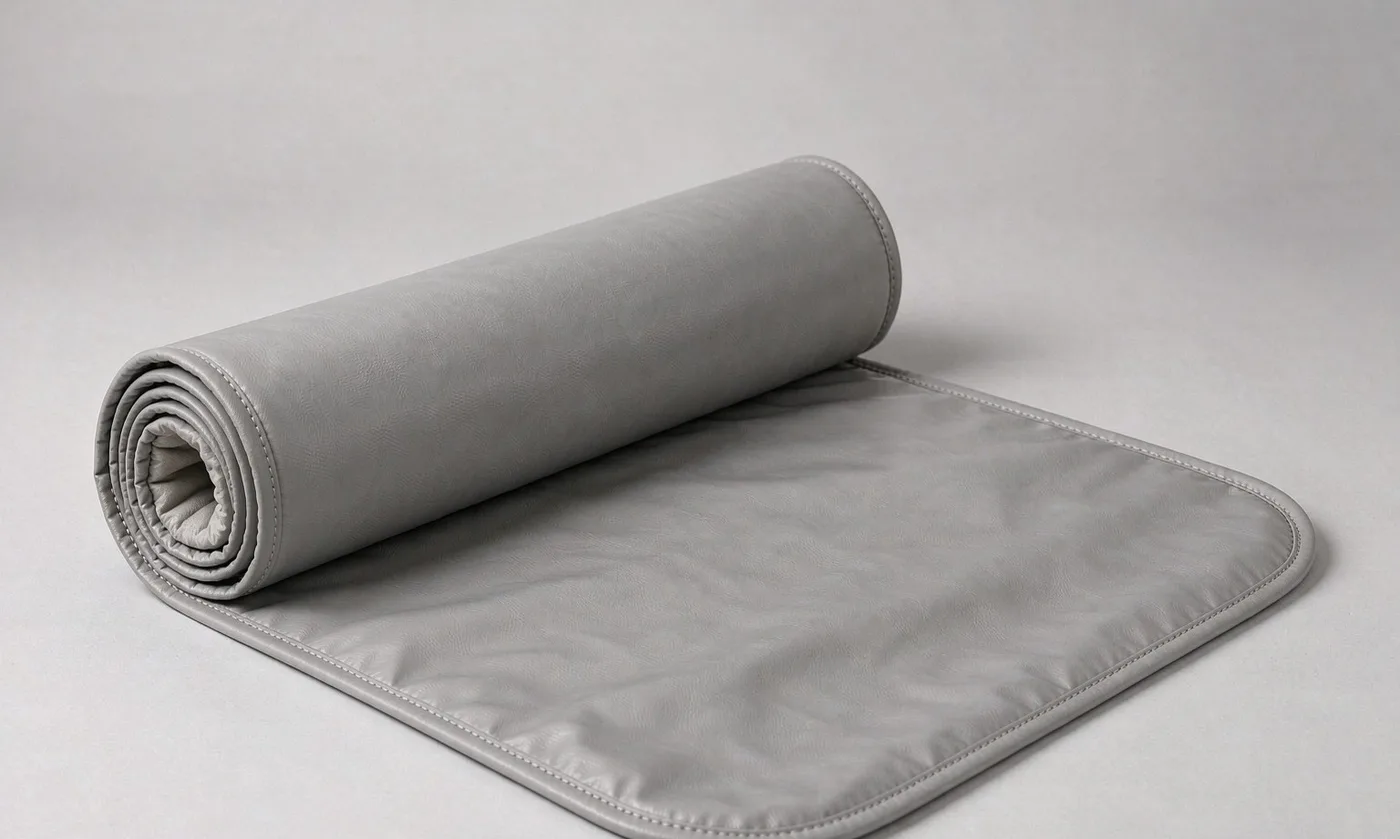
Fold memory is a quiet detail worth specifying. A flap that retains a crease from its packaging looks cheap within a week. Selecting a face fabric with adequate recovery and packing the liner rolled rather than folded removes the problem entirely at no material cost.
The measurable target is straightforward: 10,000 flex cycles on the flap with no delamination, and no visible crease retention after 72 hours unpacked. Both are cheap to test and both predict the complaint profile accurately.
Load Surface: Abrasion, Waterproofing and Cleanability
The base of a cargo liner takes a different kind of punishment than a seat cover. Claws, wet loads, grit and the occasional sharp edge all arrive at once, and the surface has to resist puncture as well as abrasion. This argues for a heavier face and a tougher barrier than the seat cover in the same range.
A 900D polyester face with a PU coating reaching 25,000-40,000 Martindale cycles is the realistic baseline, verified through recognised textile methods published by AATCC. Below roughly 20,000 cycles, claw marks become visible within a season and the product photographs badly in reviews.
Waterproofing should be specified higher than for a seat cover because a boot carries wet and dirty loads that sit for hours. A hydrostatic head above 8,000 mm, achieved with a TPU laminate and taped or welded seams, means the claim survives contact with a soaked dog and a puddle of grit.
Cleanability is the specification most often omitted and the one customers mention most. A smooth PU face can be wiped and hosed; a textured woven face traps hair and mud. Where the brand's identity permits, specifying a smooth face with a printed texture pattern gives the visual interest of a weave with the cleanability of a coating.
| Area | Value build | Core build | Premium build | Target |
|---|---|---|---|---|
| Base face | 600D, PU coat | 900D, PU coat | 900D with smooth clean face | 25,000-40,000 Martindale |
| Barrier | PVC coating | TPU laminate | TPU, welded seams | 8,000 mm hydrostatic |
| Bumper flap | 600D, stitched | 900D, bound edge | 900D, reinforced stress patch | 10,000 flex cycles |
| Side walls | Fixed 30 cm | Two-position fold | Rigid insert panels | Stays upright loaded |
| Backing | Plain woven | Dot grid | Silicone dot grid plus anchors | No shift under load |
Seam construction determines whether the waterproof claim is real. A needle-sewn seam through a laminated panel creates a leak path unless it is taped, so premium builds should specify welded or taped seams on the base and reserve stitching for areas above the expected liquid line.
Designing the Largest Brand Field in the Range
A cargo liner base typically presents 100-140 cm by 90-110 cm of continuous surface, seen from above and from standing height. That is a floor, not a poster, and the design rules are closer to interior textiles than to packaging. The brands that use this surface well treat it as a designed field with a repeat, a border and a focal placement.
Sublimation remains the default for polyester faces and handles photographic gradients without adding stiffness. Digital printing allows multiple designs inside one production order, which suits brands testing two pattern directions in a single season without committing to a screen setup.
Pattern scale should be set for a viewing distance of roughly two metres. A motif sized for a carrier reads as noise across a boot; a motif sized for a boot disappears on a carrier. Building a two-scale system - a fine ground pattern plus one large engineered placement - keeps the identity coherent across the whole travel range without redesigning it per SKU.
Borders do more work than centres on this surface. Because the eye reads the perimeter first when looking down into a boot, a branded border tape or a printed border band gives higher recognition than a centred mark that is covered by the dog, a crate or a bag of groceries within minutes of installation.
Colour discipline matters for practical reasons as well as aesthetic ones. A very light base shows every mark and a very dark base shows every scratch and runs hot. A mid-tone core with a darker border band is the combination that survives real use and still photographs as a designed product.
One warning on artwork approval: view the printed proof installed in an actual boot, at standing height, in daylight. Approvals done on a screen or on a flat table are the most common source of post-launch regret in this category.
Colour Systems, Fastness and the Sun Problem
A boot is a surprisingly hostile colour environment. Rear glass admits sustained sun, temperatures regularly exceed 60 degrees Celsius in summer, and the liner is rarely removed. Fading and coating breakdown therefore arrive faster here than for almost any other textile in a pet range.
Fix references before anything else. Matching each substrate against a physical Pantone standard under controlled lighting, with a stated Delta E tolerance per material, converts a subjective discussion into a pass-fail check. Textile faces hold within about 1.5; coated and laminated surfaces need roughly 2.5.
Light fastness should be set at 4-5 on the blue wool scale for the base, verified before bulk rather than assumed from a previous product. Where a brand's palette includes bright accents, restrict them to the border band or the flap, which are smaller areas and can be replaced or re-specified without redesigning the field.
Coating stability is the companion test. A PU coating that becomes tacky after extended heat exposure will pick up grit permanently and look ruined within a season. A heat ageing test - 168 hours at 70 degrees with no tackiness or colour shift - is an inexpensive screen that catches the problem in sampling.
Crocking, or colour transfer, deserves a target of 4 on the recognised grey scale for both dry and wet rubbing, because a liner that transfers colour onto a light crate or a light dog is an immediate return and a memorable complaint.
Retain a signed standard per substrate and reference it on every reorder. Seasonal drift of half a shade compounds, and by the third season the liner, the seat cover and the harness will no longer look like the same collection if the standard is not enforced.
Packaging for a Product That Ships Mostly by Volume
Cargo liners are heavy for their value and bulky for their weight, which means freight economics shape the pack more than design preference does. The commercial target is a folded or rolled pack under 12 litres, because above that the volumetric cost starts to erode the margin on both ocean freight and e-commerce fulfilment.
Compression is the main lever. Rolling the liner around a light core, with the bumper flap folded last, typically achieves a 35-45% volume reduction over flat folding. The trade-off is crease retention, which is solved by selecting a face fabric with good recovery and by stating a maximum compression time before the product should be unpacked.
Format choice follows channel. E-commerce works best with a printed belly band over a plain corrugated shipper, because the outer carton is never merchandised and the band carries the brand at a fraction of the cost. Physical retail favours a handled bag with a large header card showing the installed silhouette.
Fit communication on the pack is decisive. A silhouette chart showing hatchback, estate and SUV profiles with the covered dimensions marked removes the main hesitation, and a simple "measure your boot width" instruction with a printed scale reduces returns measurably.
Where the brand wants a sustainability argument, keep it verifiable. An OEKO-TEX reference on the face fabric is checkable and credible; a general green claim on a coated technical textile invites scrutiny the product will not survive.
In-pack material is worth one deliberate decision. A single card carrying the fit chart, the care instruction and the range story, printed on the reverse of the install diagram, costs almost nothing and turns an unboxing into a brand moment for a product the customer will handle for years.
Testing Protocol and Retail Documentation
Liners are straightforward to test and the protocol should be written into the tech pack rather than assembled later. Four properties cover the complaint profile: abrasion on the load surface, hydrostatic head on the barrier, flap flex life, and colour fastness to light and rubbing.
Write each as a method plus a target. "Abrasion: 25,000 cycles, no thread break, recognised textile method" is testable and ends the discussion. "Hard wearing" is not, and it wastes a sampling round on interpretation.
Transit testing matters more here than for most soft goods because the pack is heavy and the corners are vulnerable. Validating the shipper against a recognised protocol published by ASTM prevents the crushed-corner arrivals that generate full write-offs rather than cosmetic complaints.
Process documentation supports the buyer conversation. Production running under a quality management system certified to ISO 9001 answers lot consistency questions, and third-party verification through SGS produces reports in a format retail technical reviewers already recognise.
Hold two retained samples per lot for twenty-four months. When a question arrives about a specific shipment, the physical unit and its report can be produced in a day, which is the difference between a resolved query and a lost listing.
One discipline to hold: never let a cost reduction change a tested property without re-testing. A fabric substitution that saves four percent and drops abrasion by thirty percent is a decision that shows up in reviews, not in the cost sheet.
A final entry belongs in the protocol: record the fit board result for every production lot. A one-line confirmation that the batch matches the approved geometry costs nothing to produce and becomes the first document a reviewer asks for when a fit question arises.
Range Architecture, Sequencing and Launch Rhythm
A cargo liner belongs late in a travel range sequence. It is a considered, higher-ticket purchase and it converts best from customers who already own the brand's seat cover or harness, so launching it third or fourth captures demand that earlier products created rather than paying to create it from scratch.
Tiering works cleanly because the construction scales. A value tier uses a 600D face and a fixed side wall; a core tier adds a two-position wall, a dot-grid backing and a printed field; a premium tier adds welded seams, rigid insert panels and reinforced flap construction. All three share one pattern.
Colourway strategy should mirror the rest of the range - one core neutral carrying volume, one seasonal accent carrying attention - and because a colour change alters neither the pattern nor the laminate, it needs no new testing. That makes colourways the cheapest newness available in the category.
| Stage | SKU | Commercial role | Shared asset |
|---|---|---|---|
| 1 | Harness and tether | Entry into travel aisle | Colour standard |
| 2 | Seat cover | Basket building | Face fabric and print language |
| 3 | Cargo liner | Considered premium purchase | Face fabric, colour, border system |
| 4 | Barrier | System completion | Hardware finish |
| 5 | Seasonal colourway | Renewal without re-test | Pattern and pattern tooling |
Timing follows the same arithmetic as the rest of the range: bulk at 35-50 days plus transit, landing eight weeks ahead of the drop, which puts tech pack sign-off roughly five months before the shelf date. Autumn and pre-summer are the two natural windows for a boot product.
The measure of success at the end of season two is whether the liner is selling into households that already own another item from the range. If it is, the system is compounding and the next investment is colourways. If it is not, the entry SKUs need more merchandising weight before another tier is added at the top.
Bundles, Display and the Second Purchase
A cargo liner is rarely the first thing a customer buys and frequently the second, which makes it the natural anchor of a bundle. Pairing the liner with the seat cover at a modest saving lifts basket value without discounting either product individually, and it introduces the customer to the brand's system logic rather than to a single item.
Physical display is where most liners lose. Laid flat in a bag on a shelf, the product communicates nothing about scale or fit, and customers walk past it. A simple display solution - an open boot mock-up, or even a corrugated silhouette with the liner installed - converts a shapeless textile into an understandable product and costs a fraction of the margin it protects.
Where a retailer will not give floor space, the pack itself has to do the work. A large front panel showing the installed liner in a real boot, with the covered dimensions marked in centimetres, is the single most effective piece of communication available and should be treated as mandatory artwork rather than optional.
Cross-sell inside the pack is the cheapest second purchase available. A card showing the barrier and the harness in the same colourway, with a simple "complete the boot" line, costs cents to print and reaches a customer who has just demonstrated both interest and willingness to spend.
Digital merchandising needs one specific asset that most brands lack: a scale reference. A photograph of the liner installed next to a recognisable object - a crate, a grocery bag - answers the question customers cannot otherwise resolve from a dimension chart, and it measurably reduces size-related returns.
Accessories extend the line cheaply. A matching organiser pocket that clips to the side wall, or a branded wet-gear pouch in the same fabric and print, reuses existing material and colour standards and gives the brand a low-risk entry point for a third purchase.
The pattern to aim for is therefore simple: seat cover first, liner second, accessory third, each sharing one colour standard and one print language. Executed in that order, the boot becomes the most defensible part of a pet travel range rather than the most commoditised.
One commercial caveat on bundling: never bundle a new product with an unproven one. If the liner has not yet established its own review record, pairing it with the seat cover transfers the seat cover's credibility to a product that has not earned it, and a weak liner then damages both. Launch the liner alone, let it accumulate thirty to fifty reviews, and bundle once the rating is stable.
Production capability
- SGS-verified production space of 4,950 m², 149 machines, 7 assembly lines
- Pet carrier and pet bag output since 2014 from a 137-person team
- 200,000 units shipped monthly under BSCI and ISO 9001 systems
People Also Ask
What size range should a custom cargo liner cover?
Cover boot widths from 90 cm to 145 cm with side walls offered at two heights and an independently dropping bumper flap. That single geometry covers most hatchbacks, estates and SUVs.
How long should the bumper flap be?
A drop of 40-55 cm covers everything from a low hatchback lip to a high SUV tailgate, with a hook-and-loop or snap system taking up the excess.
Which fabric suits a cargo liner base?
A 900D polyester face with PU coating, reaching 25,000-40,000 Martindale cycles, paired with a TPU barrier above 8,000 mm hydrostatic head.
How do you keep a cargo liner from sliding?
Use a silicone dot grid backing plus two anchor tabs clipped to the vehicle's tie-down points. Adhesives are unnecessary and damage the load surface over time.
Can the base carry a full-colour printed design?
Yes. Sublimation handles photographic artwork on polyester faces; digital print allows several designs inside one production order.
Should the flap be detachable?
Detachable flaps pack smaller and can be replaced when worn. Stitched flaps with a reinforced stress patch suit premium tiers where pack volume is less critical.
How should a bulky liner be packed?
Roll around a light core rather than folding flat, targeting a pack volume under 12 litres, and select a face fabric with good crease recovery.
Frequently Asked Questions
What is the MOQ for a custom cargo liner?
MOQ is 500 units per colourway. Because all tiers share one pattern, brands can open with the core tier in two colourways and extend later without new development.
How long does sampling take?
Prototypes are delivered in 6-10 working days from tech pack sign-off. Two rounds are standard: one for fit matrix and flap geometry, one for print and finish.
What is the bulk lead time?
Bulk runs 35-50 days from sample approval, released at AQL 2.5 and shipped FOB Xiamen on T/T 30/70 terms.
Which test reports come with a shipment?
Abrasion on the load surface, hydrostatic head on the barrier, flap flex cycle results and colour fastness to light and rubbing, each referenced to the production batch.
Can you match our brand colours on coated fabric?
Yes, against a physical Pantone reference with a stated Delta E tolerance, typically 1.5 for textiles and 2.5 for coated or laminated surfaces.
Will the liner fade in a hot boot?
Not if light fastness is specified at 4-5 on the blue wool scale and the coating passes a heat ageing screen of 168 hours at 70 degrees with no tackiness.
How do you handle vehicles with split folding seats?
A two-panel base joined by a hook-and-loop seam lets one side fold independently, which removes a common complaint at a small manufacturing cost.
Is a welded seam worth the extra cost?
For a premium tier, yes. Needle-sewn seams through a laminated panel create a leak path unless taped, so welding is what makes the waterproof claim real.
What fastness target should we set for colour transfer?
Aim for 4 on the recognised grey scale for both dry and wet rubbing, so the liner does not transfer colour onto a light crate or a light coat.
How do we reduce freight cost on a bulky product?
Roll rather than fold, target under 12 litres of pack volume, and use a printed belly band over a plain shipper for e-commerce channels.
Can we offer a value and a premium tier together?
Yes. Both use the same pattern and differ in face fabric, seam construction, side wall configuration and flap reinforcement.
Do we need transit testing?
Yes, because the pack is heavy and corner damage produces full write-offs. Validate the shipper against a recognised transit protocol.
When should a liner launch in a travel range?
Third or fourth, after lower-ticket items have built brand familiarity. It is a considered purchase that converts best from existing customers.
Talk to QUANZHOU JUNYUAN BAGS about a pet carrier program: MOQ 500 pieces per colourway, samples in 6-10 working days, bulk production in 35-50 days under AQL 2.5 inspection.
Get a free quote Request a sample